Toddler Beds
Toddler bed rails for a queen or king bed
A rail sized for a twin does very little on an 80-inch mattress, and most of the market stops at queen. Here is what actually fits, and what to do about a king.

We earn a commission from qualifying purchases made through links on this page, at no extra cost to you. How this site is funded.
The short answer
For a queen, look for a rail that states a fit range covering twin through queen and is tall enough for your mattress — the Regalo Swing Down rail publishes 20 inches of height and 43 inches of length and states that range. For a king or California king, expect to fit two rails side by side or to run one rail at the child’s sleeping position only, because almost nothing on the market spans an 80-inch side on its own.
Why the big sizes are awkward
Standard US mattress sides are 75 inches on a twin or full, 80 inches on a queen and king, and 84 inches on a California king. A universal bed rail is typically 40-something inches long, which is a little over half a queen side. That is by design — the rail is meant to cover the sleeping position rather than the whole edge — but on a queen or king shared with an adult, the child’s sleeping position is not necessarily where you fitted it, and that is the problem to solve.
The second issue is anchoring. Most rails anchor with a strap that runs under the mattress and buckles on the far side. On a king that strap has 76 inches of mattress to cross, and on a split foundation it has a gap to cross in the middle. Check the stated strap length against your mattress width before ordering, not after.
| Mattress | Side length | Width the strap crosses | Rails needed |
|---|---|---|---|
| Twin | 75 in | 38 in | One |
| Full | 75 in | 54 in | One |
| Queen | 80 in | 60 in | One, positioned carefully |
| King | 80 in | 76 in | Two, or one at the sleeping position |
| California king | 84 in | 72 in | Two, or one at the sleeping position |
What to look for: height before length
Height is the specification that decides whether a rail works at all, and on a big bed it matters more than on a child’s bed, because queen and king mattresses are usually thicker. The rail has to stand meaningfully proud of the mattress surface after the mattress has consumed its share — a 20-inch rail on a 12-inch mattress leaves 8 inches of real barrier, and a 14-inch rail on the same mattress leaves 2, which is a speed bump.
Measure the way we measure everywhere on this site: zero the tape on the floor, note the top of the mattress, and work out what is left above it. Published rail heights are usually quoted from the point of attachment, which is the frame, not the sleeping surface. The method is on our guardrail height page, and it applies to an adult bed just as well as to a bunk.
Then check the foundation. Many rails are designed around a box spring and anchor beneath it. On a platform or slatted frame with no box spring, look for a rail whose anchor strap runs across the slats and buckles on the far side rather than one that relies on being wedged between mattress and base. Friction alone does not hold against a child pushing off it.
A rail is not a co-sleeping safety device
If what you are setting up is bed-sharing with an infant, a bed rail does not make that safe and nothing on this page should be read as saying it does. The American Academy of Pediatrics recommends infants sleep on a separate firm surface in the parents’ room, not in the adult bed. This page is about a toddler — a child who is walking, climbing and sleeping in a big bed either alone or alongside a parent — which is a different situation entirely.
The gap is the hazard, not the edge
The thing that goes wrong with rails on large beds is entrapment rather than falling. A rail that leaves a channel between itself and the mattress, or between two rails placed end to end, has created a gap a small child can slide into. The AAP’s guidance for bunk guardrails puts the acceptable space between rail and bed at no more than three and a half inches, and that is a reasonable number to hold yourself to here as well.
So if you fit two rails along a king, butt them together rather than spacing them out, and push the assembly tight to the mattress. If you fit one, fit it where the child actually sleeps and make sure the other long side is against a wall — or accept that an adult is the barrier on that side, which in practice is how most families run it.

The option that sidesteps sizing entirely
Foam bolsters go under the fitted sheet and have no compatibility question at all — no frame to grip, no strap to cross a 76-inch mattress, and they work identically on a king and a twin. CertiPUR-US certified foam, washable cover, packs flat. They are also honestly not a barrier: a bolster is a speed bump that makes rolling out less likely and far less confining, which for some children is the difference between accepting a change and fighting it every night.
We would use bolsters on a king where a rail cannot be anchored properly, and a real rail anywhere a real rail fits. What we would not do is put either on a top bunk or a loft deck — nothing sold as a toddler bed rail belongs up there, for reasons set out in bed rail vs guardrail extension.
Key takeaways
- Queen and king sides are 80 in; California king is 84 in. Most universal rails are around 43 in.
- A king usually needs two rails butted together, or one rail at the child's sleeping position.
- Check the anchor strap against the mattress width — 76 in on a king — and against a split foundation.
- Height above the mattress is the spec that matters. Published heights are measured from the frame.
- A bed rail is not a co-sleeping safety device. AAP guidance for infants is a separate firm sleep surface.
What we'd buy
Every pick below carries the same spec block, so you can compare the numbers across this page and every other page on the site.
A thick mattress on a twin, full or queen
Regalo Swing Down Bed Rail
Regalo
Twenty inches tall and it swings out of the way, which is the combination that gets a rail actually used instead of removed.
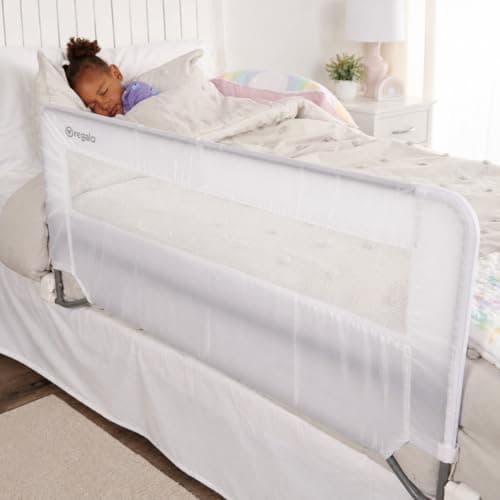
| Guardrail height above mattress | 20 in tall, 43 in long |
|---|---|
| Stated weight limit (per bunk) | Not published by the manufacturer |
| Manufacturer minimum age | Not published by the manufacturer |
| Mattress thickness ceiling | Designed for thicker mattresses with a box spring |
| Materials / construction | Steel frame with fabric panel and reinforced anchor system |
What works
- 20 in of height clears a thick mattress and still leaves real rail above it
- Swings down so you can change sheets and the child can get out
- Reinforced anchor strap runs under the mattress
- Fits twin through queen
What doesn’t
- Designed around a box spring; slat-only frames need a careful look
- The swing-down hinge is something a determined toddler will learn
- At 43 in it does not cover the full length of a twin
The catch: A 43 in rail on a 75 in mattress leaves about two and a half feet uncovered. That is fine at the foot end and it is not fine if your child sleeps diagonally, which small children do.
Children who resist a rail
hiccapop Toddler Bed Bumpers
hiccapop
Foam bolsters that slide under the fitted sheet — a soft edge rather than a cage, for the child a metal rail upsets.
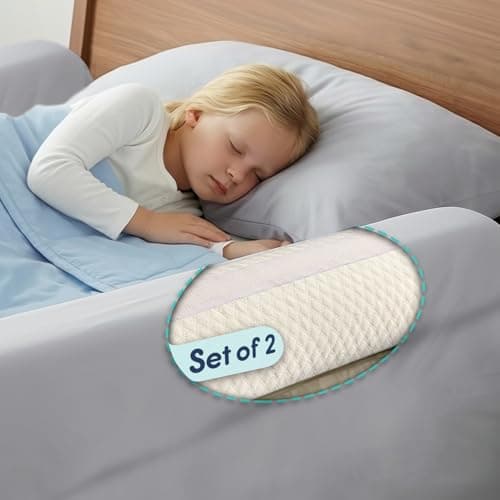
| Guardrail height above mattress | Foam bolster, low profile (height not published) |
|---|---|
| Stated weight limit (per bunk) | Not published by the manufacturer |
| Manufacturer minimum age | Not published by the manufacturer |
| Mattress thickness ceiling | Sits under the fitted sheet on any mattress |
| Materials / construction | CertiPUR-US certified foam with washable cover |
What works
- No hardware, no frame compatibility question — it goes under the sheet
- Far less confining than a full rail, which some children genuinely need
- CertiPUR-US certified foam
- Packs flat for travel
What doesn’t
- A bolster is a speed bump, not a barrier — a determined roll clears it
- Not a substitute for a rail on a raised bed of any kind
- Takes up mattress width
The catch: Be clear about what this is. It is a passive edge that makes rolling out less likely, not a guardrail that prevents a fall, and it has no business anywhere near a bunk or a loft.
Questions parents actually ask
Do bed rails fit queen size beds?
Many do — look for a stated fit range covering twin through queen. The Regalo Swing Down rail publishes 20 inches of height, 43 inches of length and that range. Position it where the child actually sleeps rather than centring it on the bed.
Can you put a toddler bed rail on a king bed?
Not usually with one rail. A king side is 80 inches and the anchor strap has 76 inches of mattress to cross. Either fit two rails butted together, or fit one at the child’s sleeping position and put the other long side against a wall.
How tall should a bed rail be for a thick mattress?
Tall enough to stand meaningfully above the mattress once it is in place. A 20-inch rail on a 12-inch mattress leaves 8 inches of real barrier. Published heights are generally measured from the attachment point, so subtract your mattress thickness to find what you actually get.
Are bed rails safe for co-sleeping?
A rail does not make bed-sharing with an infant safe, and we are not going to suggest otherwise. AAP guidance is that infants sleep on a separate firm surface in the parents’ room. For a toddler in a big bed, a correctly anchored rail with no gap is a reasonable precaution.
Will a bed rail work without a box spring?
Sometimes. Many rails are designed around a box spring and anchor beneath it. On a slatted platform, look for an anchor strap that runs across the slats and buckles on the far side rather than one relying on being wedged between mattress and base.
What is the gap limit between a bed rail and the mattress?
Keep it tight. The AAP’s bunk-bed guidance puts the acceptable space between guardrail and bed at no more than three and a half inches, and that is a sensible ceiling on an adult bed too — a wider channel is an entrapment hazard created while solving a fall one.
Sources
Read next
- Best toddler bed rails
The rails themselves, ranked on published height.
- Bed rail vs guardrail extension
Two different products, and where each one belongs.
- Guardrail height requirements
How to measure rail height above a mattress properly.
- Toddler bed vs twin bed
If the big bed was a stopgap rather than the plan.
Back to Toddler Beds.