Kids Bedding
Weighted blankets for kids
No weighted anything in a baby's sleep space - that part is settled guidance, not a preference. After infancy there is no federal age rule at all, so the numbers that matter are the ones each brand chooses to publish.
We earn a commission from qualifying purchases made through links on this page, at no extra cost to you. How this site is funded.
The short answer
Not for a baby. Not near a baby. The American Academy of Pediatrics is explicit in its safe sleep guidance: “Don’t use weighted blankets, sleepers, swaddles or other weighted objects on or near your baby.” That covers the whole first year and it is not a close call.
After infancy there is no federal age rule and no medical standard — so the usable limits are the ones each brand publishes. The Mr. Sandman 5 lb Kids Weighted Blanket publishes the most of any we found: over 3 years old, at least 30 lb, and a target range of 40 to 60 lb.
For the strictest stated floor and a certified fabric, the Sivio Cotton Weighted Blanket says over 4 years old and at least 30 lb, in Oeko-Tex certified cotton on both faces. For an older or heavier child, the Aricove Kids Weighted Blanket is the only pick sold in two weights.
The one rule that is not up for discussion
Everything else on this page is a judgment. This part is not.
The AAP’s safe sleep guidance for infants is that a baby sleeps on a firm, flat surface — one that, in its words, “shouldn’t indent when your baby is lying on it” and that is not inclined more than 10 degrees — with a fitted sheet and nothing else. On weighted products specifically it says: “Don’t use weighted blankets, sleepers, swaddles or other weighted objects on or near your baby,” and in its swaddling section it adds “Don’t use weighted swaddle blankets or weighted objects like rice bags inside the swaddle.”
Two things follow from that. First, a weighted blanket is not a product with a nursery use case — it is a product that is wrong in a nursery. Second, the guidance does not name an age at which weighted bedding becomes acceptable, because it is written about the first year. Nobody authoritative has published a number for the years after it. Any page that quotes you a confident age is quoting a brand.
A weighted blanket is not a sleep aid for a toddler
The threshold concern is simple and physical: a weighted blanket is only appropriate for a child who can push it off, uncover their own face, and get out from under it unaided, every time, including half asleep. A toddler who still needs help getting out of bed does not meet that test, whatever the listing age says. Our guide to when a toddler can use a pillow and blanket covers ordinary bedding in the same window; weighted bedding sits years later than that.
What the brands actually publish
We looked for the limits on every live listing we could find and then ranked on them, because in a category with no regulation the manufacturer’s own stated floor is the only number anyone is accountable for.
The spread is wide. One blanket states an age, a minimum body weight and a target weight range. One states an age and a minimum weight. One states an age only. One puts an age range in the product title and then says nothing in the bullets, does not name its fill material, and claims no certification at all.
That last one is still on this page, honestly ranked last, because it is a real purchasable product and some children genuinely prefer its two textures. But a listing that will not name its fill is a listing you are buying on feel.
| Blanket | Weight | Size | Stated minimum age | Stated minimum body weight | Certification |
|---|---|---|---|---|---|
| Mr. Sandman | 5 lb | 36 x 48 in | Over 3 years | 30 lb (target 40-60 lb) | None claimed |
| Sivio cotton | 5 lb | 36 x 48 in | Over 4 years | 30 lb | Oeko-Tex |
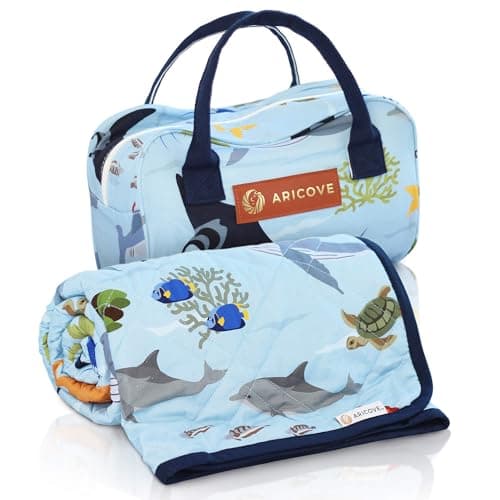
| Aricove kids | 7 lb | 40 x 60 in | Over 3 years | Not published | Oeko-Tex + child safety |
| MAXTID kids | 5 lb | 36 x 48 in | 3 to 8+ (title only) | Not published | None claimed |
The 8 to 10 percent rule, and what it is not
The sizing convention across this whole industry is that a weighted blanket should be roughly 8 to 10 percent of the user’s body weight. Two of the four listings here state it themselves.
It is worth being precise about what that is: an industry convention, repeated by manufacturers, not a medical guideline and not a tested standard. Treat it as a sizing heuristic rather than a safety threshold.
Used as a heuristic it is useful, because it rules out most of the mistakes people make in this category. Run the arithmetic before you buy:
A 5 lb blanket points at a child of roughly 50 to 62 lb — broadly a five to eight-year-old, though children vary enormously. Three of the four picks here are 5 lb.
A 7 lb blanket points at roughly 70 to 87 lb, which is older — around eight and up. This is the number that catches people out, because 7 lb sounds like a small blanket and it is not a small blanket for a five-year-old.
A 30 lb child — the minimum two of these listings state — works out at 2.4 to 3 lb on the convention, and nobody sells a 3 lb weighted blanket for children. That gap is not an oversight you can split the difference on. It means the youngest child inside the stated age limit is still outside the weight the product was built for, which is the single most important sentence on this page.
Why the blanket should be smaller than the bed
This is the detail most buyers get wrong, and it is counter-intuitive.
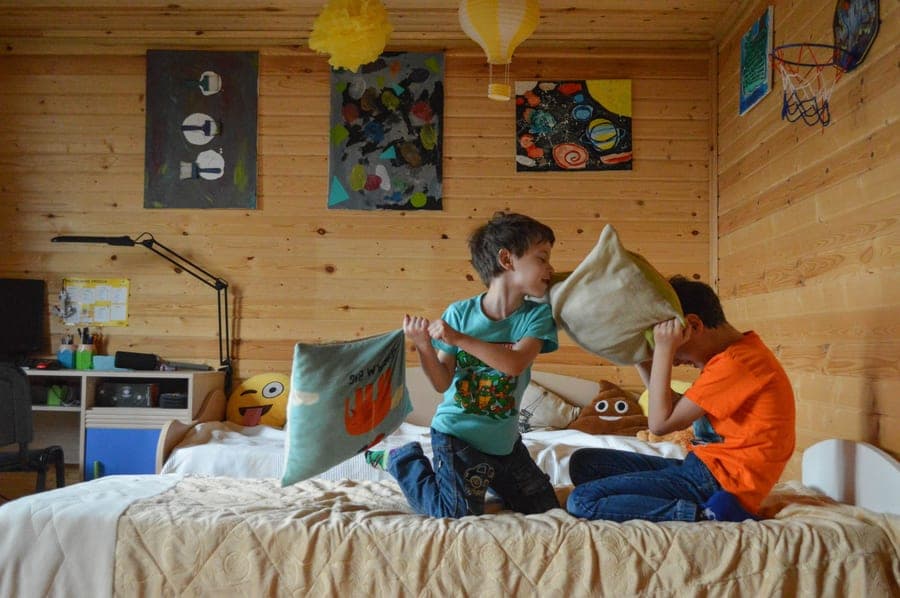
A weighted blanket is sized to the body, not to the mattress. Three of the four here are 36 by 48 inches — far smaller than a twin mattress. That is deliberate: a weighted blanket that hangs over the edge of the bed has part of its mass pulling toward the floor, which both reduces the even pressure that is the entire point of the product and gives the blanket a way to slide off in one piece.
One of the two listings that states this spells it out: weighted blankets “are designed not to drape over the edges of the bed.” If you buy a 40 by 60 inch blanket for a twin bed, as the Aricove is, expect it to reach the floor on one side.
The practical consequence on a bunk or loft deck is worse. A blanket that slides takes itself over the guardrail, and seven pounds of fabric going over a rail at 3am is not something you want on a raised bed. Our guide to bedding for a top bunk covers the sliding problem for ordinary bedding, and weighted bedding makes every part of it heavier. If the child sleeps on a top bunk, our honest answer is to skip the weighted blanket.
Glass beads, plastic pellets and the pocket grid
The weight in a modern weighted blanket comes from fine glass beads quilted into a grid of sewn pockets. All four picks here use glass.
Glass beads are denser than plastic pellets, so the blanket is thinner for the same weight, and they are quieter when the blanket moves. They are also small enough that a seam failure matters, which is why the pocket construction is worth reading: two of these listings specify a 7-layer build with reinforced stitching specifically to stop beads migrating or escaping.
The pocket grid is what keeps the weight evenly spread. A blanket whose beads have all slid into one third of it is no longer a weighted blanket, it is a sandbag with a cover on. Smaller pockets hold their distribution better.
Washability splits this category sharply. Most of these are machine wash cold, gentle cycle, and then either hang dry or tumble low. One — the Aricove — states tumble dry safe at 110 F, which is unusual and genuinely useful: a wet seven-pound blanket takes a long time to air dry. The Mr. Sandman’s eight securing loops are the other good answer, letting the blanket go inside a duvet cover so the cover takes the washing instead.
Who a weighted blanket is actually for
We are a bedding site, not a clinic, and we are not going to make claims about what a weighted blanket treats. What we can say is what the category is sold against and where the honest limits of that are.
Weighted blankets are marketed on deep pressure — the even, distributed weight that some children find calming at the end of the day. Plenty of parents report that it helps a child settle. The evidence base for sleep outcomes in children is thinner than the marketing suggests, and nothing on this page should be read as a medical claim.
If a child has a respiratory condition, low muscle tone, a developmental or sensory diagnosis, or any difficulty moving independently in bed, this is a question for their pediatrician before it is a shopping question. The product’s whole safety model rests on the child being able to get out from under it unaided, and that is exactly the assumption those conditions can undermine.
And if what you are actually solving is a child who wakes at 5am in summer, the honest answer is not a weighted blanket at all — it is blackout curtains, which are cheaper and have a mechanism you can see working.
What we would not buy
Anything weighted for a child under 3. No listing we found states a floor below three years, the AAP rules out the whole first year outright, and the body-weight arithmetic rules out most two-year-olds even where an age limit technically allows them.
A weighted sleep sack, swaddle or weighted sleeper. Named explicitly in the AAP guidance as something not to use on or near a baby. A blanket can be pushed off; a worn weighted garment cannot.
A heavier blanket because the child will grow into it. This is the mistake the category punishes most. The 8 to 10 percent convention is a window, not a floor, and a blanket that is twice the right weight today is not a bargain.
A weighted blanket on a top bunk or loft deck. Sliding bedding plus a guardrail plus seven pounds is a combination with no good version.
A blanket that names no fill and no certification. One pick here is close to this and is ranked last for it. Below that line we would not buy at all.
Key takeaways
- The AAP is explicit: no weighted blankets, sleepers, swaddles or weighted objects on or near a baby. That rules out the entire first year.
- There is no federal age rule and no medical standard after infancy, so the brand's own published floor is the only accountable number.
- The stated floors we found run from over 3 years to over 4 years, with 30 lb as the minimum body weight where one is given at all.
- The 8 to 10 percent of body weight rule is an industry sizing convention, not a safety standard. A 5 lb blanket points at a 50 to 62 lb child; 7 lb points at 70 to 87 lb.
- A 30 lb child works out at under 3 lb on that convention, and nobody sells a 3 lb kids blanket - so the youngest child inside the age limit is still outside the weight range.
- The blanket should be smaller than the mattress, not bigger. One listing says so outright: they are designed not to drape over the edge of the bed.
- Skip it entirely on a top bunk or loft deck, and ask a pediatrician first if the child has any difficulty moving freely in bed.
What we'd buy
Every pick below carries the same spec block, so you can compare the numbers across this page and every other page on the site.
A parent who wants the age and weight rules in writing
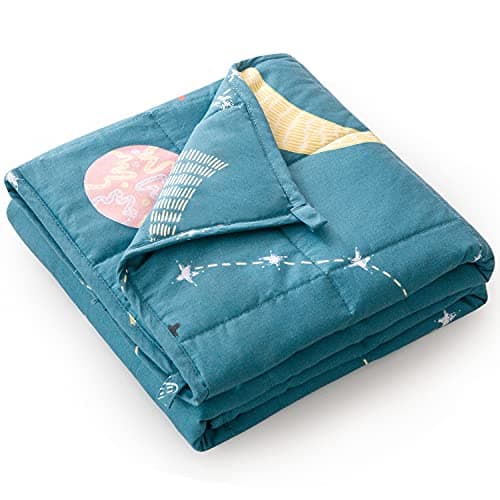
Mr. Sandman 5 lb Kids Weighted Blanket
Mr. Sandman
The clearest published limits in the category: over 3 years old, at least 30 lb, and a stated 40 to 60 lb body-weight range.
| Guardrail height above mattress | Not applicable |
|---|---|
| Stated weight limit (per bunk) | Not applicable |
| Manufacturer minimum age | Listing states use only over 3 years old and at least 30 lb |
| Mattress thickness ceiling | Not applicable |
| Materials / construction | 100% breathable cotton shell with non-toxic glass bead fill in a 7-layer pocket construction; 36 x 48 in, 5 lb; 8 securing loops for a duvet cover |
What works
- States a minimum age, a minimum body weight and a target weight range
- 36 x 48 in - deliberately smaller than the bed, so it cannot hang over the edge
- Eight securing loops, so it can go inside a duvet cover and be washed separately
- 7-layer pocket construction to stop the beads migrating into one corner
What doesn’t
- 5 lb suits a 40 to 60 lb child and nobody else - this is not a grow-with-them product
- Cotton shell with no stated certification
- Hang dry preferred, which is slow for a blanket a child uses nightly
- The listing says it takes two to seven days to get used to the weight
The catch: Even the best-labeled weighted blanket here is a single-size product. At 5 lb it is right for roughly a 50 lb child and wrong at either end of that, and no amount of good labeling changes the arithmetic.
A certified fabric against a child's face
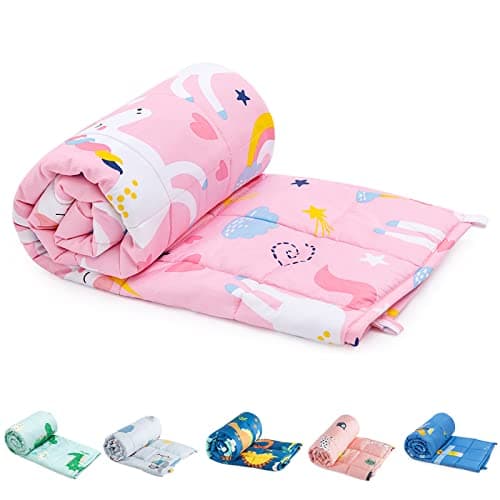
Sivio Cotton Weighted Blanket, 5 lb
Sivio
Oeko-Tex certified cotton on both faces, and the strictest stated floor in this group: over 4 years old and at least 30 lb.
| Guardrail height above mattress | Not applicable |
|---|---|
| Stated weight limit (per bunk) | Not applicable |
| Manufacturer minimum age | Listing states use only over 4 years old and at least 30 lb |
| Mattress thickness ceiling | Not applicable |
| Materials / construction | 100% cotton on both sides, Oeko-Tex certified, with glass bead fill in a 7-layer construction; 36 x 48 in, 5 lb |
What works
- Oeko-Tex certification named on the listing
- 100% cotton on both faces rather than cotton over minky
- States a 4-year minimum - the most conservative floor in the category
- Publishes the 8 to 10 percent of body weight convention in its own sizing guidance
What doesn’t
- No second size on this listing, so there is no next blanket when the child grows
- Glass beads are quieter than plastic pellets but still audible when the blanket moves
- Machine wash cold and tumble dry low only
- The listing text is written for adults and the kids use case is secondary
The catch: The 8 to 10 percent rule in the listing is an industry convention, not a medical standard, and at 5 lb it points at a 50 to 62 lb child. A 4-year-old weighing 35 lb is inside the stated age limit and outside the weight the blanket is built for - which is exactly why both numbers matter.
An older child who needs the heavier 7 lb option
Aricove Kids Weighted Blanket, 7 lb
Aricove
The only pick here sold in two weights, with Oeko-Tex and child-safety certification claimed on every material in it.
| Guardrail height above mattress | Not applicable |
|---|---|
| Stated weight limit (per bunk) | Not applicable |
| Manufacturer minimum age | Listing states suitable only for children over 3 years old |
| Mattress thickness ceiling | Not applicable |
| Materials / construction | Twill-woven cotton shell with superfine glass beads quilted between plush microfiber inner layers; all materials stated as Oeko-Tex and child-safety certified; 40 x 60 in, 7 lb; also sold 36 x 48 in at 5 lb; machine washable and tumble dry safe at 110 F |
What works
- Two weights on the same product line, so the 5 lb and 7 lb decision is one purchase apart
- Oeko-Tex and child-safety certification claimed on all materials, not just the shell
- Tumble dry safe at 110 F, which most weighted blankets are not
- Comes with a carry bag, which matters more than it sounds for a 7 lb blanket
What doesn’t
- Roughly three times the price of the cheapest pick here
- 40 x 60 in is large enough to reach the floor on a twin bed
- States an age minimum but no minimum body weight
- Microfiber inner layers under a cotton shell, so it is warmer than it looks
The catch: A 7 lb blanket points at a 70 to 87 lb child on the 8 to 10 percent convention - roughly age eight and up. Buying the 7 lb for a five-year-old because it will last is the one mistake this category punishes, and the brand's own two-size range is the argument against it.
A child who wants the soft side
MAXTID Kids Weighted Blanket, 5 lb
MAXTID
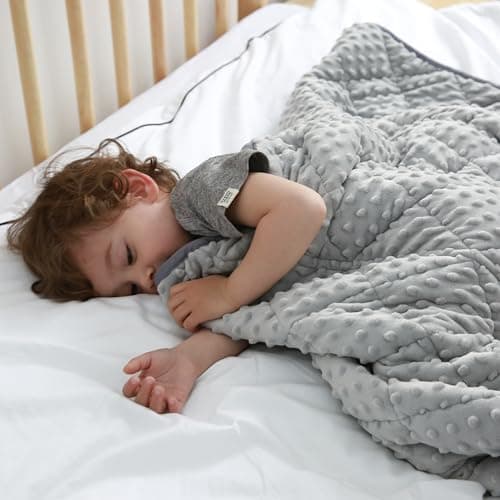
Cotton on one face and minky on the other, which is the texture most children ask for - and the thinnest listing detail on this page.
| Guardrail height above mattress | Not applicable |
|---|---|
| Stated weight limit (per bunk) | Not applicable |
| Manufacturer minimum age | Not published by the manufacturer |
| Mattress thickness ceiling | Not applicable |
| Materials / construction | Cotton on one face and minky on the other; 36 x 48 in, 5 lb; machine washable cold on a gentle cycle, no bleach |
What works
- Two different textures, so a child who dislikes one side turns it over
- 36 x 48 in, the size that stays on the body rather than over the edge
- Machine washable cold on a gentle cycle
- Names an age range in the product title - 3 to 8 and up
What doesn’t
- The age range appears only in the title, with no minimum body weight anywhere
- No certification claimed on the shell or the fill
- The listing does not state the fill material at all
- Minky mats where a child grips it, which is the first thing to go
The catch: This is the least informative listing of the four and the most expensive of the 5 lb ones. The title says 3 to 8 years, the bullets say nothing, and a blanket that does not publish its fill is a blanket you are buying on texture.
Questions parents actually ask
Are weighted blankets safe for kids?
Not for infants — the AAP’s safe sleep guidance says not to use weighted blankets, sleepers, swaddles or other weighted objects on or near a baby, and that covers the whole first year. For older children the honest answer is that it depends on one test: the child has to be able to push the blanket off, uncover their face and get out from under it unaided, every time. The listings themselves state floors of over 3 or over 4 years and a minimum of 30 lb.
What age can a child use a weighted blanket?
There is no regulated age and no medical standard, so the only answerable version of the question is what the brands state. Of the blankets we checked, the floors are “over 3 years old and at least 30 lb” and “over 4 years old and at least 30 lb”. Because the 8 to 10 percent sizing convention puts a 5 lb blanket on a 50 to 62 lb child, in practice the youngest child a 5 lb blanket genuinely fits is around five.
How heavy should a kids weighted blanket be?
The industry convention is 8 to 10 percent of the child’s body weight, and two of the listings here state it themselves. That makes 5 lb right for roughly 50 to 62 lb and 7 lb right for roughly 70 to 87 lb. It is a sizing heuristic rather than a safety standard, but it does rule out the common mistake of buying heavy so the blanket lasts.
Can a 2 year old use a weighted blanket?
No listing we found permits it, and the body-weight arithmetic rules it out even where an age limit technically would not. A two-year-old is also the age group least able to meet the one condition the whole product depends on — getting out from under it unaided while half asleep. Our pillow and blanket guide covers what ordinary bedding is appropriate at that age.
Should a weighted blanket be bigger than the bed?
No — smaller. A weighted blanket is sized to the body, which is why three of the four picks here are 36 by 48 inches rather than twin sized. One listing states it directly: these blankets are designed not to drape over the edges of the bed, because overhanging weight pulls unevenly and gives the blanket a way to slide off.
Can you put a weighted blanket on a bunk bed?
We would not. Bedding on a raised deck already slides toward the guardrail — our top bunk bedding guide is about that exact problem — and adding five to seven pounds to the thing that slides is the wrong direction. On a bottom bunk or a standard bed it is a normal purchase.
How do you wash a kids weighted blanket?
Cold, on a gentle cycle, and then check the drying instruction, because that is where these differ most. Most want hang drying or a low tumble; one of the picks here states tumble dry safe at 110 F. A seven-pound blanket takes a long time to air dry, so if washing frequency is a concern, buy one with securing loops and put it inside a duvet cover you can wash instead.
Are glass beads or plastic pellets better?
Glass. All four picks here use fine glass beads, which are denser than plastic pellets, so the blanket is thinner for the same weight, and quieter when the child moves. What matters alongside the fill is the pocket grid that holds it in place: two of these listings specify a 7-layer construction with reinforced stitching to stop the beads migrating into one corner.
Sources
Read next
- When can a toddler use a pillow and blanket?
The safe-sleep rules for ordinary bedding.
- Best kids comforter sets
Unweighted warmth, at any age.
- Best kids duvet covers
The washable layer a weighted blanket can go inside.
- Bedding for a top bunk
Why weighted bedding and guardrails do not mix.
- Best blackout curtains for kids rooms
The cheaper fix for an early waker.
Back to Kids Bedding.