Sleep Safety
Bunk bed safety nets, explained
Nets are sold as the fix for a top bunk that worries you. They are not a substitute for a compliant guardrail, and on the wrong bed they create a new hazard while covering an old one.

We earn a commission from qualifying purchases made through links on this page, at no extra cost to you. How this site is funded.
The short answer
A safety net is a mesh panel that laces or straps along the open side of a bunk. It can keep soft toys and bedding from going over the edge, and it can reassure a nervous child. It is not a guardrail: the federal standard for children’s bunk beds requires rigid guardrails whose tops sit no less than five inches above the top of the mattress, and a net does not satisfy that. If your bunk’s rails are too short for the mattress on it, the fix is a thinner mattress or a proper rail — not a net over the gap.
Where the idea comes from
Nets are common on caravan, RV and marine bunks, and that is genuinely where they belong — a built-in berth with no removable rail, in a vehicle that moves. Search results carry that usage straight over to a children’s bedroom bunk, where the situation is different: a domestic children’s bunk sold in the United States is already required to have at least two upper-bunk guardrails, one on each side, with the wall-side rail running continuously from end to end. The net is being sold as a solution to a problem the bed was supposed to have solved at the factory.
So the first question is not “which net” but “why does this bed need one”. There are three answers, and only one of them is solved by a net.
What to look for: diagnose the actual problem first
If the rail is shorter than five inches above the mattress — the usual cause being a mattress thicker than the frame was specified for — then the bed is outside the standard and a net does not bring it back inside. Measure it: zero a tape on the floor, note the top of the mattress, note the top of the rail, subtract. Our guardrail height page walks through it. The fix is a thinner mattress, or a frame whose published ceiling matches the mattress you want.
If a rail is missing entirely — a secondhand bed, or a bed assembled without a part — the fix is the correct rail for that frame. A manufacturer’s own add-on guardrail is the right answer where one exists, because it bolts to the frame and publishes its height. Fabric and mesh products clamp or lace, and they flex in a way a bolted wooden rail does not.
If the child is frightened or the bedding keeps falling out — this is the one case where a net is doing something honest. It is a containment device and a comfort object, and if it gets a child sleeping who otherwise would not, it has earned its place. Just do not let it change your judgment about the first two questions.
| Satisfies the guardrail rule | Stops a fall | Honest use | |
|---|---|---|---|
| Factory guardrail on the bed | Yes, if 5 in above the mattress | Yes | The only thing the standard recognizes |
| Manufacturer add-on guardrail | Yes, on the frame it is made for | Yes | Replacing a missing rail on that bed |
| Mesh safety net | No | Not reliably | Containing bedding and toys; reassurance |
| Toddler bed rail | No | Not on a bunk | A low bed, inches off the floor |
| Foam bolster under the sheet | No | No | A low bed, for a child who resists a rail |
The gap is the thing to check
The AAP recommends a space no wider than three and a half inches between a guardrail and the side of the bunk — that is an entrapment limit, not a fall limit. A net laced a few inches outside the rail creates exactly that kind of channel, and a child who slides into it is in a worse position than one who was simply behind a rail. If you fit a net, fit it tight against the frame with no slack pocket.
What actually makes a top bunk safer
Three things, in order of how much difference they make. First, the right mattress: thin enough that five inches of rail stand above it, on a frame that publishes a ceiling. That one change does more than every accessory on the market combined, and it is covered in mattress thickness and guardrails.
Second, the right age. The American Academy of Pediatrics advises that children younger than six should not sleep on the top bunk, because a child under six does not yet have the coordination to climb safely or to keep from falling out while asleep. No net changes that, and a net that makes a parent comfortable putting a four-year-old up there has made things worse rather than better. Read top-bunk age readiness and take the answer it gives you.
Third, light. Most falls from bunks happen on the way down rather than out of the bed, and a lit route is the cheapest safety change available — a motion-sensor light on the frame comes on before a foot does. It costs less than a net and solves the more common failure.

If you still want a net
Fit it tight to the frame with no pocket between net and rail. Keep it clear of the ladder or stair opening, which has to stay usable. Check the lacing or straps weekly for the first month, because a net under tension finds its slack quickly. And treat it as what it is — bedding containment and reassurance on a bed that is already compliant, not a compliance measure in its own right.
What we would not do is fit a net to a bunk whose rail height we had not measured, or to a bunk being used by a child below the AAP age guidance, or in place of a rail that the bed came with and lost. In all three of those cases the net is covering the view of the problem rather than the problem.
Key takeaways
- A net is not a guardrail and does not satisfy the federal standard's 5 in rule.
- Nets belong on caravan and RV berths with no removable rail — that is where the product class comes from.
- A net laced outside the rail can create an entrapment channel. Keep the AAP's 3.5 in gap limit in mind.
- Diagnose first: short rail, missing rail, or a nervous child. Only the third is a net's job.
- The three changes that matter are a thinner mattress, the right age, and a lit route down.
What we'd buy
Every pick below carries the same spec block, so you can compare the numbers across this page and every other page on the site.
Adding a rail to a bed that came without one
Max & Lily Add-On Guardrail
Max & Lily
A matching wooden rail that bolts to the frame — the right answer when the bed is a Max & Lily and the rail is missing.
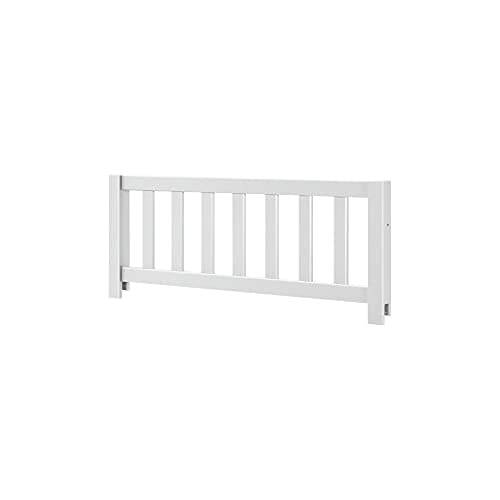
| Guardrail height above mattress | 13.25 in from the point of attachment |
|---|---|
| Stated weight limit (per bunk) | Not applicable |
| Manufacturer minimum age | Not published by the manufacturer |
| Mattress thickness ceiling | Determined by the bed it attaches to |
| Materials / construction | Solid New Zealand pine to match the bed frames |
What works
- Publishes its height, which almost no aftermarket rail does
- Bolts to the frame rather than clamping under the mattress
- Matches the finish of the beds it is designed for
- Solid wood, so it does not flex the way a fabric rail does
What doesn’t
- Only fits Max & Lily frames — this is not a universal rail
- 13.25 in of rail is consumed fast by a thick mattress
- Costs more than a generic clamp-on rail
The catch: 13.25 in measured from the attachment point is not 13.25 in above your mattress. Subtract the mattress thickness and check that at least 5 in of rail is still standing proud, per the federal rule.
Children who resist a rail
hiccapop Toddler Bed Bumpers
hiccapop
Foam bolsters that slide under the fitted sheet — a soft edge rather than a cage, for the child a metal rail upsets.
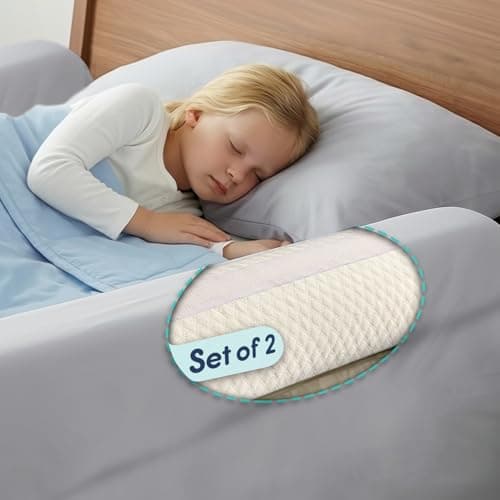
| Guardrail height above mattress | Foam bolster, low profile (height not published) |
|---|---|
| Stated weight limit (per bunk) | Not published by the manufacturer |
| Manufacturer minimum age | Not published by the manufacturer |
| Mattress thickness ceiling | Sits under the fitted sheet on any mattress |
| Materials / construction | CertiPUR-US certified foam with washable cover |
What works
- No hardware, no frame compatibility question — it goes under the sheet
- Far less confining than a full rail, which some children genuinely need
- CertiPUR-US certified foam
- Packs flat for travel
What doesn’t
- A bolster is a speed bump, not a barrier — a determined roll clears it
- Not a substitute for a rail on a raised bed of any kind
- Takes up mattress width
The catch: Be clear about what this is. It is a passive edge that makes rolling out less likely, not a guardrail that prevents a fall, and it has no business anywhere near a bunk or a loft.
A lit route down from the top bunk
Rechargeable Motion-Sensor Night Light
Various (search by spec)
The cheapest safety upgrade for a bunk: light on the ladder before a foot goes on it.
| Guardrail height above mattress | Not applicable |
|---|---|
| Stated weight limit (per bunk) | Not applicable |
| Manufacturer minimum age | Not published by the manufacturer |
| Mattress thickness ceiling | Not applicable |
| Materials / construction | Rechargeable LED with adhesive or magnetic mount |
What works
- Lights the ladder and the floor at the bottom of it automatically
- Warm color temperature does not wake the room the way a white light does
- No wiring, so it mounts anywhere on the frame
- Costs less than almost any other change you can make to a bunk
What doesn’t
- Rechargeable means remembering to recharge it
- Adhesive mounts fail on textured or painted surfaces
- Motion sensors can trigger from the bed and wake the sleeper
The catch: This is a generic category rather than a single model — search on the specification (rechargeable, motion sensor, warm white) rather than on a brand, because the brands turn over constantly and the spec does not.
Questions parents actually ask
Do bunk bed safety nets work?
For keeping bedding and soft toys on the bed, and for reassuring a nervous child, yes. For preventing a fall, not reliably — and they do not satisfy the federal guardrail requirement, which calls for rigid rails standing at least five inches above the mattress.
Can a safety net replace a bunk bed guardrail?
No. The standard requires at least two upper-bunk guardrails, one on each side, with the wall-side rail continuous end to end. If a rail is missing, source the correct rail for that frame; if it is too short for the mattress, change the mattress.
Are bunk bed safety nets safe?
Fitted tight against the frame, on a bed that is already compliant, they are benign. Fitted with slack a few inches outside the rail, they create a channel a small child can slide into — which is an entrapment hazard introduced while addressing a fall one.
What is the best way to make a top bunk safer?
A mattress thin enough that five inches of rail stand above it, a sleeper who is at least six, and a lit route down. Those three, in that order, outweigh every accessory sold for the purpose.
Is there a safety net for a loft bed?
The same products are sold for loft decks and the same reasoning applies: a loft deck needs compliant rigid guardrails, and a net is containment rather than compliance. Loft decks are higher, which makes getting the rail and mattress right more important, not less — see loft bed age and safety.
Sources
Read next
- Guardrail height requirements
The five-inch rule, and how to measure it on your own bed.
- Best bunk bed safety accessories
The accessories that do something measurable.
- Top bunk age readiness
The question a net is often being bought to avoid.
- Bed rail vs guardrail extension
Two products that are regularly confused for each other.
Back to Sleep Safety.