Loft Beds
Are loft beds safe for kids?
A loft deck is the upper bunk of a bunk bed with nothing below it. Every rule that governs a top bunk governs a loft, and the deck is frequently higher.
We earn a commission from qualifying purchases made through links on this page, at no extra cost to you. How this site is funded.
The short answer
A loft bed is as safe as a top bunk, under the same conditions: a compliant guardrail with at least five inches above the mattress, a mattress thin enough to leave it, and a child old enough. The AAP advises no child under six on an upper bunk, and the same reasoning applies to a loft deck. DHP state the under-six rule explicitly for their junior loft beds.
Why a loft deserves slightly more caution than a bunk
Three reasons, none of which is a reason to avoid loft beds.
The deck is often higher. A high loft puts the sleeping surface at 60 to 72 inches, against 55 to 65 for a standard bunk.
There is nothing underneath. A bunk’s bottom mattress is not a safety feature, but it is a softer thing to land on than a desk, a chair, or the corner of a bookcase. Whatever goes under a loft becomes the landing zone.
No intermediate step. On a bunk, the bottom bunk frame is something to steady against on the way down. A loft ladder is the only route.
The landing zone is a design decision
If you are putting a desk under a loft bed, look at what is directly beside the ladder. A desk chair with a hard back, a metal bin, or an open drawer at that spot is the thing a falling child meets. Keep the base of the ladder clear, and put the soft furnishings there.
The guardrail rule, applied to a loft
Identical to a bunk. Two rails minimum, one on each side, tops no less than five inches above the top of the mattress, and the wall-side rail running continuously end to end.
The mattress-thickness cap follows from that, and on loft beds it is sometimes tighter than on bunks. DHP specify a window on their junior lofts of over four inches and not exceeding six — that has a floor as well as a ceiling, and the floor exists because too thin a mattress changes the geometry at the other end. Full detail on mattress thickness and guardrails.
Readiness, beyond the number
Six is a floor for an upper bunk, and for a high loft we would set the bar higher — eight is a more comfortable answer for a deck at 66 inches. Beyond age, the questions are the ones on top-bunk age readiness: can they climb up and down repeatedly when tired, do they wake up where they went to sleep, do they sleepwalk, and will they follow the rule about not playing on the deck.
That last one matters more on a loft than on a bunk, because a loft deck with a desk under it is an obvious and appealing place for two children to play.
Anchoring and placement
Most loft beds are not sold with wall anchors, and most do not need them when correctly assembled and placed in a corner — which the AAP recommends for bunk beds and which applies equally here. If your loft does ship with bracing hardware, fit it.
A loft in the middle of a room has no lateral support at all, and a tall narrow frame with a child climbing it is exactly the case where that shows. Corner placement is free and it is the highest-value decision you make about a loft bed after choosing its height.
The overlooked risk: getting down in the dark
Same as a bunk and slightly worse, because there is no bottom bunk to feel for. A warm-white motion-sensor light at the top and bottom of the ladder is a few dollars and removes the highest-risk moment of an ordinary night. See safety accessories.
Key takeaways
- A loft deck is governed by the same guardrail rule as a top bunk.
- AAP guidance: no child under six on an upper bunk. For a high loft, set the bar higher.
- Whatever goes under the loft is the landing zone. Keep the ladder base clear.
- Some loft beds specify a mattress window with a floor as well as a ceiling.
- Corner placement gives lateral support and removes two fall directions, for free.
What we'd buy
Every pick below carries the same spec block, so you can compare the numbers across this page and every other page on the site.
A first loft on a budget
DHP Jett Junior Twin Metal Loft Bed
DHP
The rare budget loft that publishes its weight limit, its mattress range and an age rule, in writing.
| Guardrail height above mattress | Full-length guardrails (height not published) |
|---|---|
| Stated weight limit (per bunk) | 200 lb |
| Manufacturer minimum age | Manufacturer states children under 6 should not use the upper bunk |
| Mattress thickness ceiling | Over 4 in and not exceeding 6 in |
| Materials / construction | Powder-coated metal frame with built-in ladder |
What works
- Publishes a mattress range with both a floor and a ceiling, which almost nobody does
- States an age rule for the upper deck rather than leaving it to you
- Built-in ladder and full-length guardrails
- Short frame height for a loft, so the fall distance is smaller
What doesn’t
- 200 lb capacity is low for a bed a teenager might keep
- The 4-6 in mattress window rules out most mattresses on the market
- Metal frames need their fasteners re-checked periodically
The catch: The mattress window is genuinely narrow. Under 4 in and the guardrail geometry is wrong; over 6 in and the rail no longer clears it. You will be shopping for the mattress around the bed, not the other way round.
A first loft bed, and low ceilings
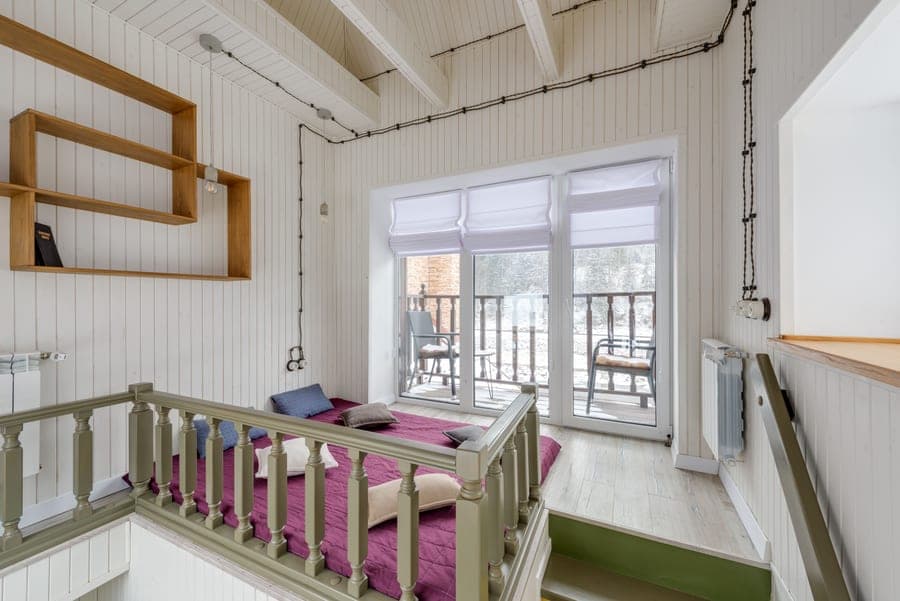
Max & Lily Twin Low Loft Bed
Max & Lily
A loft low enough to be a reasonable first loft, with the same 400 lb frame as the brand's bunks.
| Guardrail height above mattress | Not published by the manufacturer |
|---|---|
| Stated weight limit (per bunk) | 400 lb |
| Manufacturer minimum age | Not published by the manufacturer |
| Mattress thickness ceiling | Not published by the manufacturer |
| Materials / construction | Solid New Zealand pine, GREENGUARD Gold certified finish |
What works
- Low deck height works under an 8 ft ceiling with room to spare
- 400 lb rating is unusually high for a loft
- Space underneath takes a play tent, a reading nook or storage bins
- Ladder mounts on either side
What doesn’t
- Low height limits what fits underneath — a full desk usually will not
- Guardrail height is not published
- Solid pine is heavy for a piece you may want to reconfigure
The catch: Low loft means low clearance. Measure the chair back and the desk height together before assuming a workstation fits under it; on most low lofts, it does not.
A lit route down from the top bunk
Rechargeable Motion-Sensor Night Light
Various (search by spec)
The cheapest safety upgrade for a bunk: light on the ladder before a foot goes on it.

| Guardrail height above mattress | Not applicable |
|---|---|
| Stated weight limit (per bunk) | Not applicable |
| Manufacturer minimum age | Not published by the manufacturer |
| Mattress thickness ceiling | Not applicable |
| Materials / construction | Rechargeable LED with adhesive or magnetic mount |
What works
- Lights the ladder and the floor at the bottom of it automatically
- Warm color temperature does not wake the room the way a white light does
- No wiring, so it mounts anywhere on the frame
- Costs less than almost any other change you can make to a bunk
What doesn’t
- Rechargeable means remembering to recharge it
- Adhesive mounts fail on textured or painted surfaces
- Motion sensors can trigger from the bed and wake the sleeper
The catch: This is a generic category rather than a single model — search on the specification (rechargeable, motion sensor, warm white) rather than on a brand, because the brands turn over constantly and the spec does not.
Questions parents actually ask
Are loft beds safe for a 5 year old?
No — the AAP advises against any child under six sleeping on an upper bunk, and DHP state the same rule for their junior loft beds. A normal bed is the answer until then.
Do loft beds need to be attached to the wall?
Only if the manufacturer supplies bracing hardware. Corner placement gives most of the same lateral support without modification.
Is a loft bed safe for a 6 year old?
A low loft, potentially — six is the AAP’s floor and readiness varies. A high loft at 66 inches deserves an older child.
What should you not put under a loft bed?
Anything hard at the base of the ladder. A desk is fine; a desk chair parked at the ladder’s foot is not.
How high is too high for a child's loft bed?
There is no regulated limit. Practically, check the sitting room above the deck and the child’s confidence on the ladder — a deck the child cannot climb calmly when tired is too high for them.
Sources
Read next
- Top-bunk age readiness
The readiness questions, in full.
- Guardrail height requirements
The rule that applies identically to a loft deck.
- Low loft vs full loft beds
Deck height, and what it means for a younger child.
Back to Loft Beds.