Sleep Safety
Do bunk beds need to be anchored to the wall?
Follow the manufacturer first — if the instructions call for an anti-tip bracket, that is not a suggestion. Beyond that, geometry decides: the taller and narrower the frame, the more an anchor earns its place.

We earn a commission from qualifying purchases made through links on this page, at no extra cost to you. How this site is funded.
The short answer
A standard two-deck bunk bed is wide and heavy enough that it is not normally sold as requiring a wall anchor — but if the manufacturer’s instructions call for one, it is required, and nothing here overrides that. Anchoring becomes genuinely important as the frame gets taller and narrower: loft beds, triple bunks, and any frame with a wardrobe, bookcase or desk built into it. Fix into studs or use proper masonry anchors; a drywall plug will not hold a tipping load.
The instruction in the box wins
This is the whole answer for most people. Manufacturers publish assembly instructions that reflect how they tested the frame, and a brand that specifies an anti-tip bracket has a reason — usually a narrow footprint, a high deck, or integrated storage that shifts the center of gravity forward when it is loaded. The VECELO twin-over-full in our registry ships its anti-tip hardware in the box rather than selling it separately, which is a small thing that tells you how the brand expects the bed to be installed.
If the instructions are missing — which is the normal state of a secondhand bed — treat the anchor as required. You have lost the information that would have told you otherwise, and the cost of a bracket and two screws is not the thing to economize on. Our secondhand bunk bed checklist covers what else goes missing with the manual.
What to look for: the geometry that decides it
Tipping is a function of how tall the frame is relative to how wide its base is, and of where the weight sits. A twin-over-twin bunk is roughly 42 inches wide at the base and perhaps 60 inches tall — a stable ratio, and most of the mass is low. A full-height loft bed with a wardrobe underneath is tall, carries its load high, and gains a forward moment every time a drawer is pulled out. Those are different objects even though both are “beds”.
The other variable is what a child does to it. Bunks and lofts get climbed on from the outside, swung on at the ladder, and leaned against by siblings. A frame that is stable under a sleeping child is being asked a different question by a seven-year-old hanging off the end of the top rail. Where the answer is close, anchor it.
| Frame | Anchor normally specified? | Why |
|---|---|---|
| Low twin-over-twin bunk | Usually not | Wide base, low mass, short frame |
| Full-height twin-over-twin or twin-over-full | Follow the instructions | Stable ratio, but check what the maker says |
| Loft bed, full height | Often yes | Tall, load carried high, nothing above the sleeper |
| Loft or bunk with wardrobe, desk or bookcase | Yes | Integrated storage shifts the center of gravity |
| Triple bunk | Yes | Tall and narrow — the classic tipping geometry |
| Bookcases and tall dressers in the same room | Yes, always | Top-heavy when loaded, and children climb them |
Drywall plugs do not hold a tipping load
Find the studs — 16 inches on center in most US framing — and fix into them with the bracket the manufacturer supplied or an equivalent rated anti-tip strap. In masonry, use proper masonry anchors. A plastic expanding plug in plasterboard will take a picture frame and will tear out under the shock load of a frame starting to tip, which is the exact moment you need it.
Placement does some of the work
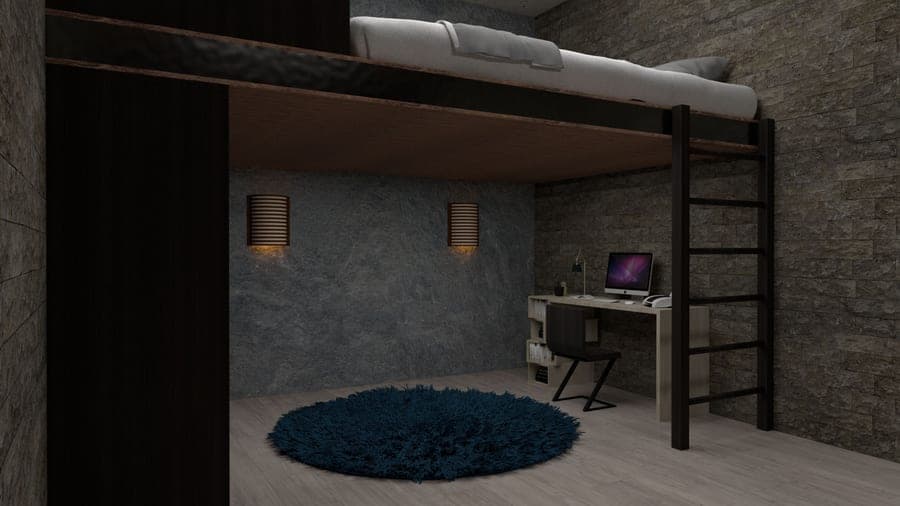
The American Academy of Pediatrics recommends putting a bunk in a corner, with two walls against it. That is not an anchoring instruction but it achieves some of the same thing: two walls remove two tipping directions, they give the sleeper a solid edge on the long side, and they make the ladder the only approach. It is the cheapest change on this page and it costs nothing but a rearranged room.
While you are rearranging: keep the bed away from ceiling fans and flush lights, away from windows where a blind cord can be reached from the top deck, and clear of anything a child might try to reach from the bunk rather than from the floor. Our safety standards page collects the placement guidance alongside the construction rules.
Anchoring is not a substitute for anything
A wall anchor stops a frame tipping. It does not stop a child falling out of bed, which is what guardrails and mattress thickness are for, and it does not stiffen a wobbly frame — lateral movement comes from the bolted joints and is fixed by re-tightening them on a schedule, which our assembly and stability guide covers in detail.
It is also worth being clear about what the federal standard does and does not say. 16 CFR Part 1513 governs the construction of children’s bunk beds — guardrail count and height, the continuous wall-side rail, entrapment gaps. Anchoring is a manufacturer instruction and an installation decision, not a clause in the regulation, which is precisely why the instruction sheet matters so much here.
A bed is the narrow case. For the rest of the room — dressers, bookcases, toy units and desks with hutches — see anchoring kids furniture to the wall.
Key takeaways
- If the manufacturer's instructions specify an anti-tip bracket, fit it. No reasoning overrides that.
- Tall and narrow is the tipping geometry: lofts, triples, and frames with built-in wardrobes or desks.
- Fix into studs at 16 in centers, or use masonry anchors. Drywall plugs will not hold.
- Corner placement removes two tipping directions for free, and the AAP recommends it.
- An anchor does not stop falls, does not stop wobble, and is not required by the federal standard itself.
What we'd buy
Every pick below carries the same spec block, so you can compare the numbers across this page and every other page on the site.
A guest room, a short-term fix, or a tight budget
VECELO Twin Over Full Metal Bunk Bed
VECELO
The cheapest bed here and the only one outside Max & Lily that publishes a guardrail height, at 15 inches the tallest figure in the roundup.
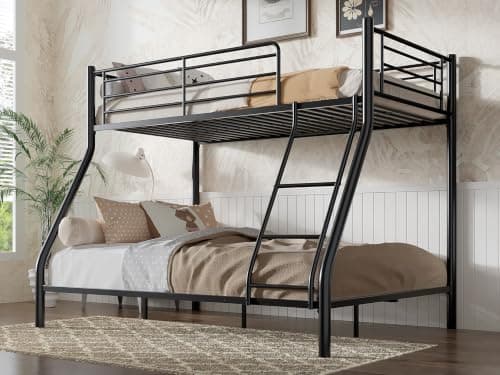
| Guardrail height above mattress | 15 in on the top bunk |
|---|---|
| Stated weight limit (per bunk) | Not published by the manufacturer |
| Manufacturer minimum age | Not published by the manufacturer |
| Mattress thickness ceiling | Not published by the manufacturer |
| Materials / construction | Heavy-duty steel frame, 22 slats with plastic mute clips |
What works
- 15 in of published rail height, taller than anything else in this roundup
- Anti-tip hardware is in the box rather than sold separately
- 60 in overall height is the shortest full-size bunk here, which helps under a low ceiling
- Costs less than a third of the solid-pine picks
What doesn’t
- No weight limit published at all, on either bunk
- No mattress ceiling published, so the 15 in rail is the only clearance figure you have
- Metal tube frames develop movement as fasteners settle and need re-tightening
- 22 slats is a thin foundation under a full-size mattress; expect sag sooner than on plywood
The catch: A published rail height and no published weight limit is a strange combination, and it is the wrong way around. Rail height you can measure yourself in ten seconds once the bed is up. Capacity you cannot measure at all, which makes it the number that actually needed printing.
Younger siblings sharing a room
Max & Lily Twin Over Twin Low Bunk Bed
Max & Lily
The clearest published safety numbers of any bunk we looked at, on a frame low enough that a fall is a short one.
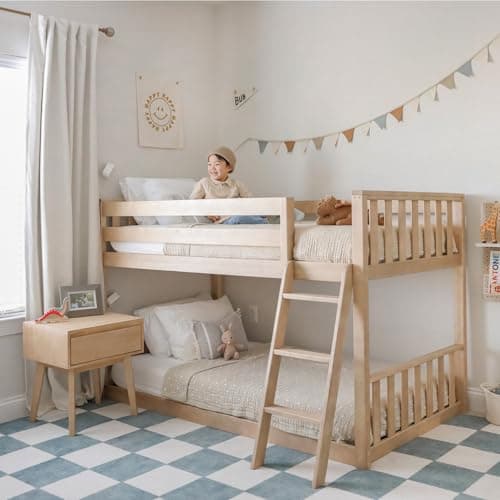
| Guardrail height above mattress | 14 in above the deck |
|---|---|
| Stated weight limit (per bunk) | 400 lb per sleeping surface |
| Manufacturer minimum age | Not published by the manufacturer |
| Mattress thickness ceiling | 8 in maximum (5 in recommended) |
| Materials / construction | Solid New Zealand pine, GREENGUARD Gold certified finish |
What works
- Publishes a guardrail height, a weight limit and a mattress ceiling — most brands publish one of the three
- 400 lb per surface is the highest stated capacity in this roundup, and it holds through the teen years
- Low overall height means the top deck sits well under a standard bunk
- Reversible, removable ladder with grooved treads and rounded edges
What doesn’t
- The 8 in mattress ceiling rules out most plush mattresses
- Solid pine is heavy to move once assembled
- No minimum age published, so the AAP's under-6 guidance is the only age rule you get
The catch: That 8 in ceiling is not a suggestion. Put a 10 in mattress on the top deck and the 14 in rail drops to 4 in of clearance, which is below the federal 5 in minimum. The bed stops being compliant and nobody tells you.
A bedroom that has to be a study as well
Max & Lily Full High Loft Bed with Bookcase
Max & Lily
The same full-size high loft with a three-shelf bookcase built in, which is the storage a teenager actually uses.
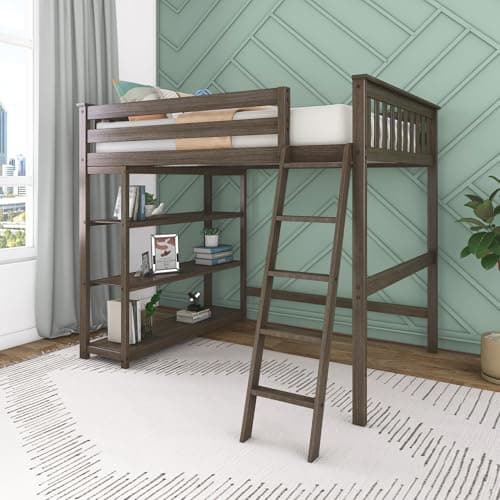
| Guardrail height above mattress | Not published by the manufacturer |
|---|---|
| Stated weight limit (per bunk) | 400 lb capacity |
| Manufacturer minimum age | Not published by the manufacturer |
| Mattress thickness ceiling | 8 in maximum |
| Materials / construction | Solid pine frame, plywood slats with a metal support bar, metal-on-metal bolt connections, low-VOC finish |
What works
- Three-shelf bookcase is part of the frame, so it cannot wander off or wobble
- 52 in of published vertical clearance under the deck
- 400 lb stated capacity, the same figure as the plain version
- End ladder keeps the long side of the bed clear for a desk
What doesn’t
- The listing's own mattress bullet says twin on a frame sold as full size - confirm the size with the seller before you buy the mattress
- No guardrail height published
- 75.25 in of overall width with the bookcase, considerably more than the plain frame
- Costs meaningfully more than the same loft without the shelves
The catch: The published mattress bullet on this listing refers to a twin while the product title and size field both say full. One of the two is wrong and we cannot tell which from the page, so treat the mattress size as unconfirmed and ask before you order bedding. The 8-inch thickness ceiling is consistent across the whole line and is the figure we would rely on.
Questions parents actually ask
Do bunk beds have to be attached to the wall?
Only where the manufacturer says so — and where they say so, it is required. A standard low or full-height two-deck bunk has a wide base and low mass and is often not sold as needing one. Taller and narrower frames usually are.
Do loft beds need to be anchored to the wall?
More often than bunks, yes. A full-height loft carries its load high on a narrow base, and anything with a wardrobe, desk or bookcase built in gains a forward moment when it is loaded or when a drawer is opened. Check the instructions and default to anchoring.
How do you anchor a bunk bed to the wall?
With the bracket or strap the manufacturer supplied, fixed into wall studs — typically 16 inches on center in US framing — or into masonry with proper masonry anchors. A plastic plug in plasterboard is not adequate for a tipping load.
Do bunk beds need to be against a wall?
They do not have to be, but a corner is the better position. The AAP recommends placing a bunk in a corner with two walls against it, which removes two tipping directions and gives the sleeper a solid edge on the long side.
Does the federal bunk bed standard require wall anchoring?
No. 16 CFR Part 1513 covers construction — guardrails, their height above the mattress, the continuous wall-side rail, entrapment gaps. Anchoring is a manufacturer instruction and an installation choice, which is why the assembly sheet carries the weight here.
Will anchoring stop my bunk bed from wobbling?
Not usually. Wobble comes from the bolted joints at the corners settling, and the fix is re-tightening every fastener after the first fortnight and then on a regular cycle. An anchor addresses tipping, which is a different failure.
Sources
Read next
- Bunk bed assembly and stability
What actually fixes a wobble, since an anchor does not.
- Bunk bed safety standards
What the regulation covers, and where it stops.
- Loft bed age and safety
The frames where anchoring matters most.
- Triple bunk beds explained
The classic tall-and-narrow tipping geometry.
Back to Sleep Safety.