Bunk Beds
Triple bunk beds, explained
Three children, one footprint, and a ceiling-height problem most rooms cannot solve. Here is the arithmetic to run before you shop, and the configuration that usually wins instead.
We earn a commission from qualifying purchases made through links on this page, at no extra cost to you. How this site is funded.
The short answer
A triple bunk sleeps three children in the floor space of one bed, and it asks for ceiling height most bedrooms do not have. Stacking three decks typically needs around eight feet of clear ceiling before the top sleeper has usable headroom, and it puts two sleepers on upper decks, both of which need compliant guardrails and both of which are subject to the same under-6 age guidance. For most families, a trundle bunk sleeps the same three people in the same footprint with one upper deck instead of two.
The two shapes, and what each one costs
Vertical triples stack three decks in a single tower. They have the smallest footprint of anything that sleeps three, and they are the configuration ceiling height rules out. L-shaped triples put a bunk over one bed and a third bed perpendicular at the base, which solves the height problem and spends it as floor area instead — an L-shaped triple occupies two walls and a corner. There is no version of a triple bunk that is small in both dimensions.
Mattress sizing varies by model and is the thing to confirm before you buy anything else. Some triples take three twins at 38 by 75 inches; some pair a full (54 by 75) at the base with twins above. We do not stock a triple in our product registry, so we are not going to publish a specification for one from memory — ask the manufacturer for the deck-by-deck mattress size and the maximum thickness per deck, in writing, and treat a listing that will not say as a listing to skip.
What to look for: run the ceiling arithmetic first
Do this before you look at a single photograph, because it decides whether the category is open to you at all. Measure floor to ceiling. Subtract the published overall height of the bed. What remains is the clearance above the top mattress, and the top sleeper needs enough of it to sit up without hitting the ceiling — call it 30 inches as a working minimum for a child, more if you want the bed to still work at fourteen.
Then check the fan. A ceiling fan or a flush light over a top deck is a hazard the specification sheet will never mention, and it is the single most common reason a triple has to be returned. The same arithmetic in full, with the sitting-clearance figures, is on our loft bed ceiling height page — a triple is a loft bed problem with an extra deck.
| Configuration | Footprint | Ceiling demand | Upper decks |
|---|---|---|---|
| Vertical triple bunk | One bed's floor area | Highest — three stacked decks | Two |
| L-shaped triple bunk | Two walls and a corner | Same as a standard bunk | One |
| Bunk with a trundle | One bed's floor area, plus pull-out room | Same as a standard bunk | One |
| Twin over full with a trundle | ~55 x 80 in, plus pull-out room | Same as a standard bunk | One |
Two upper decks means two sets of rules
On a children’s bunk bed sold in the United States, every upper deck needs at least two guardrails with one on each side, the wall-side rail running continuously end to end, and rail tops no less than five inches above the top of the mattress. A vertical triple has two upper decks, so you are running that check twice, with two mattress thicknesses, and the middle deck is the one people forget — it is an upper bunk even though something is above it.
The age guidance doubles up too. The American Academy of Pediatrics advises that children younger than six should not sleep on the top bunk; on a triple, that applies to the middle deck as well as the top one, which means a triple bunk is only genuinely usable by a family whose three children are mostly over six. If one of the three is a four-year-old, a triple buys you a bed that only sleeps two for the next two years. Read top-bunk age readiness before you commit.
The configuration most families actually want
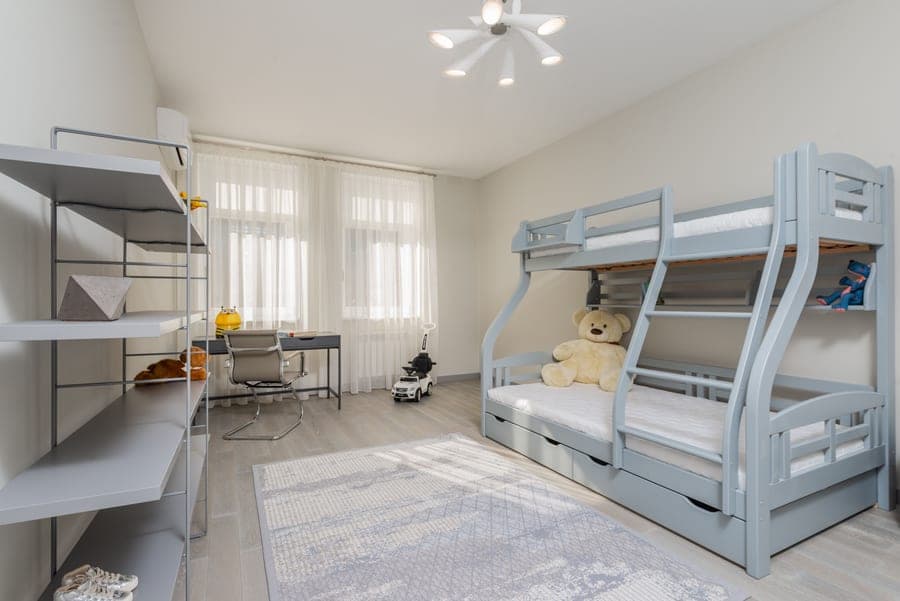
A bunk with a trundle sleeps three in a two-child footprint, keeps one sleeper at floor level, and leaves you with a single upper deck to check. The frames in our registry publish real numbers for it: the Max & Lily twin-over-twin trundle bunk states a 14-inch rail, 400 lb per sleeping surface, 8 inches of mattress ceiling on the bunks and a separate 5-inch limit on the trundle itself. The Harper & Bright twin-over-full trundle-and-stairs frame publishes a capacity for each of its three sleeping surfaces — 400 lb upper, 600 lb lower, 250 lb trundle — which is more deck-by-deck disclosure than we have seen on any triple.
The trade is real and worth stating: a trundle is a lower sleeping surface, it needs floor clearance to roll out, and the third mattress has a much lower thickness ceiling because it has to roll back under the bottom bunk. It is also the only three-sleeper configuration that disappears during the day. Our trundle roundup compares seven of them on published specs.
Key takeaways
- Measure floor to ceiling, subtract the bed's overall height, and check the top sleeper can sit up — about 30 in of clearance.
- A vertical triple has two upper decks. Both need compliant guardrails and both fall under the under-6 guidance.
- L-shaped triples trade the ceiling problem for a corner of floor. Nothing that sleeps three is small in both dimensions.
- Confirm the mattress size and thickness ceiling deck by deck, in writing, before you buy.
- A trundle bunk sleeps the same three people with one upper deck and no ceiling arithmetic.
What we'd buy
Every pick below carries the same spec block, so you can compare the numbers across this page and every other page on the site.
A shared room that hosts a third child most weekends
Max & Lily Twin Over Twin Bunk Bed With Trundle
Max & Lily
The only trundle bunk we found that publishes a rail height, a per-surface weight limit and a separate mattress ceiling for the trundle itself.
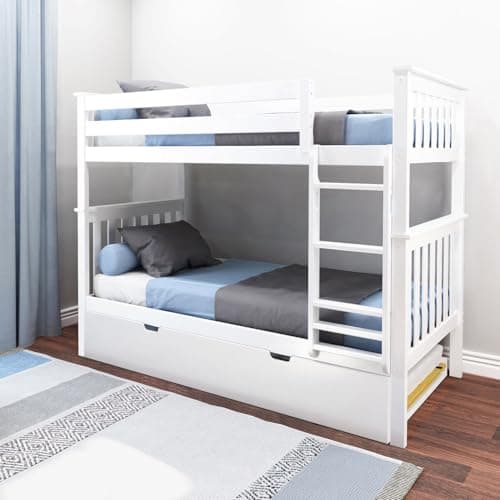
| Guardrail height above mattress | 14 in above the slats |
|---|---|
| Stated weight limit (per bunk) | 400 lb per sleeping surface |
| Manufacturer minimum age | Not published by the manufacturer |
| Mattress thickness ceiling | 8 in on both bunks (5 in recommended on top); 5 in on the trundle |
| Materials / construction | Solid knot-free pine, GREENGUARD Gold certified finish |
What works
- Publishes all three numbers that matter on a trundle bunk, including the trundle's own mattress limit
- 400 lb per sleeping surface is the highest stated capacity in this roundup
- Trundle can be assembled to pull out from either side of the bed
- Separates into two standalone twin beds, so the frame outlasts the sharing arrangement
What doesn’t
- The trundle takes a 5 in mattress, which is thinner than most people expect and narrows your options
- No minimum age published, so the AAP's under-6 top-bunk guidance is the only age rule you get
- The trundle on this model has no wheels, so it wants a hard floor or a low-pile rug
- Sits at the top of the price range for the category
The catch: That 8 in bunk ceiling and 5 in trundle ceiling are two different numbers, and buying one mattress for all three surfaces is the obvious mistake. A 5 in trundle mattress on the top bunk wastes rail margin you paid for; an 8 in mattress on the trundle stops it sliding under the bottom bunk at all.
Three children, or two plus whoever stays over
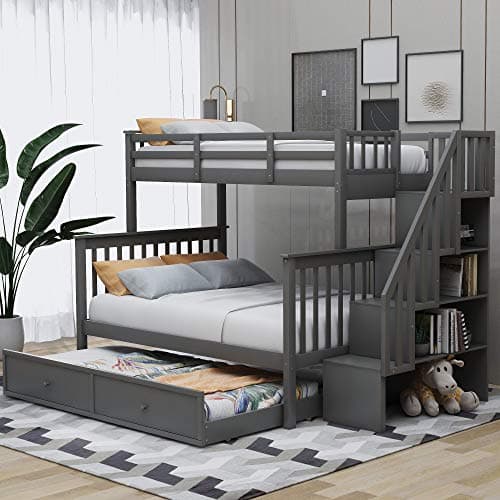
Harper & Bright Designs Twin Over Full Bunk Bed with Trundle and Storage Stairs
Harper & Bright Designs
Three published capacities on a three-mattress bed, and the highest stated bottom-bunk figure anywhere in this roundup.
| Guardrail height above mattress | Not published by the manufacturer |
|---|---|
| Stated weight limit (per bunk) | 400 lb upper, 600 lb lower, 250 lb trundle |
| Manufacturer minimum age | Not published by the manufacturer |
| Mattress thickness ceiling | Not published by the manufacturer |
| Materials / construction | Pine wood and MDF, wooden slats on all three sleeping levels |
What works
- Publishes a separate capacity for each of the three sleeping surfaces, which almost nobody does
- 600 lb stated for the full-size bottom bunk is the highest figure in this roundup
- Storage staircase instead of a ladder, at roughly a third of the price of the solid-pine equivalent
- Sleeps three without a third bed's footprint once the trundle is closed
What doesn’t
- No guardrail height and no mattress ceiling published, so the clearance arithmetic is yours to do with a tape measure
- 93.8 in long by 58 in wide, the largest footprint here
- MDF in the frame means it tolerates being taken apart and rebuilt poorly
- Arrives in three boxes that routinely turn up on different days
The catch: The trundle is the reason to buy this bed, and the trundle needs a mattress thin enough to roll under the bottom bunk, which the listing does not specify. Buy the trundle mattress last, after you have measured the actual clearance on the assembled frame, or you will own a drawer you cannot close.
A room that has to hold a guest, not just a friend
Max & Lily Twin Over Full Bunk Bed With Trundle
Max & Lily
Three beds, one of them full size, which makes this the only pick here an adult can sleep in without checking a sticker first.
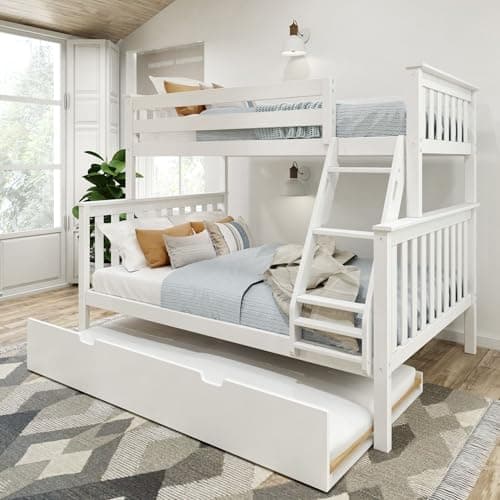
| Guardrail height above mattress | Approximately 14 in, per the manufacturer |
|---|---|
| Stated weight limit (per bunk) | 400 lb per sleeping surface |
| Manufacturer minimum age | Not published by the manufacturer |
| Mattress thickness ceiling | 8 in top and bottom, 5 in trundle (6 in maximum) |
| Materials / construction | Solid pine with plywood slats and a metal support bar, GREENGUARD Gold certified |
What works
- A full-size bottom bunk plus a twin trundle sleeps three without a sofa bed anywhere in the house
- 400 lb per surface means the full bunk is genuinely adult-rated
- The trundle on this model has wheels, which makes it far easier to pull out on carpet
- Separates into a twin and a full when the sharing ends
What doesn’t
- 57.75 in wide — about a foot wider than a twin-over-twin, and that foot is usually the walkway
- The guardrail figure is given as approximate rather than as a measured spec
- A full mattress, a twin mattress and a thin trundle mattress is three separate purchases
- Heavy enough that repositioning the assembled bed is a two-person job
The catch: The width is the real cost, not the price. A twin-over-full with the trundle open occupies roughly the floor area of two separate beds, which undoes the space argument that made you consider a bunk bed in the first place. Buy this one for sleeping capacity, not for floor space.
Questions parents actually ask
What ceiling height do you need for a triple bunk bed?
Enough that the top sleeper can sit up — work on roughly 30 inches of clearance above the top mattress as a minimum for a child. Subtract the bed’s published overall height from your floor-to-ceiling measurement to find out what you have, and check for a ceiling fan or flush light while you are up there.
What size mattress does a triple bunk bed take?
It varies by model — some take three twins at 38 by 75 inches, others pair a full at the base with twins above. We do not carry a triple in our registry and will not publish a figure we cannot source, so ask the manufacturer for the size and maximum thickness of each deck before buying.
Are triple bunk beds safe?
A compliant triple meets the same federal standard as any children’s bunk — but it has two upper decks, so every guardrail and mattress-clearance check happens twice, and the AAP’s under-6 top-bunk guidance applies to the middle deck as well as the top.
Is a triple bunk bed better than a bunk with a trundle?
Only if the ceiling allows it and all three children are over six. A trundle bunk sleeps three in the same footprint with one upper deck, no ceiling arithmetic and a third bed that rolls away during the day — which is why it is the configuration we point most families toward.
Do triple bunk beds need to be anchored to the wall?
Follow whatever the manufacturer specifies, and treat tall furniture as needing an anchor by default. A three-deck tower is tall and narrow — exactly the geometry anti-tip hardware exists for. See do bunk beds need to be anchored.
Sources
Read next
- Best bunk beds with trundles
The three-sleeper configuration that fits a normal ceiling.
- Loft bed ceiling height
The full arithmetic, with the sitting-clearance figures.
- Top bunk age readiness
Why two upper decks doubles the age problem.
- Bunk bed sizes and dimensions
Mattress sizes and footprints for every configuration.
Back to Bunk Beds.