Bunk Beds
Bunk bed sizes and dimensions
Every measurement you need before you order: mattress sizes, frame footprints, the clearance the top sleeper needs, and the thickness the guardrail allows.

We earn a commission from qualifying purchases made through links on this page, at no extra cost to you. How this site is funded.
The short answer
Most bunk beds take a standard twin mattress, 38 by 75 inches, on both decks. Twin-over-full configurations take a full (54 by 75 in) on the bottom. Thickness is capped by the guardrail rather than by the frame — usually six to eight inches on the top deck.
Mattress sizes
| Size | Dimensions | Where it appears |
|---|---|---|
| Crib / toddler | 52 x 28 in | Toddler beds, not bunks |
| Twin | 38 x 75 in | The default on both bunk decks |
| Twin XL | 38 x 80 in | Occasional on teen and adult bunks |
| Full (double) | 54 x 75 in | The bottom of a twin-over-full |
The length catch: some frames specify 74 to 75 inches. A 75-inch mattress in a frame built for 74 does not sit flat and can bow. Check the frame’s stated internal dimension rather than assuming “twin” is one number.
Frame footprints
| Configuration | Footprint | Height |
|---|---|---|
| Twin over twin, low | ~42 x 80 in | ~38-45 in |
| Twin over twin, standard | ~42 x 80 in | ~55-65 in |
| Twin over twin + ladder overhang | ~54 x 80 in | As above |
| Twin over twin with stairs | ~42 x 95 in | As above |
| Twin over full | ~55 x 80 in | ~55-65 in |
Note the ladder row. A reversible ladder often projects beyond the frame, so the bed’s advertised width and the space it actually needs are two different numbers. Max & Lily, for example, publish both an overall footprint including the ladder and a bed-only measurement, which is genuinely useful and unusual.
Ceiling clearance for the top sleeper
Take your ceiling height. Subtract the top deck height. Subtract the mattress thickness. What remains is sitting room, and you want somewhere between thirty and thirty-three inches for a child to sit up comfortably.
| Deck height | Mattress | Clearance above the mattress |
|---|---|---|
| 40 in (low bunk) | 6 in | 50 in — very comfortable |
| 55 in (standard) | 6 in | 35 in — comfortable |
| 60 in (standard, tall) | 6 in | 30 in — workable |
| 65 in (tall) | 8 in | 23 in — cramped; child ducks |
A ceiling fan changes this calculation entirely, and not in your favor. Do not put a bunk bed under one.
Mattress thickness
The most-missed dimension in the whole category, and the one with a safety consequence. Maximum thickness on the top deck is the guardrail height above the deck minus five inches, or whatever lower ceiling the manufacturer publishes. The full arithmetic is on mattress thickness and guardrails, and it is worth reading before you order either the bed or the mattress.
The bottom bunk is not limited by a guardrail rule, so its thickness is limited only by headroom under the top deck.
Bedding sizes that follow from all this
A thin bunk mattress needs a fitted sheet cut for a thin mattress. A deep-pocket twin sheet designed for a twelve-inch mattress on a six-inch bunk mattress gathers into folds under the sleeper and works loose. Our kids bedding sizes guide has the pocket depths, and bedding for a top bunk covers the comforter problem, which is separate and worse.
Key takeaways
- Twin is 38 x 75 in; check whether your frame wants 74 or 75 inches of length.
- Advertised frame width often excludes the ladder overhang.
- Stairs add roughly 15-18 inches to the bed's length.
- Aim for 30-33 inches of sitting room above the top mattress.
- Top-deck mattress thickness is capped by the guardrail, not by the frame.
What we'd buy
Every pick below carries the same spec block, so you can compare the numbers across this page and every other page on the site.
Younger siblings sharing a room
Max & Lily Twin Over Twin Low Bunk Bed
Max & Lily
The clearest published safety numbers of any bunk we looked at, on a frame low enough that a fall is a short one.
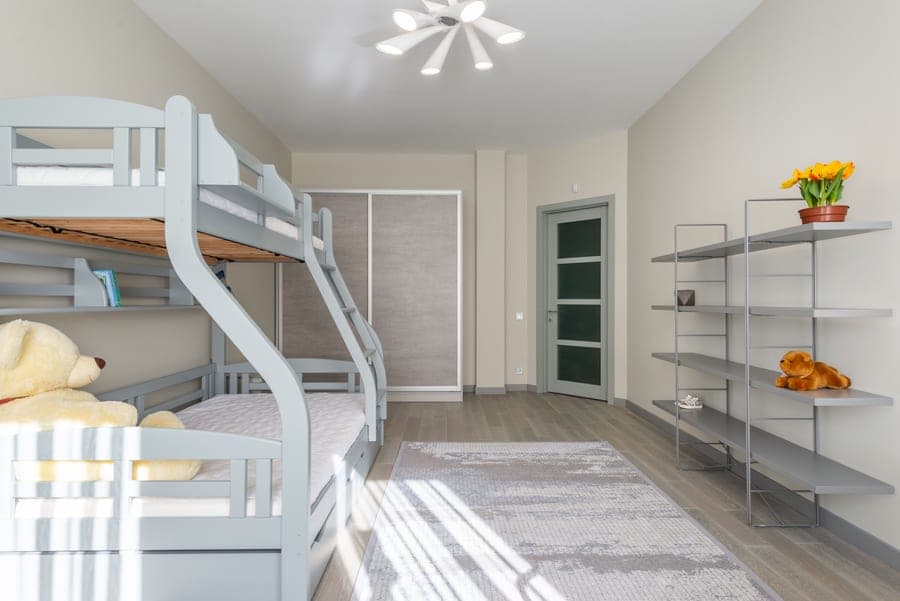
| Guardrail height above mattress | 14 in above the deck |
|---|---|
| Stated weight limit (per bunk) | 400 lb per sleeping surface |
| Manufacturer minimum age | Not published by the manufacturer |
| Mattress thickness ceiling | 8 in maximum (5 in recommended) |
| Materials / construction | Solid New Zealand pine, GREENGUARD Gold certified finish |
What works
- Publishes a guardrail height, a weight limit and a mattress ceiling — most brands publish one of the three
- 400 lb per surface is the highest stated capacity in this roundup, and it holds through the teen years
- Low overall height means the top deck sits well under a standard bunk
- Reversible, removable ladder with grooved treads and rounded edges
What doesn’t
- The 8 in mattress ceiling rules out most plush mattresses
- Solid pine is heavy to move once assembled
- No minimum age published, so the AAP's under-6 guidance is the only age rule you get
The catch: That 8 in ceiling is not a suggestion. Put a 10 in mattress on the top deck and the 14 in rail drops to 4 in of clearance, which is below the federal 5 in minimum. The bed stops being compliant and nobody tells you.
A younger and an older sibling, or a room that hosts guests
Max & Lily Twin Over Full Bunk Bed
Max & Lily
A full-size bottom bunk that an adult can actually sleep in, which quietly makes this a ten-year bed rather than a five-year one.
| Guardrail height above mattress | Not published by the manufacturer |
|---|---|
| Stated weight limit (per bunk) | 400 lb per sleeping surface |
| Manufacturer minimum age | Not published by the manufacturer |
| Mattress thickness ceiling | Not published by the manufacturer |
| Materials / construction | Solid New Zealand pine, GREENGUARD Gold certified finish |
What works
- Full-size bottom bunk fits a parent reading at bedtime or a guest overnight
- 400 lb per surface means the bottom bunk is genuinely adult-rated
- Solid pine construction with metal-on-metal bolt connections
- Two different mattress sizes gives the siblings a real distinction
What doesn’t
- Wider footprint than twin-over-twin; measure the room before ordering
- You buy two mattress sizes, which costs more than two twins
- Guardrail height and mattress ceiling are not published
The catch: The full bottom bunk is the selling point and the cost. It adds roughly a foot of width over twin-over-twin, and in the small room most people are buying a bunk for, a foot is the difference between a walkway and a squeeze.
Hot sleepers and top bunks
Mellanni 100% Cotton Percale Sheet Set
Mellanni
Percale cotton, 300 thread count, deep pockets — the sheet to buy if your child sleeps hot.
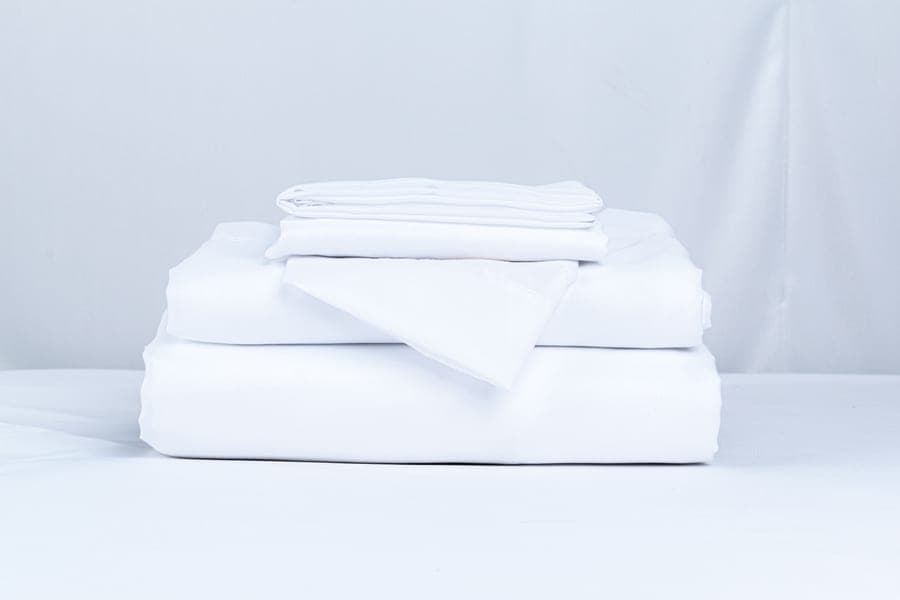
| Guardrail height above mattress | Not applicable |
|---|---|
| Stated weight limit (per bunk) | Not applicable |
| Manufacturer minimum age | Not published by the manufacturer |
| Mattress thickness ceiling | Deep pocket; confirm against your mattress depth |
| Materials / construction | 100% cotton, 300 thread count percale weave |
What works
- Percale weave breathes far better than microfiber
- Real cotton rather than a polyester blend
- Deep pockets stay on through a restless night
- Gets softer with washing instead of pilling
What doesn’t
- Percale wrinkles; it comes out of the dryer looking lived-in
- Crisper than microfiber, which some children dislike at first
- Costs more than a microfiber set
The catch: Deep pockets are a problem on a bunk, not a feature. Bunk mattresses are thin, so a deep-pocket fitted sheet has a lot of slack to gather — check the pocket depth against your actual mattress before ordering.
Questions parents actually ask
What size mattress goes on a bunk bed?
A standard twin, 38 by 75 inches, on most models. Twin-over-full configurations take a full, 54 by 75 inches, on the bottom.
How tall is a standard bunk bed?
Usually 55 to 65 inches overall. Low bunks run roughly 38 to 45 inches.
How much space do you need above a top bunk?
Thirty to thirty-three inches above the mattress lets a child sit up comfortably. Less than that and they will duck.
Will a twin XL mattress fit a bunk bed?
Only if the frame is built for one. A twin XL is five inches longer than a twin and will not fit a standard twin bunk frame.
How wide is a twin over full bunk bed?
Roughly 55 inches, against about 42 for a twin-over-twin. That difference is frequently the room’s walkway.
Do bunk bed frames fit standard sheets?
The length and width, yes. The pocket depth is the problem — bunk mattresses are thin, so a deep-pocket sheet gathers.
Sources
Read next
- Mattress thickness and guardrails
The dimension with a safety consequence.
- Kids bedding sizes guide
Sheet sizes and pocket depths to match these mattresses.
- Best bunk beds for small rooms
What these footprints mean in a real bedroom.
Back to Bunk Beds.