Bunk Beds
Do bunk beds need a bunkie board?
Usually not — and on a bunk, adding one can quietly break the guardrail clearance. The answer is decided by your frame's slat spacing and your mattress type, both of which you can check today.
We earn a commission from qualifying purchases made through links on this page, at no extra cost to you. How this site is funded.
The short answer
Most bunk beds do not need a bunkie board. A bunkie board is a thin, rigid foundation — usually one to three inches — that sits between the mattress and the slats, and it only earns its place when the slats are spaced too far apart to support the mattress you are using. On a bunk there is an extra catch: anything you add under the mattress raises the sleeping surface and eats into the five inches of guardrail clearance the federal standard requires above it.
What a bunkie board actually is
A bunkie board is a flat panel — plywood, particle board or a slatted frame wrapped in fabric — designed to replace a box spring where there is no room for one. It is not a mattress support upgrade in the way the marketing suggests. It is a spacer that turns a slatted platform into a continuous surface. On a regular bed that is sometimes exactly what you want. On a bunk bed, where vertical space is the scarce resource, it is a change you should make deliberately.
A box spring is a different object and does not belong on a bunk at all. It is several inches thick with springs inside, and on an upper deck it raises the sleeper high enough to defeat any guardrail. If someone has told you a bunk needs a box spring, they are describing a different kind of bed.
What to look for: the slat spacing number
This is the whole decision, and it is a number some manufacturers publish. The Harper & Bright twin-over-full stairs-and-drawers frame publishes 7.6 inches of slat spacing, which is unusual and genuinely useful. Most listings say nothing, in which case you measure it yourself: center of one slat to center of the next, on the deck the mattress will sit on.
The rough rule used across the mattress industry is that an innerspring mattress tolerates wider spacing than foam, because the spring unit is its own structure. All-foam and memory-foam mattresses sag into gaps, and the sag shows up as a dip under the hips within a year. If the spacing is around three inches or less, a foam mattress is fine as-is. Between about three and five inches, a foam mattress will be noticeably better on a solid surface. Above that, you either add a board or buy an innerspring.
| What you measure | Innerspring mattress | All-foam mattress |
|---|---|---|
| Slat spacing under 3 in | No board needed | No board needed |
| Spacing 3-5 in | No board needed | A board will help |
| Spacing over 5 in | Consider a board | Add a board or change mattress |
| Metal slat deck | No board needed | Usually fine — check for flex by hand |
| Solid plywood deck | Never needed | Never needed |
On a bunk, every inch you add comes off the rail
The guardrail rule is measured from the top of the mattress: rail tops must sit no less than five inches above the sleeping surface. Add a two-inch bunkie board under an eight-inch mattress and you have a ten-inch stack. On a bed with a 14-inch rail that still passes with room to spare. On a metal frame with a 12.5-inch rail and a published six-inch mattress specification, it does not. Measure the rail before and after, not just before — see mattress thickness and guardrails.
The frames that make the question go away
Several bunks are built so a board is never a consideration, and that is worth knowing before you buy rather than after. The Max & Lily frames use plywood slats with a metal center support bar, which is a continuous-enough surface for any mattress type and is part of why the brand can publish a 400 lb per-surface figure. The DHP metal frames use metal slats explicitly specified to support the mattress without a box spring. In both cases the published mattress ceiling already assumes nothing underneath, which is the detail that gets missed.
If you are at the shopping stage rather than the troubleshooting stage, treat “no box spring required” and a published mattress ceiling as the pair of claims to look for. A frame that publishes neither is a frame where the foundation question is yours to work out with a tape measure.

What a bunkie board does not fix
It does not fix a wobble. Lateral movement in a bunk comes from the bolted joints at the corners, and the fix is re-tightening every fastener on a schedule — our assembly and stability guide walks through it. A rigid panel under the mattress changes nothing about the frame geometry.
It does not raise a stated weight limit either. The limit is a property of the frame, the joints and the slats, and the published figures in our registry range from 200 lb to 600 lb per surface depending on the bed. Spreading the load over a board may make the mattress feel better; it does not re-rate the bed. And it does not make a non-compliant bunk compliant: if the rail is too short for the mattress, the answer is a thinner mattress, not more stuff under it.
Key takeaways
- Slat spacing and mattress type decide it. Measure center-to-center on the deck the mattress sits on.
- Foam mattresses need closer support than innersprings. Over about 5 in of spacing, foam will sag.
- A board adds height, and every inch of height comes off your guardrail clearance.
- A box spring has no place on a bunk bed at all.
- A board does not fix wobble, does not raise a weight limit and does not make a short rail compliant.
What we'd buy
Every pick below carries the same spec block, so you can compare the numbers across this page and every other page on the site.
Younger siblings sharing a room
Max & Lily Twin Over Twin Low Bunk Bed
Max & Lily
The clearest published safety numbers of any bunk we looked at, on a frame low enough that a fall is a short one.
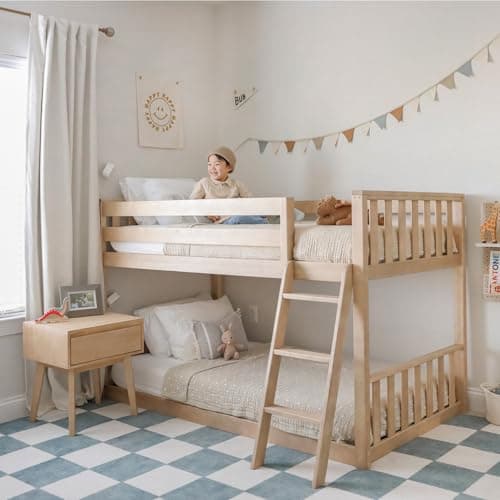
| Guardrail height above mattress | 14 in above the deck |
|---|---|
| Stated weight limit (per bunk) | 400 lb per sleeping surface |
| Manufacturer minimum age | Not published by the manufacturer |
| Mattress thickness ceiling | 8 in maximum (5 in recommended) |
| Materials / construction | Solid New Zealand pine, GREENGUARD Gold certified finish |
What works
- Publishes a guardrail height, a weight limit and a mattress ceiling — most brands publish one of the three
- 400 lb per surface is the highest stated capacity in this roundup, and it holds through the teen years
- Low overall height means the top deck sits well under a standard bunk
- Reversible, removable ladder with grooved treads and rounded edges
What doesn’t
- The 8 in mattress ceiling rules out most plush mattresses
- Solid pine is heavy to move once assembled
- No minimum age published, so the AAP's under-6 guidance is the only age rule you get
The catch: That 8 in ceiling is not a suggestion. Put a 10 in mattress on the top deck and the 14 in rail drops to 4 in of clearance, which is below the federal 5 in minimum. The bed stops being compliant and nobody tells you.
A shared room that has to hold everything as well as everyone
Harper & Bright Designs Twin Over Full Bunk Bed with Storage Stairs and Drawers
Harper & Bright Designs
Stairs, four stair compartments and three under-bed drawers at a price the solid-pine staircase bunks cannot touch, with the lowest published capacities here.
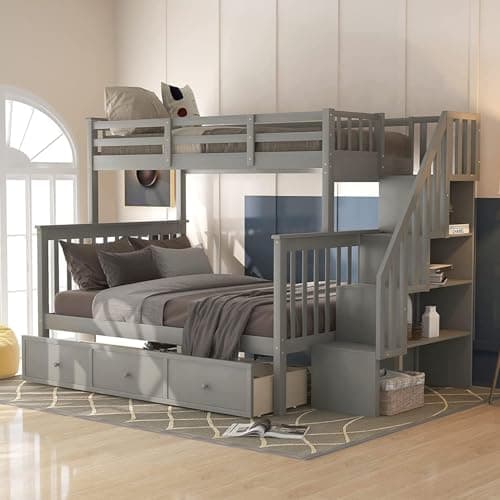
| Guardrail height above mattress | Not published by the manufacturer |
|---|---|
| Stated weight limit (per bunk) | 200 lb upper, 250 lb lower |
| Manufacturer minimum age | Not published by the manufacturer |
| Mattress thickness ceiling | Not published by the manufacturer |
| Materials / construction | Solid pine and MDF with iron alloy bolts, 7.6 in slat spacing |
What works
- Four compartments under the staircase plus three drawers under the bed, all published
- Splits into two separate beds, which is the exit route when the children stop sharing
- 34.84 in of published clearance between the bunks tells you whether an adult fits below
- Slat spacing of 7.6 in is published, which is unusual and useful if you are buying a foam mattress
What doesn’t
- 200 lb on the top bunk is the lowest stated capacity in this roundup and will not see a teenager out
- No guardrail height published despite a full-length rail being the headline safety claim
- MDF content makes repeated disassembly a bad idea
- 91.73 in long by 54.33 in wide, so the staircase is not free
The catch: The 200 lb top-bunk figure is the thing to read twice. A twin-over-full is usually bought so the older child gets the bigger bed below, but families often swap the children around, and 200 lb is a number a growing teenager plus a mattress can get close to. Decide who sleeps where before you buy, not after.
Small rooms on a budget
DHP Miles Low Metal Bunk Bed, Twin Over Twin
DHP
Publishes its guardrail height and both weight limits, which is more than most metal frames manage, and the bottom bunk sits on the floor.
| Guardrail height above mattress | 12.5 in above the deck |
|---|---|
| Stated weight limit (per bunk) | 200 lb top bunk / 250 lb bottom bunk |
| Manufacturer minimum age | Not published by the manufacturer |
| Mattress thickness ceiling | 6 in (the frame is specified for 6 in mattresses) |
| Materials / construction | Powder-coated metal frame with metal slats, no box spring required |
What works
- Publishes a guardrail height and separate top and bottom weight limits
- Metal slats support the mattress without a box spring
- Low profile with the bottom bunk close to the floor
- One of the least expensive bunks that still publishes real numbers
What doesn’t
- 200 lb top-bunk limit is half what the solid-wood options state
- Metal frames are more prone to creaking than pine as fasteners loosen
- The 6 in mattress specification is tight for an older child
The catch: The 200 lb top-bunk limit is the one to watch. It is fine for a child and it is not fine for a parent who climbs up to read at bedtime, which is a thing parents do without thinking about the sticker.
Questions parents actually ask
Can you use a bunkie board on a top bunk?
Only if the rail clearance survives it. Add the board thickness to the mattress thickness and confirm at least five inches of guardrail remains above the sleeping surface. On frames publishing a six-inch mattress specification, a board almost always breaks that.
What is the difference between a bunkie board and a box spring?
A bunkie board is a thin rigid panel, typically one to three inches. A box spring is a sprung frame several inches thick. A box spring should never go on a bunk — the height alone defeats the guardrail.
Do you need a bunkie board with a foam mattress?
It depends on the gaps. Under about three inches of slat spacing, no. Between three and five, a board noticeably improves support and lifespan. Over five, a foam mattress will dip and you need either a board or an innerspring instead.
Will a bunkie board stop my bunk bed squeaking?
No. Squeaking and wobble come from the bolted frame joints settling, not from the mattress foundation. Re-tighten every fastener after the first fortnight and then every few months.
How do I know my bunk bed's slat spacing?
Measure it — center of one slat to the center of the next. A few manufacturers publish it; the Harper & Bright twin-over-full stairs-and-drawers model states 7.6 inches. Most do not, and a measurement takes thirty seconds.
Sources
Read next
- Mattress thickness and guardrails
The five-inch rule, and what adding height underneath does to it.
- Bunk bed sizes and dimensions
Mattress sizes, frame footprints and the length catch.
- Bunk bed assembly and stability
What actually fixes a wobble, since a board does not.
- Best bunk beds with drawers
Where the only published slat-spacing figure in our registry lives.
Back to Bunk Beds.