Bunk Beds
Twin over twin vs twin over full bunk beds
One is about a foot narrower. The other sleeps an adult. The decision comes down to how much floor you have and how long you need the bed to last.

We earn a commission from qualifying purchases made through links on this page, at no extra cost to you. How this site is funded.
How we chose
We are a small publisher, not a testing lab. We don’t buy, assemble or sleep in the beds we write about, and we won’t pretend otherwise. What we do instead is read the published specifications and check them against the rules that actually govern children’s beds in the United States: the federal standard for children’s bunk beds (16 CFR Part 1513), the ASTM F1427 requirements it incorporates, and the American Academy of Pediatrics’ guidance on upper-bunk age. Where a manufacturer publishes no number, we write “not published by the manufacturer” rather than guess — that absence is itself worth knowing. We read owner feedback at volume for the things specs can’t tell you, and we label it as signal, not proof.
We earn a commission when you buy through our links. It never changes an ordering. Our full editorial policy.
Decide for me
Buy twin over twin if the room is tight, both children are under about ten, and you want the smallest footprint that sleeps two. Roughly 42 by 80 inches of floor, two identical mattresses, and the cheaper bed.
Buy twin over full if there is a real age gap, if you want an adult to be able to sleep in the room, or if you would rather buy one bed than two. You pay about a foot more width, two different mattress sizes, and a higher price — and you get a bed that is still useful when the younger child is sixteen.
The two configurations are mechanically the same bed. Same standard, same guardrail rule, same climb. On the Max & Lily frames that publish a figure, both state 400 lb per sleeping surface, so capacity is not the variable. What changes is the bottom mattress: a twin is 38 by 75 inches, a full is 54 by 75. Everything that follows comes from those sixteen inches of width.
The footprint difference, in numbers
A twin-over-twin bunk occupies roughly 42 by 80 inches of floor, and a twin-over-full roughly 55 by 80 — a little over a foot of extra width on the same length. In a 10-by-10 bedroom that is the difference between a walkway down one side and a bed you edge past. If the bunk also has a ladder that overhangs the end, add that; if it has a staircase, add about fifteen inches of length as well.
| Twin over twin | Twin over full | |
|---|---|---|
| Bottom mattress | 38 x 75 in twin | 54 x 75 in full |
| Typical floor footprint | ~42 x 80 in | ~55 x 80 in |
| Stated capacity (Max & Lily) | 400 lb per surface | 400 lb per surface |
| Mattresses to buy | Two twins — interchangeable | One twin and one full |
| Adult can sleep on the bottom | Not comfortably | Yes, on a 400 lb-rated frame |
| Useful lifespan | Until the older child outgrows a twin | Into the teen years and as a guest bed |
The case for twin over twin
Interchangeable mattresses are underrated. With two twins you can swap decks when one child wants the top, move a mattress to a trundle or a floor bed, and replace one without matching the other. You also buy the cheaper mattress twice rather than a full once, and full-size bedding costs more than twin bedding every time you buy sheets for the next ten years.
It is also the configuration where the low-frame option exists. The low twin-over-twin bunks in our registry — the Max & Lily low bunk publishes a 14-inch rail, a 400 lb per-surface limit and an 8-inch mattress ceiling — put the top deck far closer to the floor than any twin-over-full. For a family with a child near the lower end of the age guidance, that is the strongest argument on this page. See best low bunk beds.
The case for twin over full
A full-size bottom bunk quietly turns a five-year bed into a ten-year one. The child on the bottom does not outgrow it; a parent can lie down to read; a guest can stay without a sofa bed appearing in the living room. On the Max & Lily twin-over-full the 400 lb per-surface rating means the bottom bunk is genuinely adult-rated rather than adult-shaped, which is a distinction worth checking on any frame you are considering.
The configuration also handles an age gap honestly. Two children four or five years apart do not want the same bed, and giving the older one the full-size bottom while the younger takes the twin above resolves the argument with furniture rather than negotiation. Our twin-over-full roundup has eight of them compared on published specs.
Check the headroom, not just the footprint
A full-size bottom bunk invites adults to sit on it, which makes the clearance between the decks a practical number rather than a specification. Max & Lily publish 36 inches between the bottom and top slats on their twin-over-full staircase model; Harper & Bright publish 34.84 inches on theirs. Under about 34 inches, an adult reading a bedtime story is ducking the whole time.
What does not change
Neither configuration changes the safety arithmetic, and it is worth saying plainly because the twin-over-full is often sold as the “grown-up” option. The federal standard for children’s bunk beds requires at least two upper-bunk guardrails with one on each side, the wall-side rail running continuously, and rail tops no less than five inches above the top of the mattress. The AAP’s guidance that children younger than six should not sleep on the top bunk applies identically to both. A full mattress on the bottom does not make the top deck safer for a four-year-old.
Mattress thickness is the one spec that bites harder on a twin-over-full, for an unexpected reason: full mattresses are more often sold in plush 10- and 12-inch builds, and if the bottom deck is the one you buy a thick mattress for you also lose headroom under the top bunk. The top deck still needs to respect its own published ceiling, which on the Max & Lily frames is 8 inches maximum with 5 inches recommended.
The budget version of the same decision
If the decision is really about money, the metal frames shift it. The DHP Miles twin-over-full is a full-size bottom bunk at a metal-frame price with a built-in ladder that cannot be knocked out of position — and DHP publish nothing for that configuration: no rail height, no weight limit, no mattress ceiling, despite publishing all three on their low twin-over-twin. That is a real trade, not a bargain. Buy it knowing the measuring is yours to do.
Key takeaways
- Same bed, different bottom mattress: 38 x 75 in twin against 54 x 75 in full.
- Twin over full costs about a foot of extra width on the same length.
- Two twins are interchangeable and the bedding is cheaper for a decade.
- A 400 lb-rated full bottom bunk is the thing that makes the bed last into the teens.
- Neither configuration changes the guardrail rule or the AAP's under-6 top-bunk guidance.
What we'd buy
Every pick below carries the same spec block, so you can compare the numbers across this page and every other page on the site.
Rooms where the space under the bottom bunk has a job
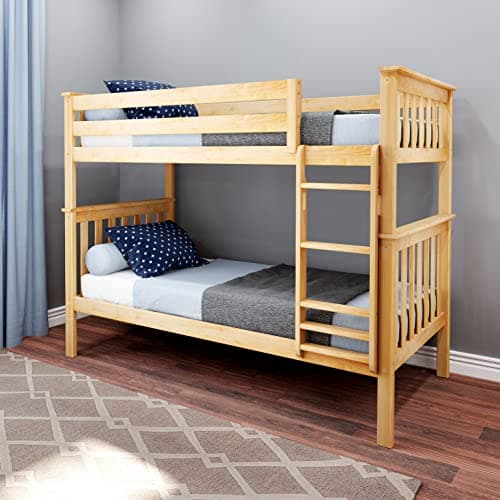
Max & Lily Twin Over Twin Bunk Bed
Max & Lily
Full-height version of the low bunk, same 400 lb frame, and the extra clearance underneath is the whole reason to buy it.
| Guardrail height above mattress | Not published by the manufacturer |
|---|---|
| Stated weight limit (per bunk) | 400 lb per sleeping surface |
| Manufacturer minimum age | Not published by the manufacturer |
| Mattress thickness ceiling | Not published by the manufacturer |
| Materials / construction | Solid New Zealand pine, GREENGUARD Gold certified finish |
What works
- Same 400 lb per-surface capacity as the low bunk
- Full standing clearance under the bottom bunk for storage or play
- Knot-free solid pine rather than particleboard
- Reversible ladder works on either side of the room
What doesn’t
- Guardrail height is not published for this model, so you have to measure it yourself on arrival
- A full-height top deck is a longer fall than the low bunk version
- Heavier and more awkward to assemble than the low bunk
The catch: Max & Lily publish a clear guardrail number on their low bunks and not on this one. That is not a reason to avoid the bed, but it does mean the 5 in clearance check is yours to run with a tape measure rather than theirs to guarantee on the listing.
A younger and an older sibling, or a room that hosts guests
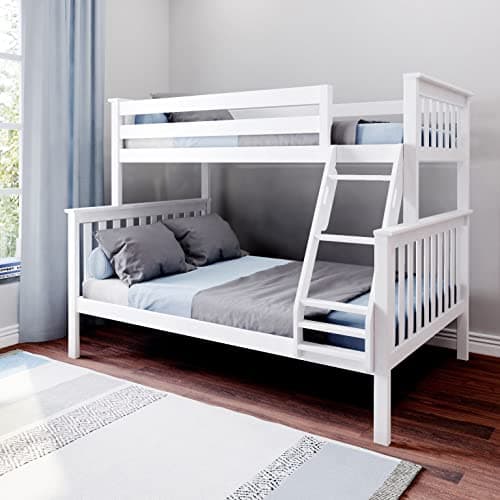
Max & Lily Twin Over Full Bunk Bed
Max & Lily
A full-size bottom bunk that an adult can actually sleep in, which quietly makes this a ten-year bed rather than a five-year one.
| Guardrail height above mattress | Not published by the manufacturer |
|---|---|
| Stated weight limit (per bunk) | 400 lb per sleeping surface |
| Manufacturer minimum age | Not published by the manufacturer |
| Mattress thickness ceiling | Not published by the manufacturer |
| Materials / construction | Solid New Zealand pine, GREENGUARD Gold certified finish |
What works
- Full-size bottom bunk fits a parent reading at bedtime or a guest overnight
- 400 lb per surface means the bottom bunk is genuinely adult-rated
- Solid pine construction with metal-on-metal bolt connections
- Two different mattress sizes gives the siblings a real distinction
What doesn’t
- Wider footprint than twin-over-twin; measure the room before ordering
- You buy two mattress sizes, which costs more than two twins
- Guardrail height and mattress ceiling are not published
The catch: The full bottom bunk is the selling point and the cost. It adds roughly a foot of width over twin-over-twin, and in the small room most people are buying a bunk for, a foot is the difference between a walkway and a squeeze.
Younger siblings sharing a room
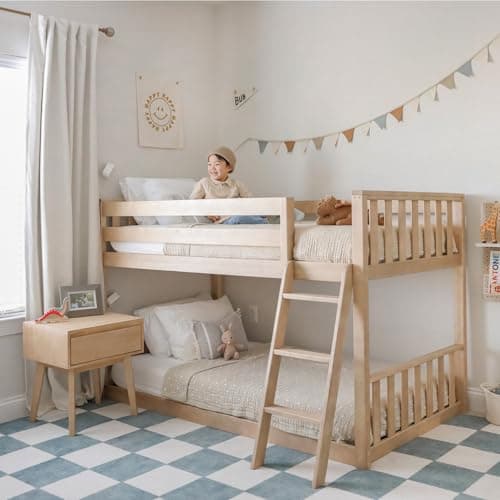
Max & Lily Twin Over Twin Low Bunk Bed
Max & Lily
The clearest published safety numbers of any bunk we looked at, on a frame low enough that a fall is a short one.
| Guardrail height above mattress | 14 in above the deck |
|---|---|
| Stated weight limit (per bunk) | 400 lb per sleeping surface |
| Manufacturer minimum age | Not published by the manufacturer |
| Mattress thickness ceiling | 8 in maximum (5 in recommended) |
| Materials / construction | Solid New Zealand pine, GREENGUARD Gold certified finish |
What works
- Publishes a guardrail height, a weight limit and a mattress ceiling — most brands publish one of the three
- 400 lb per surface is the highest stated capacity in this roundup, and it holds through the teen years
- Low overall height means the top deck sits well under a standard bunk
- Reversible, removable ladder with grooved treads and rounded edges
What doesn’t
- The 8 in mattress ceiling rules out most plush mattresses
- Solid pine is heavy to move once assembled
- No minimum age published, so the AAP's under-6 guidance is the only age rule you get
The catch: That 8 in ceiling is not a suggestion. Put a 10 in mattress on the top deck and the 14 in rail drops to 4 in of clearance, which is below the federal 5 in minimum. The bed stops being compliant and nobody tells you.
A growing age gap on a tight budget
DHP Miles Metal Bunk Bed, Twin Over Full
DHP
The twin-over-full metal frame with a built-in ladder, for when the bottom sleeper has outgrown a twin but the budget has not moved.
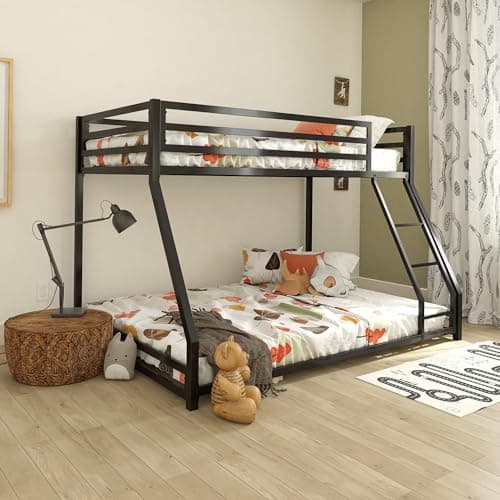
| Guardrail height above mattress | Not published by the manufacturer |
|---|---|
| Stated weight limit (per bunk) | Not published by the manufacturer |
| Manufacturer minimum age | Not published by the manufacturer |
| Mattress thickness ceiling | Not published by the manufacturer |
| Materials / construction | Powder-coated metal frame with metal slats, built-in ladder |
What works
- Full-size lower bunk at a metal-frame price
- Built-in ladder cannot be knocked out of position
- Metal slats mean no box spring on either level
- Compact footprint for the sleeping capacity
What doesn’t
- DHP publishes far less for this model than for the Miles low bunk
- Metal frames develop movement as bolts settle; expect to re-tighten
- No published mattress ceiling, so the clearance check is entirely yours
The catch: We could not find published guardrail, weight or mattress figures for this configuration, and the sister model publishes all three. Buy it knowing you will be measuring the rail yourself before anyone sleeps on the top.
Questions parents actually ask
Is a twin over full bunk bed worth the extra money?
If an adult will ever sleep in the room, or the children are several years apart, yes — it is the difference between a bed you replace in five years and one that works into the teens. If the room is small and both children are young, the extra foot of width usually costs more than the full mattress is worth.
How much bigger is a twin over full bunk bed?
About sixteen inches wider at the mattress (54 in against 38 in), and roughly 55 by 80 inches of floor against 42 by 80 for a twin-over-twin. Length is essentially the same unless the bed has a staircase.
Can an adult sleep on the bottom bunk of a twin over full?
On a frame that publishes an adult-capable limit, yes. The Max & Lily twin-over-full states 400 lb per sleeping surface. Where the limit is unpublished — which is the case on several budget frames — treat it as unknown rather than generous, and read bunk bed weight limits first.
Do twin over full bunk beds need special mattresses?
No special type, but two different sizes and the same thickness discipline as any bunk: the top mattress must leave at least five inches of guardrail standing above it. Max & Lily publish 8 inches maximum with 5 recommended on their frames. Full mattresses are more often sold plush, so check the number before you buy the comfortable one.
Which is safer, twin over twin or twin over full?
Neither, as configurations. Both must meet the same federal standard and the same five-inch rail clearance. What does change safety is deck height — and the only low-frame bunks in our registry are twin-over-twin, which makes a low twin-over-twin the safest bunk on this page for a younger child.
Sources
Read next
- Best twin over full bunk beds
Eight of them, compared on what each one publishes.
- Bunk bed sizes and dimensions
Every mattress size and footprint in one table.
- Best low bunk beds
The configuration that actually changes the fall distance.
- Best bunk beds for small rooms
When the extra foot of width is the deciding factor.
Back to Bunk Beds.