Sleep Safety
Buying a secondhand bunk bed
A used bunk can be a genuinely good buy — or a bed built before the current standard, missing a rail, and reassembled with the wrong bolts. These are the checks that tell you which one you are looking at.
We earn a commission from qualifying purchases made through links on this page, at no extra cost to you. How this site is funded.
The short answer
Before you buy a used bunk, do four things: search the CPSC recalls database for the brand and model, confirm every piece of original hardware is present along with the assembly instructions, measure the guardrail height above the mattress you intend to use, and check both upper-bunk rails exist — one on each side, with the wall-side rail running continuously end to end. A bed that fails any of those is not a bargain.
Why used bunks are a different purchase
Every bed we cover on this site is assessed on what the manufacturer publishes: guardrail height above the deck, stated weight limit per sleeping surface, minimum age, mattress-thickness ceiling. A secondhand bed usually arrives with none of that. There is no listing, often no brand name, and the person selling it has no obligation to know. You are buying an object rather than a specification, which means the measurements become yours to take.
The federal standard for children’s bunk beds has been in force long enough that most beds in circulation were built under it, but “most” is doing real work in that sentence. An older bed, an imported bed or a bed built by hand may never have been subject to it. That is not a reason to avoid the used market — it is a reason to treat the checks as mandatory rather than optional.
What to look for: the five-minute inspection
The recall check comes first, before you travel. Search the CPSC recalls database for the brand and, if you can get it, the model name. Bunk beds are recalled for real reasons — entrapment gaps, rail failures, ladder detachment — and a recalled frame in a stranger’s spare room has by definition not had the remedy applied.
Then the hardware. Ask for the original bolts, barrel nuts, rail brackets and ladder fixings, and for the assembly instructions. Substituted hardware is the single most common defect in a used bunk: a bolt of the right diameter and the wrong length does not hold a joint the way the engineer intended, and the stated weight limit stops meaning anything. If the hardware is missing, price in sourcing it from the manufacturer, and if the manufacturer no longer exists, walk away.
Then the rails. Count them. The standard requires at least two upper-bunk guardrails with at least one on each side, and the rail on the wall side must run continuously from one end of the bed to the other. A bed with a single rail and a long gap is not a bed with a missing accessory; it is a bed outside the standard until the rail is replaced with the correct part for that frame.
| Check | Pass looks like | If it fails |
|---|---|---|
| CPSC recall search | No recall for the brand or model | Walk away — the remedy has not been applied |
| Original hardware and instructions | All bolts, brackets and the manual present | Price in manufacturer parts, or walk away |
| Guardrail count and continuity | Two rails, one per side, wall side continuous | Correct replacement rail for that frame only |
| Rail height above your mattress | At least 5 in of rail above the sleeping surface | A thinner mattress, or a different bed |
| Frame and joint condition | No cracks, no stripped bolt holes, no flex | Structural — do not buy it |
| Ladder or stairs | Fixed securely, treads intact, no play | Replacement part from the maker |
Stripped bolt holes are the end of the conversation
A bunk bed is only as strong as the joints where the rails meet the posts. Wood that has been bolted, unbolted and rebolted several times — which is what happens to a bed that has moved house twice — can have bolt holes that no longer grip. You cannot see this from a photograph and you often cannot see it on an assembled bed. Rock the frame firmly at the top corner; any play that is not obviously a loose bolt is a structural problem.
What a used bed cannot tell you
It cannot tell you its weight limit. The published figures across our registry range from 200 lb to 600 lb per sleeping surface depending on the bed, and there is no way to infer yours from looking at it. If the bunk is for a child, that is usually survivable; if a teenager or an adult will use it, an unknown limit on a frame with unknown joint history is a genuine reason to buy new instead.
It also cannot tell you its mattress ceiling, which is the spec most likely to catch you out. The ceiling exists to protect the rail clearance, so with no published figure you work backwards: measure the rail from the slats, subtract five inches, and the answer is the thickest mattress the bed can take. That is the whole arithmetic, and it is the same method we use on mattress thickness and guardrails.

What to buy new even when the bed is used
The mattress, always. A used mattress is a hygiene question and a thickness question at the same time, and the thickness is the one that affects the guardrail. Buy to the ceiling you calculated, not to what looks comfortable in a shop.
Any replacement rail, and only the correct one for that frame. A manufacturer’s own add-on guardrail — the Max & Lily rail publishes 13.25 inches from its point of attachment, which is more than almost any aftermarket rail discloses — bolts to the frame it was designed for. A universal rail that clamps under a mattress is not a bunk guardrail and does not belong on an upper deck, for the reasons set out in bed rail vs guardrail extension.
When new is the better buy
Run the honest comparison. A used bunk at a third of retail, needing a new mattress and a replacement rail, on a frame with no published specifications and an unknown joint history, is often within sight of the price of a new low bunk that publishes a 14-inch rail, a 400 lb per-surface limit and an 8-inch mattress ceiling — or a new metal frame that publishes a 12.5-inch rail and separate top and bottom limits for considerably less than that.
A used bed is a good buy when it is a known brand, complete, recall-free and recent. It is a poor buy when it is anonymous, incomplete, or when making it safe costs most of what a documented new bed costs. The checks above are what tell the two apart.
If the reason you are looking at a used frame is price, it is worth pricing the new budget end first — the cheap bunk bed roundup covers the frames that still publish their specs, with none of the missing-hardware risk.
Key takeaways
- Search the CPSC recalls database for the brand and model before you travel to see it.
- Original hardware and the assembly manual are not optional. Substituted bolts invalidate the frame.
- Count the rails: two upper-bunk rails, one per side, wall side continuous end to end.
- No published mattress ceiling? Measure the rail, subtract 5 in, and that is your maximum thickness.
- Buy the mattress new, and any replacement rail only from the frame's own manufacturer.
What we'd buy
Every pick below carries the same spec block, so you can compare the numbers across this page and every other page on the site.
Younger siblings sharing a room
Max & Lily Twin Over Twin Low Bunk Bed
Max & Lily
The clearest published safety numbers of any bunk we looked at, on a frame low enough that a fall is a short one.
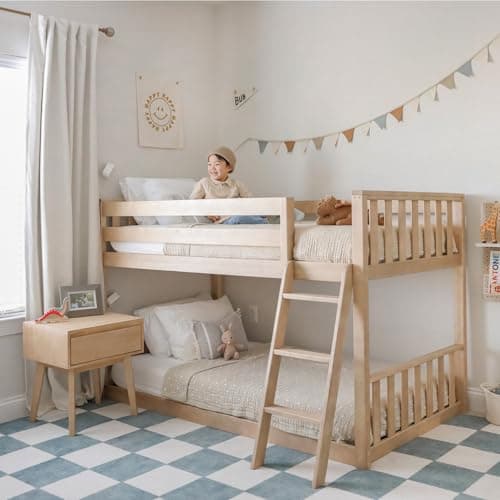
| Guardrail height above mattress | 14 in above the deck |
|---|---|
| Stated weight limit (per bunk) | 400 lb per sleeping surface |
| Manufacturer minimum age | Not published by the manufacturer |
| Mattress thickness ceiling | 8 in maximum (5 in recommended) |
| Materials / construction | Solid New Zealand pine, GREENGUARD Gold certified finish |
What works
- Publishes a guardrail height, a weight limit and a mattress ceiling — most brands publish one of the three
- 400 lb per surface is the highest stated capacity in this roundup, and it holds through the teen years
- Low overall height means the top deck sits well under a standard bunk
- Reversible, removable ladder with grooved treads and rounded edges
What doesn’t
- The 8 in mattress ceiling rules out most plush mattresses
- Solid pine is heavy to move once assembled
- No minimum age published, so the AAP's under-6 guidance is the only age rule you get
The catch: That 8 in ceiling is not a suggestion. Put a 10 in mattress on the top deck and the 14 in rail drops to 4 in of clearance, which is below the federal 5 in minimum. The bed stops being compliant and nobody tells you.
Small rooms on a budget
DHP Miles Low Metal Bunk Bed, Twin Over Twin
DHP
Publishes its guardrail height and both weight limits, which is more than most metal frames manage, and the bottom bunk sits on the floor.
| Guardrail height above mattress | 12.5 in above the deck |
|---|---|
| Stated weight limit (per bunk) | 200 lb top bunk / 250 lb bottom bunk |
| Manufacturer minimum age | Not published by the manufacturer |
| Mattress thickness ceiling | 6 in (the frame is specified for 6 in mattresses) |
| Materials / construction | Powder-coated metal frame with metal slats, no box spring required |
What works
- Publishes a guardrail height and separate top and bottom weight limits
- Metal slats support the mattress without a box spring
- Low profile with the bottom bunk close to the floor
- One of the least expensive bunks that still publishes real numbers
What doesn’t
- 200 lb top-bunk limit is half what the solid-wood options state
- Metal frames are more prone to creaking than pine as fasteners loosen
- The 6 in mattress specification is tight for an older child
The catch: The 200 lb top-bunk limit is the one to watch. It is fine for a child and it is not fine for a parent who climbs up to read at bedtime, which is a thing parents do without thinking about the sticker.
Adding a rail to a bed that came without one
Max & Lily Add-On Guardrail
Max & Lily
A matching wooden rail that bolts to the frame — the right answer when the bed is a Max & Lily and the rail is missing.
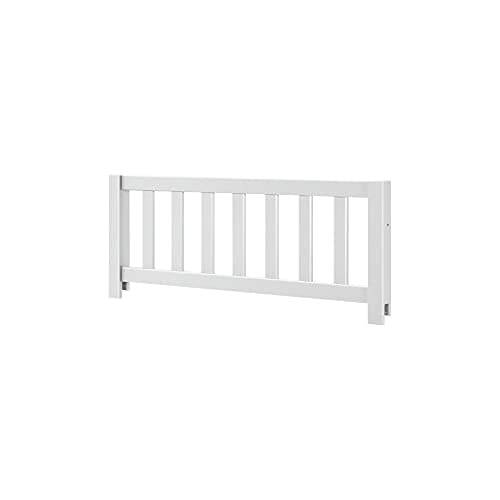
| Guardrail height above mattress | 13.25 in from the point of attachment |
|---|---|
| Stated weight limit (per bunk) | Not applicable |
| Manufacturer minimum age | Not published by the manufacturer |
| Mattress thickness ceiling | Determined by the bed it attaches to |
| Materials / construction | Solid New Zealand pine to match the bed frames |
What works
- Publishes its height, which almost no aftermarket rail does
- Bolts to the frame rather than clamping under the mattress
- Matches the finish of the beds it is designed for
- Solid wood, so it does not flex the way a fabric rail does
What doesn’t
- Only fits Max & Lily frames — this is not a universal rail
- 13.25 in of rail is consumed fast by a thick mattress
- Costs more than a generic clamp-on rail
The catch: 13.25 in measured from the attachment point is not 13.25 in above your mattress. Subtract the mattress thickness and check that at least 5 in of rail is still standing proud, per the federal rule.
Questions parents actually ask
Is it safe to buy a used bunk bed?
It can be, if the bed is a known brand, complete with its original hardware, free of any recall, structurally sound, and its rails measure at least five inches above the mattress you will use. Anonymous or incomplete frames are the ones to avoid.
How do I check if a used bunk bed has been recalled?
Search the CPSC recalls database for the brand name and, if you can get it, the model. Do it before you travel to view the bed. A recalled frame in private hands has almost certainly not had the remedy applied.
What should I check on a secondhand bunk bed?
Recall status, complete original hardware and instructions, two upper guardrails with the wall-side rail continuous, at least five inches of rail above your mattress, sound joints with no stripped bolt holes, and a securely fixed ladder or staircase.
Should you buy a new mattress for a used bunk bed?
Yes — and not only for hygiene. Mattress thickness is what protects the guardrail clearance, and a used bunk rarely comes with a published ceiling. Measure the rail, subtract five inches, and buy to that figure.
Can you use a bunk bed that is missing a guardrail?
Not until the correct rail for that frame is fitted. The standard requires at least two upper-bunk guardrails with one on each side. Source the part from the manufacturer; a universal clamp-on rail is not a substitute on an upper deck.
How old is too old for a secondhand bunk bed?
There is no single year to quote, and we are not going to invent one. What matters is whether the bed meets the current requirements as it stands in front of you: rail count, rail continuity, rail height above the mattress, gap sizes and joint condition. A bed that passes those checks is fine regardless of age; one that fails them is not, however new it is.
Sources
- U.S. Consumer Product Safety Commission — Bunk Beds business guidance
- CPSC recalls database
- 16 CFR Part 1513 — Requirements for Bunk Beds (children's)
- ASTM F1427 — Standard Consumer Safety Specification for Bunk Beds
- American Academy of Pediatrics (HealthyChildren.org) — Bunk Beds: Safety Information for Parents
Read next
- Bunk bed safety standards
The three documents a used bed either meets or does not.
- Bunk bed assembly and stability
Reassembling a bed that has been taken apart before.
- Best bed rails and guardrail extensions
What to fit when a rail is missing, and what not to.
- Best low bunk beds
What a new bed with published numbers actually costs.
Back to Sleep Safety.