Toddler Beds
When to stop using a toddler bed rail
There is no regulation and no birthday. The honest test is whether the child has stopped arriving at the edge of the mattress in their sleep - and three quiet nights with the rail down is how you find out.

We earn a commission from qualifying purchases made through links on this page, at no extra cost to you. How this site is funded.
The short answer
Most children stop needing a bed rail between three and five years old, and the deciding factor is behavior rather than age: a child who no longer rolls to the edge of the mattress in their sleep does not need a rail, and a six-year-old who still does, does.
The practical test is a swing-down rail folded down for three nights. If the child stays mid-mattress and nothing happens, the rail has done its job. If they end up against the edge, put it back up and try again in a few months — nothing is lost by waiting.
Why there is no age rule to look up
Bed rails are not covered by the federal construction standard that governs children’s bunk beds — 16 CFR Part 1513 deals with guardrails built into an upper bunk, which is a different product answering a different risk. An add-on rail on a floor-level bed is an aftermarket accessory, and no standard sets an age at which it comes off. Our rail versus guardrail extension page explains the distinction, because it matters for what you are allowed to rely on.
What that means in practice is that the decision is yours, and the evidence available to you is better than any general rule: you can watch where your own child ends up at 3 a.m. A rule of thumb covers the average child, and the rail is protecting this one.
The three-night test
Night one to three, rail down. If the rail swings down rather than unbolting, this costs nothing to try. Check at your own bedtime and again first thing: the question is where the child is lying, not whether anything went wrong. A child found mid-mattress three mornings running has stopped needing an edge.
If they are against the edge, stop. Put the rail back up and repeat in two or three months. There is no cost to the child in keeping it and no milestone being missed.
Then remove it properly rather than leaving it down. A folded-down rail is a bar along the side of a bed at mattress height, which is a thing to catch a knee on. Once the test passes, take it off.
| Ready to remove the rail | Keep it on |
|---|---|
| Consistently wakes mid-mattress | Regularly found against the edge or on the floor |
| Gets in and out of bed deliberately and steadily | Still rolling rather than climbing out |
| Three quiet nights with the rail folded down | Any night in the test where they reached the edge |
| Sleeping through most nights | Restless sleeper, or a recent change in sleep |
| Mattress at normal twin height, floor is carpeted | High mattress, hard floor, or a raised bed of any kind |

Two cases where the rail does not come off
A raised bed of any kind. If the bed is a bunk, a loft, or anything with a deck above floor level, the guardrail is not an optional aid — it is part of the bed, it is covered by the federal standard, and it stays regardless of the child’s age. Removing an upper-bunk guardrail is not a milestone, it is a modification. See guardrail height requirements.
A high mattress on a hard floor. The consequence of a fall is set by the drop and the surface, not by age. A tall mattress on boards or tile is a different proposition from a low frame on carpet, and it is reasonable to keep a rail longer on that basis alone.
A bumper is not a rail, and neither belongs on a bunk
Foam bolsters under the fitted sheet are a soft edge that makes rolling out less likely. They are not a guardrail and they do not prevent a fall — which is fine on a low bed and unacceptable anywhere raised. Neither a bumper nor an aftermarket bed rail has any business on a bunk or a loft, where the bed’s own guardrails are the safety system.
The transitional option, if you want one
Some children object to the rail itself long before they stop needing an edge, and a foam bolster under the fitted sheet is the step between. Understand what you are swapping to: a passive edge rather than a barrier. On a low toddler frame with a carpeted floor that is a reasonable trade. On anything higher it is not.
If the rail is coming off because the child is moving to a bigger bed rather than because they have outgrown the need, that is a different question — see when to move from a toddler bed to a twin, because a twin sits higher and usually wants a taller rail for the first year.
After it comes off
Two small things worth doing on the night the rail goes. Put something soft beside the bed for a few weeks — a folded duvet or a rug is enough — because the first fall, if it comes, comes early. And check the rest of the room now that the child can leave the bed freely at night: tall furniture anchored, cords out of reach, and a low warm-white light so the route to the door is visible. Our furniture anchoring guide covers the first of those.
Key takeaways
- No standard sets an age. Most children stop needing a rail between three and five.
- Run the three-night test with the rail folded down and watch where they wake up.
- Nothing is lost by waiting. If they reach the edge, put it back and retry in a few months.
- On a bunk or a loft the guardrail is part of the bed and never comes off.
- Remove the rail properly once the test passes - a folded-down rail is a knee-height bar.
What we'd buy
Every pick below carries the same spec block, so you can compare the numbers across this page and every other page on the site.
A thick mattress on a twin, full or queen
Regalo Swing Down Bed Rail
Regalo
Twenty inches tall and it swings out of the way, which is the combination that gets a rail actually used instead of removed.
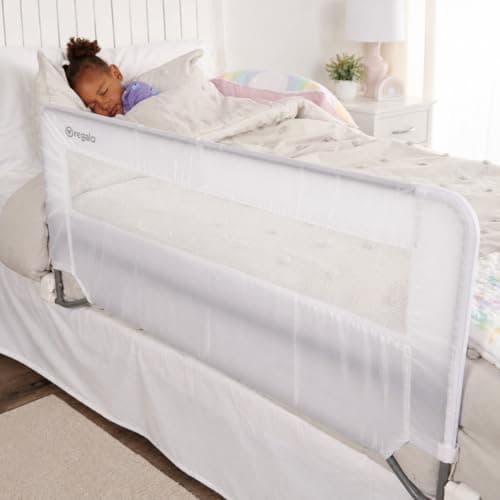
| Guardrail height above mattress | 20 in tall, 43 in long |
|---|---|
| Stated weight limit (per bunk) | Not published by the manufacturer |
| Manufacturer minimum age | Not published by the manufacturer |
| Mattress thickness ceiling | Designed for thicker mattresses with a box spring |
| Materials / construction | Steel frame with fabric panel and reinforced anchor system |
What works
- 20 in of height clears a thick mattress and still leaves real rail above it
- Swings down so you can change sheets and the child can get out
- Reinforced anchor strap runs under the mattress
- Fits twin through queen
What doesn’t
- Designed around a box spring; slat-only frames need a careful look
- The swing-down hinge is something a determined toddler will learn
- At 43 in it does not cover the full length of a twin
The catch: A 43 in rail on a 75 in mattress leaves about two and a half feet uncovered. That is fine at the foot end and it is not fine if your child sleeps diagonally, which small children do.
Children who resist a rail
hiccapop Toddler Bed Bumpers
hiccapop
Foam bolsters that slide under the fitted sheet — a soft edge rather than a cage, for the child a metal rail upsets.
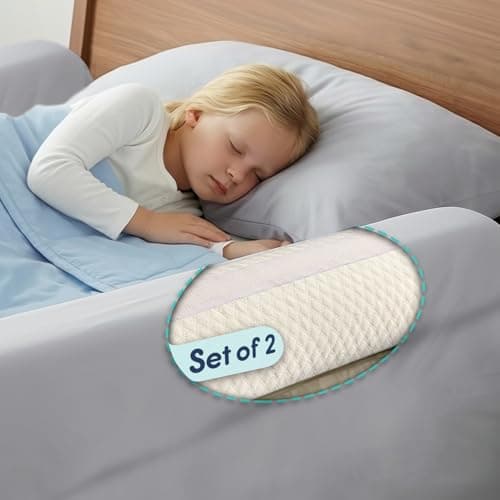
| Guardrail height above mattress | Foam bolster, low profile (height not published) |
|---|---|
| Stated weight limit (per bunk) | Not published by the manufacturer |
| Manufacturer minimum age | Not published by the manufacturer |
| Mattress thickness ceiling | Sits under the fitted sheet on any mattress |
| Materials / construction | CertiPUR-US certified foam with washable cover |
What works
- No hardware, no frame compatibility question — it goes under the sheet
- Far less confining than a full rail, which some children genuinely need
- CertiPUR-US certified foam
- Packs flat for travel
What doesn’t
- A bolster is a speed bump, not a barrier — a determined roll clears it
- Not a substitute for a rail on a raised bed of any kind
- Takes up mattress width
The catch: Be clear about what this is. It is a passive edge that makes rolling out less likely, not a guardrail that prevents a fall, and it has no business anywhere near a bunk or a loft.
Adding a rail to a bed that came without one
Max & Lily Add-On Guardrail
Max & Lily
A matching wooden rail that bolts to the frame — the right answer when the bed is a Max & Lily and the rail is missing.
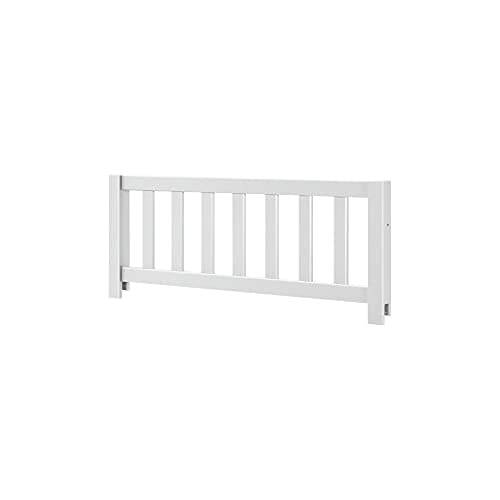
| Guardrail height above mattress | 13.25 in from the point of attachment |
|---|---|
| Stated weight limit (per bunk) | Not applicable |
| Manufacturer minimum age | Not published by the manufacturer |
| Mattress thickness ceiling | Determined by the bed it attaches to |
| Materials / construction | Solid New Zealand pine to match the bed frames |
What works
- Publishes its height, which almost no aftermarket rail does
- Bolts to the frame rather than clamping under the mattress
- Matches the finish of the beds it is designed for
- Solid wood, so it does not flex the way a fabric rail does
What doesn’t
- Only fits Max & Lily frames — this is not a universal rail
- 13.25 in of rail is consumed fast by a thick mattress
- Costs more than a generic clamp-on rail
The catch: 13.25 in measured from the attachment point is not 13.25 in above your mattress. Subtract the mattress thickness and check that at least 5 in of rail is still standing proud, per the federal rule.
Questions parents actually ask
What age do you stop using a toddler bed rail?
Most families stop between three and five, but there is no standard that sets an age. The test is whether the child still arrives at the edge of the mattress while asleep.
How do I know my child no longer needs a bed rail?
Fold the rail down for three nights and check where they are lying at your bedtime and in the morning. Three nights mid-mattress is the signal; one night against the edge means put it back up.
Can you take the guardrail off a bunk bed when the child is older?
No. An upper-bunk guardrail is part of the bed under the federal standard — two rails, with the wall-side rail continuous end to end, standing five inches above the mattress. It is not an aid that gets outgrown.
Are bed bumpers as good as a bed rail?
No, and they are not meant to be. Foam bolsters under the sheet make rolling out less likely; they do not prevent a fall. That is a reasonable step down on a low bed and not acceptable on anything raised.
Should I put something beside the bed after removing the rail?
For the first few weeks, yes — a rug or a folded duvet. If a fall happens it tends to happen early, and the landing surface is the part you control.
Sources
Read next
- Best toddler bed rails
The picks, and what fits a thicker mattress.
- Bed rail vs guardrail extension
Two different products answering two different risks.
- When to move to a twin
The other reason a toddler bed rail comes off.
- Guardrail height requirements
Why a built-in bunk rail is not the same thing at all.
Back to Toddler Beds.