Bunk Beds
Are bunk beds worth it?
Worth it if the room cannot hold two beds and both children are six or older. Not worth it if you are buying one for the look, for a single child, or for a four-year-old who will not be allowed on the top deck for two years.
We earn a commission from qualifying purchases made through links on this page, at no extra cost to you. How this site is funded.
The short answer
A bunk bed is worth it when two conditions hold together: the bedroom genuinely cannot fit two beds with a walkway, and both children are six or older — the age the American Academy of Pediatrics sets for the upper bunk. In that situation a bunk returns roughly 20 square feet of floor, about a fifth of a small bedroom.
It is a poor buy for a single child, for a room that could hold two beds, or for a pair where the younger one is under six — because the top deck then sits empty for years while you live with a ladder and an awkward bed to make.
The three questions that settle it
1. Can the room hold two beds? Measure it rather than eyeballing it. Two twins plus a walkway is around 45 square feet; a bunk is about 23 plus ladder clearance. If the answer is yes, buy two beds — every other factor in this comparison favors them, and our head-to-head has the full arithmetic.
2. Is the younger child six? If not, you are buying a bunk bed to use as a single bed with a ladder attached for however long it takes. Our age readiness guide covers the signals beyond the birthday.
3. Will the frame still be useful in five years? A bunk that splits into two standalone beds is a ten-year purchase. One that does not becomes an awkward object the day the children stop sharing. This is the question that most changes the cost-per-year and almost nobody asks it in the shop.
The cost arithmetic, honestly
A bunk bed is not cheaper than two twin beds. It is usually more expensive, because you are buying a single engineered structure with guardrails, a ladder and bolted joints rather than two simple frames. The saving is floor area, not money — and floor area in a child’s bedroom is genuinely valuable, which is why the purchase makes sense despite the price rather than because of it.
Two costs get left out of the mental sum. Mattresses on a bunk are constrained: the top deck typically caps at 6 to 8 inches depending on the frame, so a plush mattress you already own may not be usable up there. And bedding changes — loose comforters slide off a raised bed, which is the entire argument for zip-together bedding and a real additional line item. Our top-bunk bedding guide covers it.
| Your situation | Verdict |
|---|---|
| Two children, small room, both 6+ | Worth it — this is the case bunks exist for |
| Two children, small room, younger is 3-5 | Wait, or buy a low bunk and use the bottom deck |
| Two children, room fits two beds | Not worth it — buy two beds |
| One child who wants a bunk for the look | Not worth it — a loft bed gives usable space instead |
| Occasional sleepovers | A trundle or a daybed, not a bunk |
| Three sleepers in one room | Worth it with a trundle; a triple bunk needs the ceiling checked |
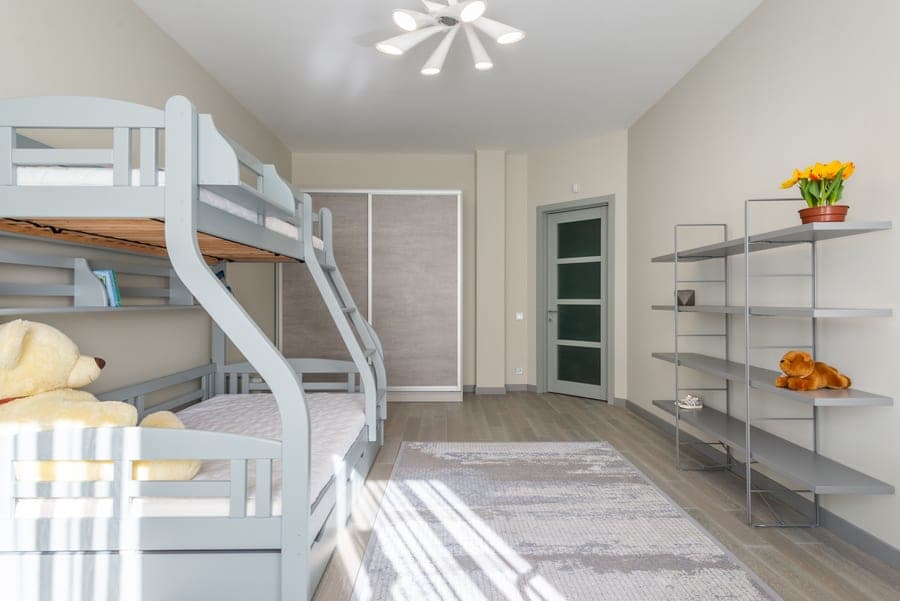
What makes a bunk worth it when it is
The frames that justify the money are the ones that publish their numbers, because that is the difference between a bed you can verify and a bed you hope about. In our registry that means a stated guardrail height, a stated weight limit per sleeping surface and a stated mattress ceiling on the same listing — three numbers that between them let you confirm the federal five-inch clearance rule before spending anything.
Three of our picks publish all three. The spread on stated capacity across the wider registry is two-fold, from 200 lb to 400 lb per deck, between beds that all meet the same standard. Paying more does not automatically buy you the numbers — but on this category it correlates, and our main roundup ranks on exactly that.
The costs that show up in year two
Re-tightening. Every bolted joint on a bunk settles and the wobble people describe is almost always loose fasteners rather than a bad frame — check them two weeks after assembly and then every few months. Our stability guide has the routine. Budget an hour for assembly with two people, not one person and an afternoon.
The alternatives worth pricing first
A trundle bed. If the real requirement is an occasional third sleeper rather than two permanent ones, a trundle under a normal bed solves it with no fall height at all.
A loft bed. For a single child, a loft gives back the same floor area and puts a desk, storage or a reading nook underneath instead of a second mattress. It is the answer to “my child wants a bunk and has no sibling” — see bunk bed versus loft bed.
A low bunk. Most of the floor saving, a much shorter fall, and no price premium. If you are buying a bunk for a younger pair, this is the version to buy.
Key takeaways
- Worth it when the room cannot hold two beds AND both children are six or older.
- A bunk costs more than two twin frames. What you buy is about 20 sq ft of floor.
- Mattress thickness is capped on the top deck, and loose bedding does not work up there.
- A frame that splits into two beds roughly doubles the useful life of the purchase.
- For one child, a loft bed delivers the same floor saving with something usable underneath.
What we'd buy
Every pick below carries the same spec block, so you can compare the numbers across this page and every other page on the site.
Younger siblings sharing a room
Max & Lily Twin Over Twin Low Bunk Bed
Max & Lily
The clearest published safety numbers of any bunk we looked at, on a frame low enough that a fall is a short one.
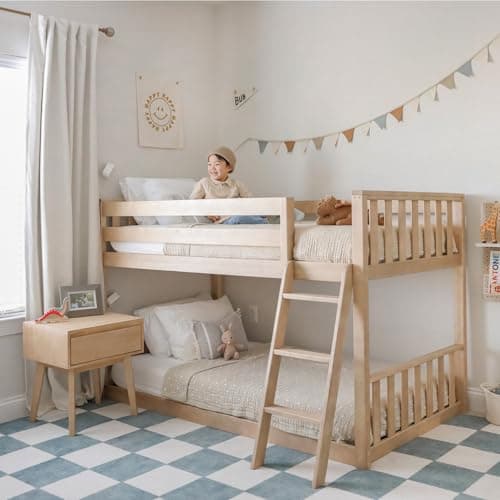
| Guardrail height above mattress | 14 in above the deck |
|---|---|
| Stated weight limit (per bunk) | 400 lb per sleeping surface |
| Manufacturer minimum age | Not published by the manufacturer |
| Mattress thickness ceiling | 8 in maximum (5 in recommended) |
| Materials / construction | Solid New Zealand pine, GREENGUARD Gold certified finish |
What works
- Publishes a guardrail height, a weight limit and a mattress ceiling — most brands publish one of the three
- 400 lb per surface is the highest stated capacity in this roundup, and it holds through the teen years
- Low overall height means the top deck sits well under a standard bunk
- Reversible, removable ladder with grooved treads and rounded edges
What doesn’t
- The 8 in mattress ceiling rules out most plush mattresses
- Solid pine is heavy to move once assembled
- No minimum age published, so the AAP's under-6 guidance is the only age rule you get
The catch: That 8 in ceiling is not a suggestion. Put a 10 in mattress on the top deck and the 14 in rail drops to 4 in of clearance, which is below the federal 5 in minimum. The bed stops being compliant and nobody tells you.
A shared room that hosts a third child most weekends
Max & Lily Twin Over Twin Bunk Bed With Trundle
Max & Lily
The only trundle bunk we found that publishes a rail height, a per-surface weight limit and a separate mattress ceiling for the trundle itself.
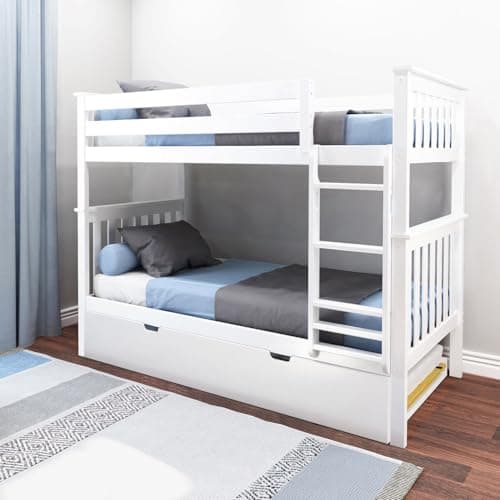
| Guardrail height above mattress | 14 in above the slats |
|---|---|
| Stated weight limit (per bunk) | 400 lb per sleeping surface |
| Manufacturer minimum age | Not published by the manufacturer |
| Mattress thickness ceiling | 8 in on both bunks (5 in recommended on top); 5 in on the trundle |
| Materials / construction | Solid knot-free pine, GREENGUARD Gold certified finish |
What works
- Publishes all three numbers that matter on a trundle bunk, including the trundle's own mattress limit
- 400 lb per sleeping surface is the highest stated capacity in this roundup
- Trundle can be assembled to pull out from either side of the bed
- Separates into two standalone twin beds, so the frame outlasts the sharing arrangement
What doesn’t
- The trundle takes a 5 in mattress, which is thinner than most people expect and narrows your options
- No minimum age published, so the AAP's under-6 top-bunk guidance is the only age rule you get
- The trundle on this model has no wheels, so it wants a hard floor or a low-pile rug
- Sits at the top of the price range for the category
The catch: That 8 in bunk ceiling and 5 in trundle ceiling are two different numbers, and buying one mattress for all three surfaces is the obvious mistake. A 5 in trundle mattress on the top bunk wastes rail margin you paid for; an 8 in mattress on the trundle stops it sliding under the bottom bunk at all.
Small rooms on a budget
DHP Miles Low Metal Bunk Bed, Twin Over Twin
DHP
Publishes its guardrail height and both weight limits, which is more than most metal frames manage, and the bottom bunk sits on the floor.

| Guardrail height above mattress | 12.5 in above the deck |
|---|---|
| Stated weight limit (per bunk) | 200 lb top bunk / 250 lb bottom bunk |
| Manufacturer minimum age | Not published by the manufacturer |
| Mattress thickness ceiling | 6 in (the frame is specified for 6 in mattresses) |
| Materials / construction | Powder-coated metal frame with metal slats, no box spring required |
What works
- Publishes a guardrail height and separate top and bottom weight limits
- Metal slats support the mattress without a box spring
- Low profile with the bottom bunk close to the floor
- One of the least expensive bunks that still publishes real numbers
What doesn’t
- 200 lb top-bunk limit is half what the solid-wood options state
- Metal frames are more prone to creaking than pine as fasteners loosen
- The 6 in mattress specification is tight for an older child
The catch: The 200 lb top-bunk limit is the one to watch. It is fine for a child and it is not fine for a parent who climbs up to read at bedtime, which is a thing parents do without thinking about the sticker.
Questions parents actually ask
Are bunk beds a good idea for small rooms?
Yes, that is the situation they exist for. Expect about 20 square feet back against two twin beds with a walkway — roughly one mattress footprint, and about a fifth of a 10-by-10 bedroom.
Are bunk beds cheaper than two beds?
Usually not. A bunk is one engineered structure with guardrails, a ladder and bolted joints, and it typically costs more than two simple twin frames. The return is floor area rather than money.
How long do bunk beds last?
A solid-pine frame with re-tightened joints will outlast the children sharing the room. The practical lifespan question is whether the frame separates into two standalone beds, because that determines whether it is still useful after they stop sharing.
Is a bunk bed worth it for one child?
Rarely. A loft bed returns the same floor area and puts a desk or storage underneath rather than an unused mattress, and there is no second sleeper to justify the second deck.
What is the downside of bunk beds?
Fall height from the upper deck, an age restriction of six and over on the top bunk, a capped mattress thickness, bedding that is hard to change, and a frame that becomes awkward if it does not split into two beds.
Sources
Read next
- Bunk beds vs two twin beds
The floor-area arithmetic in full.
- Bunk bed vs loft bed
The answer when there is only one child in the room.
- Best bunk beds for kids
If the answer is yes, this is where to start.
- Top bunk age readiness
The age rule that decides most of these questions.
Back to Bunk Beds.