Bunk Beds
Bunk beds vs two twin beds
This is a floor-area decision wearing a safety costume. A bunk gives you back roughly a twin mattress of floor and costs you a six-foot fall height; two separate beds cost the floor and have no upper deck to fall from.

We earn a commission from qualifying purchases made through links on this page, at no extra cost to you. How this site is funded.
How we chose
We are a small publisher, not a testing lab. We don’t buy, assemble or sleep in the beds we write about, and we won’t pretend otherwise. What we do instead is read the published specifications and check them against the rules that actually govern children’s beds in the United States: the federal standard for children’s bunk beds (16 CFR Part 1513), the ASTM F1427 requirements it incorporates, and the American Academy of Pediatrics’ guidance on upper-bunk age. Where a manufacturer publishes no number, we write “not published by the manufacturer” rather than guess — that absence is itself worth knowing. We read owner feedback at volume for the things specs can’t tell you, and we label it as signal, not proof.
We earn a commission when you buy through our links. It never changes an ordering. Our full editorial policy.
Decide for me
Buy two twin beds if either child is under six, if the room can spare about 20 extra square feet, or if the children are likely to stop sharing within two or three years. Nothing about a bunk is worth having in those cases.
Buy a bunk bed if the room genuinely cannot hold two beds with a walkway, and both children are six or older. If you are on the line, a low bunk is the real answer: it returns the floor area and cuts the fall height to something closer to a normal bed.
The floor-area arithmetic, done properly
A twin mattress is 38 by 75 inches, which is 19.8 square feet. Two of them side by side with the narrowest sensible gap is a little under 45 square feet including the walkway. One bunk bed in the same room is about 42 inches wide by 80 inches long — roughly 23 square feet — plus the clearance you need at one end for a ladder.
So the honest figure is about 20 square feet returned, which in a 10-by-10 bedroom is a fifth of the room. That is a real amount and it is less than people expect, because the mental model is “half the floor” and the actual answer is one mattress footprint. If you choose a staircase version instead of a ladder, the stairs take back around 18 inches at one end and the saving shrinks further — our stairs versus ladder page has the measurements.
| Bunk bed | Two twin beds | |
|---|---|---|
| Floor area used | About 23 sq ft plus ladder clearance | About 45 sq ft including a walkway |
| Fall height | Upper deck, typically 4-6 ft | Mattress height only |
| Minimum age | Six or older on the top deck (AAP) | Any age with a rail as needed |
| Guardrail rule | Federal 5 in above the mattress, two rails | Not applicable |
| Bedding | Hard to make on the upper deck | Normal |
| If they stop sharing | One bed, or a frame that splits | Two usable beds already |
| Night waking | Climbing down in the dark | Walking |
The age rule is not negotiable, and it decides most cases
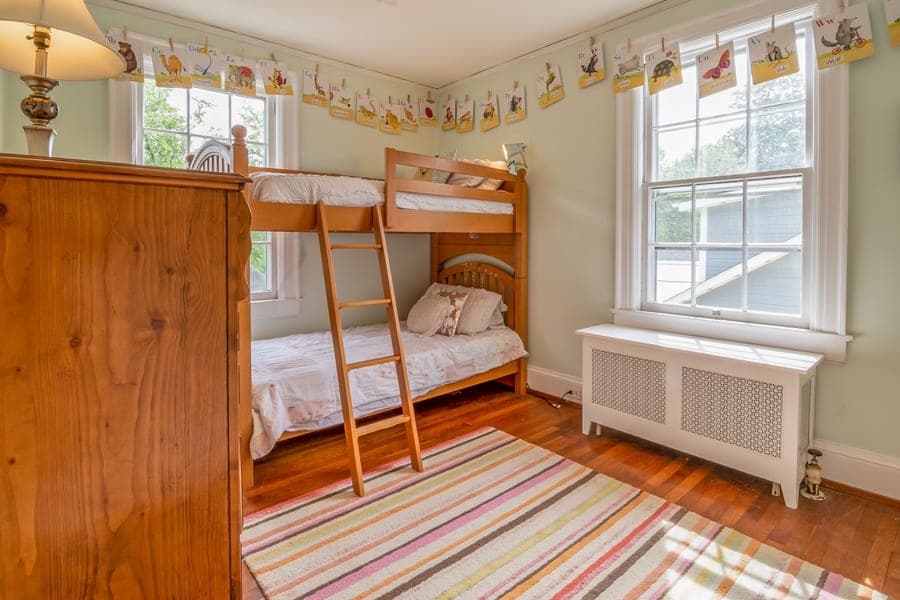
The American Academy of Pediatrics advises that no child under six should sleep on the upper bunk. That is the single fact that resolves this comparison for a large share of the families asking it, because the usual trigger for the question is a four-year-old and a six-year-old moving into one room.
A bunk in that situation means one child on the bottom deck and an empty top bunk for two years — which is two separate beds with worse access and a ladder in the room. Our top bunk age readiness guide goes through the readiness signals beyond the birthday, because age is the floor rather than the whole test.
The things nobody weighs until afterwards
Making the bed. A fitted sheet on an upper deck, against a guardrail, by an adult who cannot stand up, is a genuinely irritating weekly task. It is also why zip-together bedding exists — see bedding for a top bunk.
The 2 a.m. descent. Climbing down a ladder half asleep, feeling for a rung with a bare foot, is the highest-risk moment an ordinary night on a bunk bed produces. It is also the cheapest to fix: a warm-white motion-sensor light on the ladder costs very little.
Illness. A child being sick on a top bunk is a different event from a child being sick on a floor-level bed. Families who have done both bring it up unprompted.
Resale and reuse. Two twins are two usable beds for however long you own them. A bunk is one object that becomes awkward the day the children stop sharing — unless the frame splits into two standalone beds, which several solid-pine models do and which is worth confirming before you buy.
The low bunk is the compromise that actually works
If the room is too small for two beds and one child is on the young side of ready, a low bunk resolves most of the tension. It returns the same floor area as a standard bunk, the top deck sits well below standard height, and the better frames publish the guardrail number so you can check the clearance. It does not change the AAP age guidance — but it changes the consequence of being wrong about readiness. See the low bunk roundup.
If you go with two twin beds
The rail question comes back, because a floor-level twin for a three-year-old still wants an edge. A low twin with integrated guardrails is the buy-once option and skips the toddler bed entirely — it is a twin-sized object in the room from day one, which is the cost. Our toddler bed versus twin comparison works through that decision, and the bed rail roundup covers adding a rail to a bed that came without one.
Key takeaways
- A bunk returns about 20 sq ft - one mattress footprint - not half the room.
- A staircase version gives roughly 18 in of that saving straight back.
- The AAP's under-six guidance for the upper bunk settles the question for most young pairs.
- Two twins stay two usable beds. A bunk becomes awkward unless the frame splits.
- A low bunk is the genuine middle ground: same floor saving, much shorter fall.
What we'd buy
Every pick below carries the same spec block, so you can compare the numbers across this page and every other page on the site.
Younger siblings sharing a room
Max & Lily Twin Over Twin Low Bunk Bed
Max & Lily
The clearest published safety numbers of any bunk we looked at, on a frame low enough that a fall is a short one.
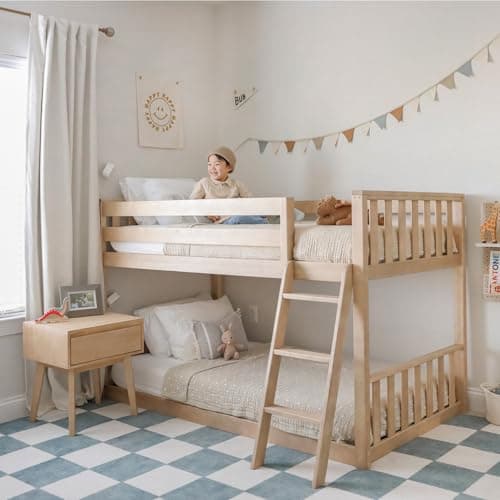
| Guardrail height above mattress | 14 in above the deck |
|---|---|
| Stated weight limit (per bunk) | 400 lb per sleeping surface |
| Manufacturer minimum age | Not published by the manufacturer |
| Mattress thickness ceiling | 8 in maximum (5 in recommended) |
| Materials / construction | Solid New Zealand pine, GREENGUARD Gold certified finish |
What works
- Publishes a guardrail height, a weight limit and a mattress ceiling — most brands publish one of the three
- 400 lb per surface is the highest stated capacity in this roundup, and it holds through the teen years
- Low overall height means the top deck sits well under a standard bunk
- Reversible, removable ladder with grooved treads and rounded edges
What doesn’t
- The 8 in mattress ceiling rules out most plush mattresses
- Solid pine is heavy to move once assembled
- No minimum age published, so the AAP's under-6 guidance is the only age rule you get
The catch: That 8 in ceiling is not a suggestion. Put a 10 in mattress on the top deck and the 14 in rail drops to 4 in of clearance, which is below the federal 5 in minimum. The bed stops being compliant and nobody tells you.
Parents who want to buy once
Max & Lily Twin Bed with Guard Rails
Max & Lily
Skips the toddler bed entirely: a low twin with rails on it, so you buy one frame instead of two.
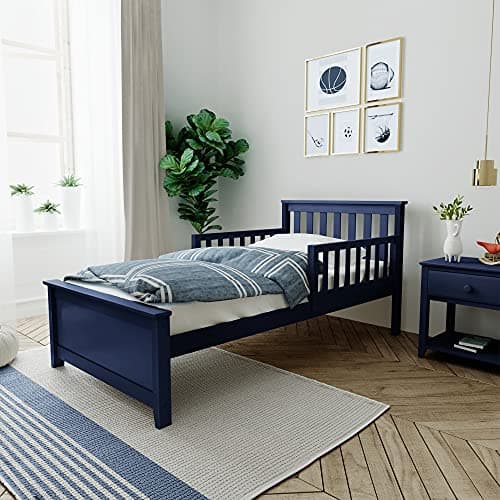
| Guardrail height above mattress | Not published by the manufacturer |
|---|---|
| Stated weight limit (per bunk) | 400 lb |
| Manufacturer minimum age | Not published by the manufacturer |
| Mattress thickness ceiling | Not published by the manufacturer |
| Materials / construction | Solid New Zealand pine, GREENGUARD Gold certified finish |
What works
- A twin mattress from day one means no second bed purchase at five
- Rails come off when they stop being needed
- 400 lb capacity will outlast childhood
- Solid pine rather than a plastic-clad toddler frame
What doesn’t
- A twin footprint is much bigger than a toddler bed
- Costs several times what a crib-mattress toddler bed costs
- Higher off the floor than a toddler bed
The catch: It is a twin, which means it is a twin-sized object in the room from the day your two-year-old moves in. If the room is small, the toddler bed genuinely buys you three years of floor space.
Younger children, and anyone who climbs up at 2 a.m.
Max & Lily Twin Over Twin Low Bunk Bed with Stairs
Max & Lily
Stairs instead of a ladder on a low frame — the combination that makes a bunk workable for a child who is not a confident climber.
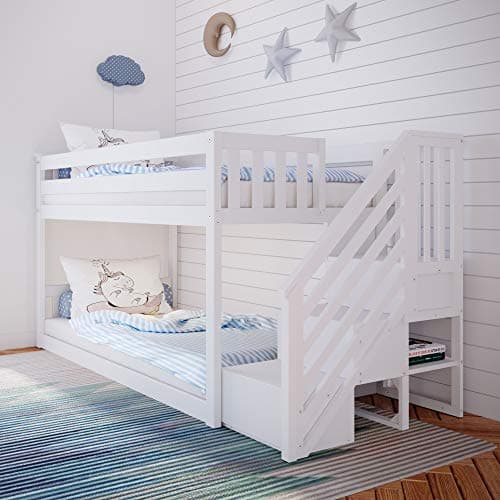
| Guardrail height above mattress | Not published by the manufacturer |
|---|---|
| Stated weight limit (per bunk) | 400 lb per sleeping surface |
| Manufacturer minimum age | Not published by the manufacturer |
| Mattress thickness ceiling | Not published by the manufacturer |
| Materials / construction | Solid New Zealand pine, GREENGUARD Gold certified finish |
What works
- Stairs are dramatically easier to climb half-asleep than a vertical ladder
- Low frame keeps the top deck within reach for tucking in
- Solid pine with the same 400 lb per-surface rating as the rest of the line
- Steps double as a place to sit while getting dressed
What doesn’t
- Stairs claim floor space a ladder does not
- Costs more than the ladder version of the same bed
- Guardrail height is not published
The catch: Stairs eat about a foot and a half of the room along one end. If you are buying a bunk because the room is small, the staircase version can cancel out the space you were trying to save.
Questions parents actually ask
How much space does a bunk bed actually save?
About 20 square feet against two twin beds with a walkway between them — roughly one twin mattress footprint. A staircase version returns around 18 inches of that at one end.
At what age can a child sleep on a bunk bed?
The American Academy of Pediatrics advises against any child under six on the upper bunk. The bottom deck has no such guidance. Age is the floor rather than the whole test — readiness to climb down safely at night matters too.
Are two twin beds better than a bunk bed?
Better if the room can hold them. Two separate beds have no fall height, no age restriction, normal bedding and remain two usable beds afterwards. A bunk is the right answer when the floor area genuinely is not there.
Can you separate a bunk bed into two beds?
Several frames are designed to, including a number of the solid-pine models we recommend. It is not universal, so confirm it on the listing — a bunk that splits is a much longer purchase.
Is a low bunk bed a good compromise?
It is the best one available. You keep the floor-area saving and the top deck sits well below standard bunk height, which reduces the consequence of a fall without changing the age guidance.
Sources
Read next
- Top bunk age readiness
The age rule, and the readiness signals that come after it.
- Best low bunk beds
The middle ground, ranked on published specs.
- Are bunk beds worth it?
The same question asked about cost rather than floor area.
- Toddler bed vs twin bed
If you decide on separate beds, this is the next decision.
Back to Bunk Beds.