Bunk Beds
Bunk bed stairs vs ladder
Stairs win on every dimension except the one that made you buy a bunk bed in the first place.
We earn a commission from qualifying purchases made through links on this page, at no extra cost to you. How this site is funded.
How we chose
We are a small publisher, not a testing lab. We don’t buy, assemble or sleep in the beds we write about, and we won’t pretend otherwise. What we do instead is read the published specifications and check them against the rules that actually govern children’s beds in the United States: the federal standard for children’s bunk beds (16 CFR Part 1513), the ASTM F1427 requirements it incorporates, and the American Academy of Pediatrics’ guidance on upper-bunk age. Where a manufacturer publishes no number, we write “not published by the manufacturer” rather than guess — that absence is itself worth knowing. We read owner feedback at volume for the things specs can’t tell you, and we label it as signal, not proof.
We earn a commission when you buy through our links. It never changes an ordering. Our full editorial policy.
Decide for me
Stairs if the room can spare fifteen to eighteen inches along one end, if the child is at the younger end of top-bunk-ready, or if they get up at night. Stairs are genuinely safer to climb, and the treads usually double as storage.
Ladder if floor space is the constraint — which, in the room that most needs a bunk bed, it usually is. A fixed, correctly angled ladder with a lit route is a perfectly good answer.
The middle option nobody mentions: keep the ladder and spend a few dollars on lighting it. Most ladder incidents are about not being able to see the rung, not about the ladder.
The trade in one table
| Stairs | Ladder | |
|---|---|---|
| Extra floor space | 15-18 in along one end | None |
| Ease of climbing while half asleep | Much better | Requires attention |
| Carrying things up | Possible | Not really |
| Storage in the structure | Usually — drawer treads | None |
| Reversible left/right | Rarely | Often |
| Added cost | Substantial | None |
| Assembly time | Considerably longer | Shortest |
Safety
Stairs are easier to climb, and easier is safer for a tired child. A set of stairs with a handrail gives three points of contact almost automatically; a vertical ladder requires the climber to think about it.
That said, the federal standard does not require stairs and a compliant ladder is not a hazard. What does matter, on either, is that the climbing structure is fixed. A ladder that hooks over the rail and can be knocked sideways is worse than both, and if your bed has one, that is the thing to look at before you consider upgrading to stairs.
What actually goes wrong on a ladder
Descending in the dark, barefoot, half asleep, feeling for a rung. That is the moment, and a small warm-white motion-sensor light at the top and bottom of the ladder removes it for a few dollars. It is the single best value safety change you can make to a bunk bed, and it costs nothing in floor space.
Cost
A staircase model typically costs meaningfully more than the ladder version of the same bed — often close to what an entire budget metal bunk costs. If the treads are drawers, some of that is storage you would otherwise buy separately, which narrows the gap considerably in a room that has no dresser.
Space
The number that decides it. Stairs add fifteen to eighteen inches to the length of the bed, and they are fixed to one side — so they also decide your room layout, which a reversible ladder does not. Work out which wall the bed goes against before you choose a staircase variant, because most cannot be swapped after the fact.
Who should choose neither
If the reason you are looking at stairs is that your child is nervous about the climb, the honest question is whether they are ready for the top bunk at all. Stairs make an unready child able to get up there; they do not make them able to stay there safely while asleep. Read top-bunk age readiness, and consider a low bunk instead.
What we'd buy
Every pick below carries the same spec block, so you can compare the numbers across this page and every other page on the site.
Younger children, and anyone who climbs up at 2 a.m.
Max & Lily Twin Over Twin Low Bunk Bed with Stairs
Max & Lily
Stairs instead of a ladder on a low frame — the combination that makes a bunk workable for a child who is not a confident climber.
| Guardrail height above mattress | Not published by the manufacturer |
|---|---|
| Stated weight limit (per bunk) | 400 lb per sleeping surface |
| Manufacturer minimum age | Not published by the manufacturer |
| Mattress thickness ceiling | Not published by the manufacturer |
| Materials / construction | Solid New Zealand pine, GREENGUARD Gold certified finish |
What works
- Stairs are dramatically easier to climb half-asleep than a vertical ladder
- Low frame keeps the top deck within reach for tucking in
- Solid pine with the same 400 lb per-surface rating as the rest of the line
- Steps double as a place to sit while getting dressed
What doesn’t
- Stairs claim floor space a ladder does not
- Costs more than the ladder version of the same bed
- Guardrail height is not published
The catch: Stairs eat about a foot and a half of the room along one end. If you are buying a bunk because the room is small, the staircase version can cancel out the space you were trying to save.
Younger siblings sharing a room
Max & Lily Twin Over Twin Low Bunk Bed
Max & Lily
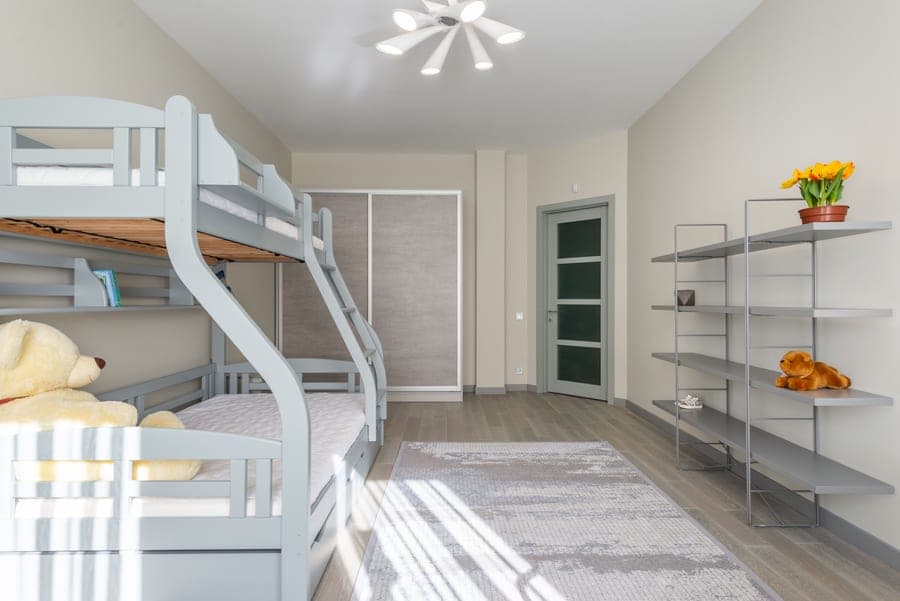
The clearest published safety numbers of any bunk we looked at, on a frame low enough that a fall is a short one.
| Guardrail height above mattress | 14 in above the deck |
|---|---|
| Stated weight limit (per bunk) | 400 lb per sleeping surface |
| Manufacturer minimum age | Not published by the manufacturer |
| Mattress thickness ceiling | 8 in maximum (5 in recommended) |
| Materials / construction | Solid New Zealand pine, GREENGUARD Gold certified finish |
What works
- Publishes a guardrail height, a weight limit and a mattress ceiling — most brands publish one of the three
- 400 lb per surface is the highest stated capacity in this roundup, and it holds through the teen years
- Low overall height means the top deck sits well under a standard bunk
- Reversible, removable ladder with grooved treads and rounded edges
What doesn’t
- The 8 in mattress ceiling rules out most plush mattresses
- Solid pine is heavy to move once assembled
- No minimum age published, so the AAP's under-6 guidance is the only age rule you get
The catch: That 8 in ceiling is not a suggestion. Put a 10 in mattress on the top deck and the 14 in rail drops to 4 in of clearance, which is below the federal 5 in minimum. The bed stops being compliant and nobody tells you.
A lit route down from the top bunk
Rechargeable Motion-Sensor Night Light
Various (search by spec)
The cheapest safety upgrade for a bunk: light on the ladder before a foot goes on it.

| Guardrail height above mattress | Not applicable |
|---|---|
| Stated weight limit (per bunk) | Not applicable |
| Manufacturer minimum age | Not published by the manufacturer |
| Mattress thickness ceiling | Not applicable |
| Materials / construction | Rechargeable LED with adhesive or magnetic mount |
What works
- Lights the ladder and the floor at the bottom of it automatically
- Warm color temperature does not wake the room the way a white light does
- No wiring, so it mounts anywhere on the frame
- Costs less than almost any other change you can make to a bunk
What doesn’t
- Rechargeable means remembering to recharge it
- Adhesive mounts fail on textured or painted surfaces
- Motion sensors can trigger from the bed and wake the sleeper
The catch: This is a generic category rather than a single model — search on the specification (rechargeable, motion sensor, warm white) rather than on a brand, because the brands turn over constantly and the spec does not.
Questions parents actually ask
Are bunk beds with stairs safer than ladders?
They are easier to climb, particularly for a tired or younger child, and easier generally means safer. A compliant, fixed ladder is not unsafe.
How much extra space do bunk bed stairs take?
Typically 15 to 18 inches along one end of the bed, and they are usually fixed to one side.
Can you add stairs to a bunk bed later?
Only if the manufacturer sells them for that model. Improvised stairs are not a good idea — the attachment points matter structurally.
What angle should a bunk bed ladder be?
Whatever the manufacturer designed. An angled ladder is easier than a vertical one, but changing the angle yourself alters the load path and the guardrail geometry.
Should the ladder be attached to the bed?
Yes. A hooked-on ladder that can be knocked out of position is the worst of the options here, regardless of angle.
Sources
Read next
- Best bunk beds for small rooms
Where the staircase trade-off bites hardest.
- Bunk bed safety accessories
Lighting the ladder, and what else actually helps.
- Top-bunk age readiness
If the climb is the worry, this is the prior question.
Back to Bunk Beds.