Bunk Beds
Metal vs wood bunk beds
Neither is safer — both are built to the same federal standard. The difference shows up in year three, and in how much you paid.

We earn a commission from qualifying purchases made through links on this page, at no extra cost to you. How this site is funded.
How we chose
We are a small publisher, not a testing lab. We don’t buy, assemble or sleep in the beds we write about, and we won’t pretend otherwise. What we do instead is read the published specifications and check them against the rules that actually govern children’s beds in the United States: the federal standard for children’s bunk beds (16 CFR Part 1513), the ASTM F1427 requirements it incorporates, and the American Academy of Pediatrics’ guidance on upper-bunk age. Where a manufacturer publishes no number, we write “not published by the manufacturer” rather than guess — that absence is itself worth knowing. We read owner feedback at volume for the things specs can’t tell you, and we label it as signal, not proof.
We earn a commission when you buy through our links. It never changes an ordering. Our full editorial policy.
Decide for me
Choose solid wood if the bed needs to last through two children, if it will be disassembled and moved, or if a wobble would bother you. Solid pine with metal-on-metal bolt connections holds its tension for years.
Choose metal if budget is the binding constraint, if the room is small (metal frames are visually lighter and physically narrower), or if you want a bed that ships flat and goes together in an evening. Accept that you will re-tighten it.
Avoid engineered wood for a bunk you will ever take apart. Particleboard and MDF hold a fastener well once, and less well the second time.
On safety — neither wins
Both are covered by 16 CFR Part 1513 and both must meet the same guardrail requirements. There is no material-based safety argument here, and anyone telling you metal bunks are inherently dangerous or that wood is inherently safer is making it up.
What is true is a maintenance difference. Metal tube frames bolt together at more points and those bolts loosen faster under a climbing child. A loose bunk bed is genuinely less safe than a tight one — so the safety difference is real, it just lives in the calendar rather than in the material.
| Powder-coated metal | Solid pine | |
|---|---|---|
| Typical weight limit published | 200-250 lb per bunk | Up to 400 lb per surface |
| Mattress range | Often narrow (4-6 in windows exist) | Usually more generous |
| Re-tightening needed | Every few months, realistically | Annually is usually enough |
| Survives disassembly | Well | Very well |
| Noise | Can creak and ring | Quieter |
| Visual footprint | Lighter, more open | Heavier, more substantial |
| Price | Lowest in the category | Highest |
Durability
Solid pine is the more durable material in practice, mostly because of how the joints work. A bolt threaded into a steel insert in a wooden post stays where it is; a bolt through two steel tubes relies on friction between the tubes and works loose as the bed is climbed on.
Metal’s advantage is that it does not split, dent or stain. A pine bunk that has been through two children looks it. A metal one mostly does not, apart from chipped powder coat.
Cost
Metal bunks are the cheapest real beds in this category, comfortably less than half what a solid-pine equivalent costs. That gap is large enough to be the deciding factor for many families and there is no shame in it — a metal bunk that is correctly assembled and re-tightened twice a year is a perfectly good bed.
Space
Metal frames are usually narrower for the same mattress, because tube walls are thinner than timber. In a genuinely tight room that can be an inch or two on each side, and visually they are much lighter — a solid pine bunk is a large brown object in a small room.
Resale and longevity
Solid wood bunks hold value and get passed on; metal ones largely do not. If you expect to sell the bed when the children outgrow it, that narrows the real price gap. If you expect to keep it until it falls apart, it does not.
Who should choose neither
Anyone whose real constraint is the mattress. Some metal junior frames specify a window as narrow as four to six inches, which rules out most mattresses on the market. If you already own a mattress you intend to use, check the bed’s published range before choosing a material at all.
What we'd buy
Every pick below carries the same spec block, so you can compare the numbers across this page and every other page on the site.
Younger siblings sharing a room
Max & Lily Twin Over Twin Low Bunk Bed
Max & Lily
The clearest published safety numbers of any bunk we looked at, on a frame low enough that a fall is a short one.
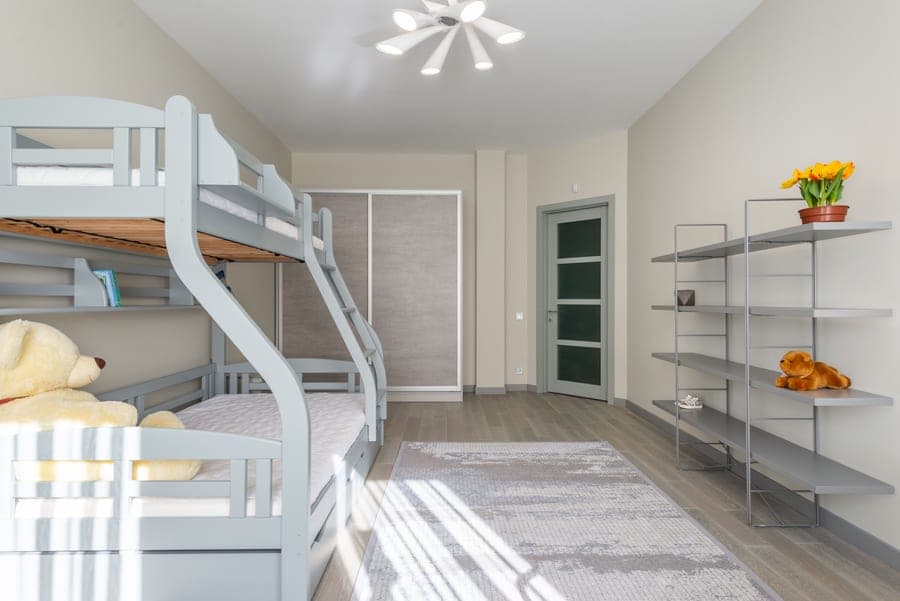
| Guardrail height above mattress | 14 in above the deck |
|---|---|
| Stated weight limit (per bunk) | 400 lb per sleeping surface |
| Manufacturer minimum age | Not published by the manufacturer |
| Mattress thickness ceiling | 8 in maximum (5 in recommended) |
| Materials / construction | Solid New Zealand pine, GREENGUARD Gold certified finish |
What works
- Publishes a guardrail height, a weight limit and a mattress ceiling — most brands publish one of the three
- 400 lb per surface is the highest stated capacity in this roundup, and it holds through the teen years
- Low overall height means the top deck sits well under a standard bunk
- Reversible, removable ladder with grooved treads and rounded edges
What doesn’t
- The 8 in mattress ceiling rules out most plush mattresses
- Solid pine is heavy to move once assembled
- No minimum age published, so the AAP's under-6 guidance is the only age rule you get
The catch: That 8 in ceiling is not a suggestion. Put a 10 in mattress on the top deck and the 14 in rail drops to 4 in of clearance, which is below the federal 5 in minimum. The bed stops being compliant and nobody tells you.
Small rooms on a budget
DHP Miles Low Metal Bunk Bed, Twin Over Twin
DHP
Publishes its guardrail height and both weight limits, which is more than most metal frames manage, and the bottom bunk sits on the floor.
| Guardrail height above mattress | 12.5 in above the deck |
|---|---|
| Stated weight limit (per bunk) | 200 lb top bunk / 250 lb bottom bunk |
| Manufacturer minimum age | Not published by the manufacturer |
| Mattress thickness ceiling | 6 in (the frame is specified for 6 in mattresses) |
| Materials / construction | Powder-coated metal frame with metal slats, no box spring required |
What works
- Publishes a guardrail height and separate top and bottom weight limits
- Metal slats support the mattress without a box spring
- Low profile with the bottom bunk close to the floor
- One of the least expensive bunks that still publishes real numbers
What doesn’t
- 200 lb top-bunk limit is half what the solid-wood options state
- Metal frames are more prone to creaking than pine as fasteners loosen
- The 6 in mattress specification is tight for an older child
The catch: The 200 lb top-bunk limit is the one to watch. It is fine for a child and it is not fine for a parent who climbs up to read at bedtime, which is a thing parents do without thinking about the sticker.
Questions parents actually ask
Are metal or wood bunk beds safer?
Neither. Both must meet 16 CFR Part 1513. Metal frames need their fasteners re-checked more often, which is a maintenance difference rather than a design one.
Why does my metal bunk bed wobble?
Almost always loose fasteners. Go round every bolt with the allen key from the box. If it still moves, check that the bed is level — an uneven floor puts a frame into twist.
Do wooden bunk beds hold more weight?
The ones in our registry publish higher limits — up to 400 lb per surface against 200 to 250 lb for metal — but this is what each manufacturer states rather than a property of the material.
Is a particleboard bunk bed safe?
If it meets the standard, yes. It is less tolerant of being taken apart and rebuilt, so it is a poor choice if you move often.
How often should I tighten a bunk bed?
Metal, every few months. Solid wood, once a year. Any bed, after moving it.
Sources
Read next
- Bunk bed assembly and stability
What to tighten, and why bunks develop a wobble.
- Bunk bed weight limits
What the published numbers mean and who they exclude.
- Best bunk beds for kids
Both materials, ranked on published specs.
Back to Bunk Beds.