Bunk Beds
The best wooden bunk beds for kids
Wood is where the published safety numbers live in this category. It is also where the gap between solid pine and pine-plus-MDF decides how long the bed lasts, and almost no listing says which you are getting in the title.
We earn a commission from qualifying purchases made through links on this page, at no extra cost to you. How this site is funded.
Quick picks
The short version. Tap any row for the full write-up and its spec block.
| # | Product | Best for | Score | Price |
|---|---|---|---|---|
| 1 | 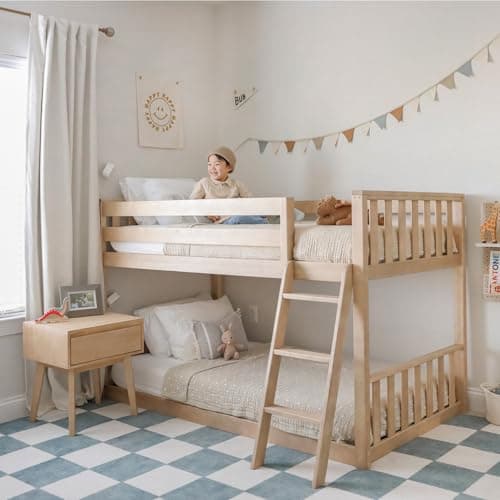 Max & Lily Twin Over Twin Low Bunk Bed The clearest published safety numbers of any bunk we looked at, on a frame low enough that a fall is a short one. | Younger siblings sharing a room | 8.8 | |
| 2 | 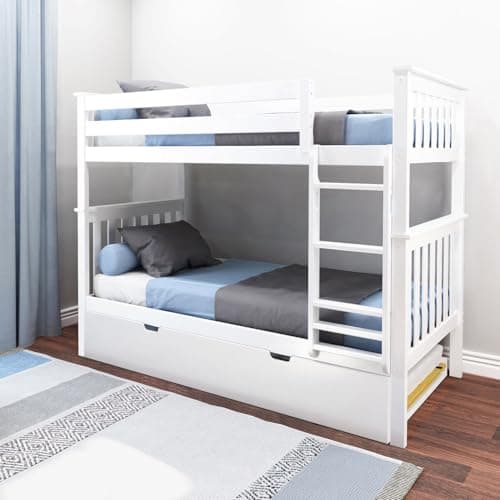 Max & Lily Twin Over Twin Bunk Bed With Trundle The only trundle bunk we found that publishes a rail height, a per-surface weight limit and a separate mattress ceiling for the trundle itself. | A shared room that hosts a third child most weekends | 8.7 | |
| 3 | 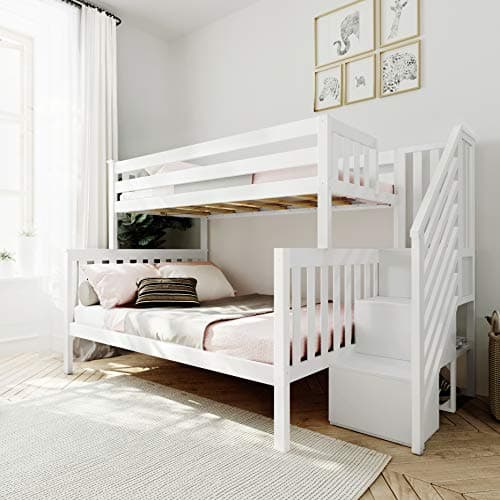 Max & Lily Twin Over Full Bunk Bed with Stairs The only twin-over-full we found that publishes a guardrail height, a mattress ceiling, a weight limit and the headroom between the two bunks. | Siblings a few years apart, in a room with the floor to spare | 8.7 | |
| 4 | 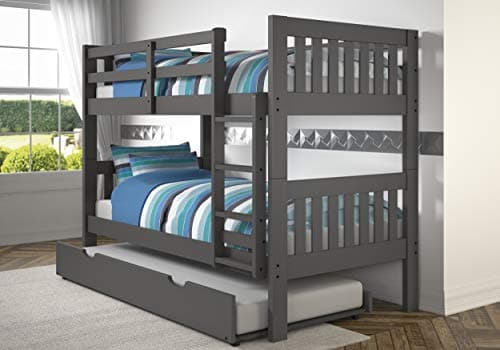 Donco Kids Austin Mission Twin Over Twin Bunk Bed With Twin Trundle Solid pine in a mission style that does not look like children's furniture, with a weight limit published and nothing else. | A room the child will not outgrow the look of | 6.8 | |
| 5 | 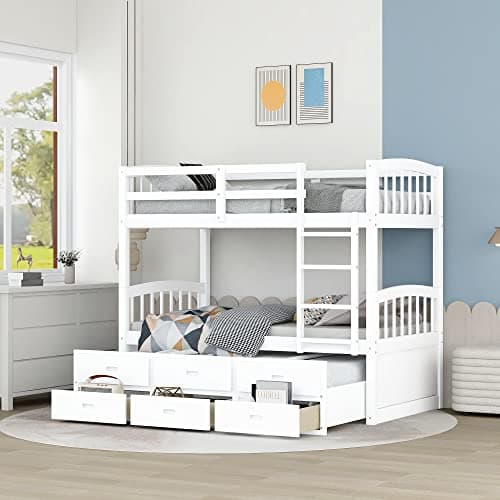 Harper & Bright Designs Twin Over Twin Bunk Bed With Trundle and 3 Drawers A trundle and three drawers under one frame at well under the price of the solid-pine specialists, with a published weight limit and nothing else. | A small room that needs storage and a spare bed | 7.4 | |
| 6 | 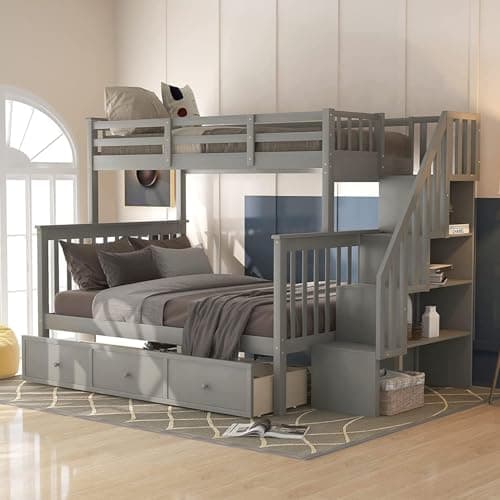 Harper & Bright Designs Twin Over Full Bunk Bed with Storage Stairs and Drawers Stairs, four stair compartments and three under-bed drawers at a price the solid-pine staircase bunks cannot touch, with the lowest published capacities here. | A shared room that has to hold everything as well as everyone | 7.4 |
How we chose
We are a small publisher, not a testing lab. We don’t buy, assemble or sleep in the beds we write about, and we won’t pretend otherwise. What we do instead is read the published specifications and check them against the rules that actually govern children’s beds in the United States: the federal standard for children’s bunk beds (16 CFR Part 1513), the ASTM F1427 requirements it incorporates, and the American Academy of Pediatrics’ guidance on upper-bunk age. Where a manufacturer publishes no number, we write “not published by the manufacturer” rather than guess — that absence is itself worth knowing. We read owner feedback at volume for the things specs can’t tell you, and we label it as signal, not proof.
We earn a commission when you buy through our links. It never changes an ordering. Our full editorial policy.
The short answer
The best wooden bunk bed for most children is the Max & Lily Twin Over Twin Low Bunk Bed: solid New Zealand pine, a GREENGUARD Gold certified finish, and the only frame in our registry that publishes a 14-inch guardrail height, a 400 lb per-surface weight limit and an 8-inch mattress ceiling together.
The distinction that matters across this whole category is solid pine versus pine-and-MDF. Both are sold as “wood”. One holds a bolted joint through a decade of re-tightening; the other is where a stripped fastener eventually ends the bed.
Why most buyers end up on wood
Wood and steel both have to meet the same federal standard, so this is not a safety question in the way it is usually framed. Our metal versus wood comparison goes through it properly, but the short version is that wood buys three things: a thicker frame section that takes a mattress ceiling of 8 inches rather than 6, joints that can be re-tightened repeatedly without wearing, and — in practice — manufacturers who publish more numbers.
What wood costs you is weight and price. A solid-pine twin over twin is genuinely hard to move once assembled, and the frames here that publish everything cost roughly double the metal budget picks. If the bed is for a guest room or a short-term fix, our metal roundup is the more honest page to be reading.
Solid pine, or pine and MDF
This is the one spec to read on a wooden bunk and it is usually buried in the materials line rather than the title. Of the six picks here, three are described as solid pine throughout: the two Max & Lily frames and the Donco Kids mission bunk. Two are described as pine or pinewood with MDF — the Harper & Bright trundle-and-drawers and the twin-over-full stairs-and-drawers models. The sixth, Max & Lily’s twin over full with stairs, is solid pine with plywood slats and a metal support bar, which is the construction we would choose if we were choosing on the materials line alone.
MDF is not a defect. It is dimensionally stable, it takes a laminate finish well, and on drawer boxes and stair treads it is a sensible material. The place it matters is where a bolt passes through it under load, because MDF does not take repeated tightening the way solid timber does — and re-tightening the fasteners is the whole maintenance regime for a bunk bed. Our assembly and stability guide covers the schedule.
The published numbers, side by side
| Bed | Materials | Weight limit | Mattress ceiling |
|---|---|---|---|
| Max & Lily low bunk | Solid New Zealand pine | 400 lb per surface | 8 in max (5 in rec) |
| Max & Lily twin over twin + trundle | Solid knot-free pine | 400 lb per surface | 8 in bunks, 5 in trundle |
| Max & Lily twin over full + stairs | Solid pine, plywood slats, metal support bar | 400 lb per surface | 8 in max (5 in rec) |
| Donco Kids Austin Mission + trundle | Solid pine, non-toxic finish | 220 lb per bunk | Not published |
| Harper & Bright trundle + 3 drawers | Pinewood and MDF, iron alloy bolts | 400 lb top and bottom | Not published |
| Harper & Bright twin over full stairs + drawers | Solid pine and MDF, 7.6 in slat spacing | 200 lb upper, 250 lb lower | Not published |
Three of six publish a mattress ceiling and all three are Max & Lily. The spread on stated capacity is almost two-fold, from 200 lb to 400 lb on the upper deck, between beds built from nominally the same material.
The finish certification is worth reading
A wooden bed in a bedroom is a large surface area of coated timber in a room with a closed door for ten hours a night, which is why the finish certification is more than marketing on this category. GREENGUARD Gold — which the Max & Lily frames carry — tests the finished product for chemical emissions against a children’s-room exposure model. The Donco frame is described as a non-toxic finish without a named scheme, which is weaker evidence of the same claim.
We would not reject a bed for lacking a certification. We would read a named, auditable scheme as better than an adjective, and on this category the brands that publish the certification also tend to be the brands that publish the rail height.
One published number nobody else prints
The Harper & Bright twin-over-full stairs-and-drawers model states 7.6 inches of slat spacing. It is the only slat-spacing figure in our whole registry, and it is genuinely useful: at that spacing an all-foam mattress will sag and you want either an innerspring or a board. Our bunkie board guide explains how to read your own frame.
Where the variants catch people out
Harper & Bright’s trundle bunks are not one product. We found listings in the same range rated 150 lb on the top bunk and listings rated 400 lb, in frames that look nearly identical in the photographs. The weight limit does not carry across variants or colorways, so read it on the exact listing you are ordering rather than on the review you read first.
The Donco mission bunk is the pick for a room the child will not outgrow the look of — it does not read as children’s furniture — and it publishes a 220 lb per-bunk limit and nothing else. The listing says it meets or exceeds ASTM and CPSC standards, which covers the bed as designed rather than the bed as you assemble it. Without a published rail height or mattress ceiling, the clearance check is yours to run once the mattress is in.
Key takeaways
- Read the materials line, not the title: solid pine and pine-with-MDF are both sold as wood.
- MDF is fine for drawer boxes and treads, and weaker where a bolt passes through it under load.
- Wood typically allows an 8 in mattress where metal frames specify 6 in.
- Stated upper-deck capacity across these six runs 200 lb to 400 lb.
- Weight limits do not carry across variants of the same model — read the listing you are buying.
The picks, in full
Every pick below carries the same spec block, so you can compare the numbers across this page and every other page on the site.
#1 · Younger siblings sharing a room
Max & Lily Twin Over Twin Low Bunk Bed
Max & Lily
The clearest published safety numbers of any bunk we looked at, on a frame low enough that a fall is a short one.
| Guardrail height above mattress | 14 in above the deck |
|---|---|
| Stated weight limit (per bunk) | 400 lb per sleeping surface |
| Manufacturer minimum age | Not published by the manufacturer |
| Mattress thickness ceiling | 8 in maximum (5 in recommended) |
| Materials / construction | Solid New Zealand pine, GREENGUARD Gold certified finish |
What works
- Publishes a guardrail height, a weight limit and a mattress ceiling — most brands publish one of the three
- 400 lb per surface is the highest stated capacity in this roundup, and it holds through the teen years
- Low overall height means the top deck sits well under a standard bunk
- Reversible, removable ladder with grooved treads and rounded edges
What doesn’t
- The 8 in mattress ceiling rules out most plush mattresses
- Solid pine is heavy to move once assembled
- No minimum age published, so the AAP's under-6 guidance is the only age rule you get
The catch: That 8 in ceiling is not a suggestion. Put a 10 in mattress on the top deck and the 14 in rail drops to 4 in of clearance, which is below the federal 5 in minimum. The bed stops being compliant and nobody tells you.
#2 · A shared room that hosts a third child most weekends
Max & Lily Twin Over Twin Bunk Bed With Trundle
Max & Lily
The only trundle bunk we found that publishes a rail height, a per-surface weight limit and a separate mattress ceiling for the trundle itself.
| Guardrail height above mattress | 14 in above the slats |
|---|---|
| Stated weight limit (per bunk) | 400 lb per sleeping surface |
| Manufacturer minimum age | Not published by the manufacturer |
| Mattress thickness ceiling | 8 in on both bunks (5 in recommended on top); 5 in on the trundle |
| Materials / construction | Solid knot-free pine, GREENGUARD Gold certified finish |
What works
- Publishes all three numbers that matter on a trundle bunk, including the trundle's own mattress limit
- 400 lb per sleeping surface is the highest stated capacity in this roundup
- Trundle can be assembled to pull out from either side of the bed
- Separates into two standalone twin beds, so the frame outlasts the sharing arrangement
What doesn’t
- The trundle takes a 5 in mattress, which is thinner than most people expect and narrows your options
- No minimum age published, so the AAP's under-6 top-bunk guidance is the only age rule you get
- The trundle on this model has no wheels, so it wants a hard floor or a low-pile rug
- Sits at the top of the price range for the category
The catch: That 8 in bunk ceiling and 5 in trundle ceiling are two different numbers, and buying one mattress for all three surfaces is the obvious mistake. A 5 in trundle mattress on the top bunk wastes rail margin you paid for; an 8 in mattress on the trundle stops it sliding under the bottom bunk at all.
#3 · Siblings a few years apart, in a room with the floor to spare
Max & Lily Twin Over Full Bunk Bed with Stairs
Max & Lily
The only twin-over-full we found that publishes a guardrail height, a mattress ceiling, a weight limit and the headroom between the two bunks.
| Guardrail height above mattress | 14 in on the top bunk |
|---|---|
| Stated weight limit (per bunk) | 400 lb resting weight per sleeping surface |
| Manufacturer minimum age | Not published by the manufacturer |
| Mattress thickness ceiling | 5 in recommended, 8 in maximum |
| Materials / construction | Solid knot-free New Zealand pine, plywood slats with a metal support bar, low-VOC finish |
What works
- Publishes all four numbers this site ranks on, which nothing else in the configuration does
- 14 in of rail over a 5 in recommended mattress leaves 9 in of clearance against the federal 5 in minimum
- 36 in of published headroom between the bottom slats and the top slats, so you can check whether an adult fits underneath
- Staircase installs on the left or the right, with shelf storage built into the steps
What doesn’t
- 99.5 in long by 54.75 in wide with the staircase fitted, nearly a foot and a half longer than the mattress
- The most expensive bed in this roundup by a wide margin
- No minimum age published, so the AAP's under-6 guidance is the only age rule you get
- Ships in several boxes that may arrive on different days
The catch: The staircase is what makes this bed work for a younger child and it is also what makes it 99.5 inches long. That is more than eight feet along one wall, in a configuration people usually choose because the room is already short of space. Measure the wall before the price talks you out of it.
#4 · A room the child will not outgrow the look of
Donco Kids Austin Mission Twin Over Twin Bunk Bed With Twin Trundle
Donco Kids
Solid pine in a mission style that does not look like children's furniture, with a weight limit published and nothing else.
| Guardrail height above mattress | Not published by the manufacturer |
|---|---|
| Stated weight limit (per bunk) | 220 lb per bunk |
| Manufacturer minimum age | Not published by the manufacturer |
| Mattress thickness ceiling | Not published by the manufacturer |
| Materials / construction | Solid pine with a non-toxic finish; listed as meeting or exceeding ASTM and CPSC standards |
What works
- Solid pine throughout rather than pine and MDF
- Mission styling reads as furniture rather than as a kids' bed, which extends its useful life
- The trundle is a separate unit, so it can be added or skipped depending on the configuration
- Explicitly listed as meeting or exceeding ASTM and CPSC standards
What doesn’t
- 220 lb per bunk is little more than half the capacity of the pine specialists here
- No guardrail height and no mattress ceiling published
- No published weight limit for the trundle itself
- Configurations and trundle availability vary between retailers, so the listing you buy from decides what arrives
The catch: The compliance claim on the listing covers the bed as designed, not the bed as you will assemble it. Without a published rail height or mattress ceiling, the only way to know the finished bunk still clears the federal 5 in rule is to measure it yourself once the mattress is in. Budget for the tape measure, not just the bed.
#5 · A small room that needs storage and a spare bed
Harper & Bright Designs Twin Over Twin Bunk Bed With Trundle and 3 Drawers
Harper & Bright Designs
A trundle and three drawers under one frame at well under the price of the solid-pine specialists, with a published weight limit and nothing else.
| Guardrail height above mattress | Not published by the manufacturer |
|---|---|
| Stated weight limit (per bunk) | 400 lb top bunk and 400 lb bottom bunk on this listing |
| Manufacturer minimum age | Not published by the manufacturer |
| Mattress thickness ceiling | Not published by the manufacturer |
| Materials / construction | Pinewood and MDF with iron alloy bolt connections |
What works
- A trundle and three storage drawers on a single frame, which is two furniture purchases avoided
- Wheels on the trundle unit, so it pulls out on carpet without lifting
- Publishes a per-bunk weight limit, which the cheapest wood bunks often do not
- Separates into two individual beds
What doesn’t
- No guardrail height and no mattress ceiling published, so the 5 in clearance check is entirely yours to run
- MDF in the mix means the frame tolerates being taken apart and rebuilt less well than solid pine
- Harper & Bright publish very different weight limits across near-identical trundle models
- Long assembly — a bunk, a trundle and three drawers share one manual
The catch: This brand's trundle bunks are not one product. We found listings from the same range rated 150 lb on the top bunk and listings rated 400 lb, in frames that look nearly identical in the photographs. Read the weight limit on the exact variant and color you are ordering, because it does not carry over.
#6 · A shared room that has to hold everything as well as everyone
Harper & Bright Designs Twin Over Full Bunk Bed with Storage Stairs and Drawers
Harper & Bright Designs
Stairs, four stair compartments and three under-bed drawers at a price the solid-pine staircase bunks cannot touch, with the lowest published capacities here.
| Guardrail height above mattress | Not published by the manufacturer |
|---|---|
| Stated weight limit (per bunk) | 200 lb upper, 250 lb lower |
| Manufacturer minimum age | Not published by the manufacturer |
| Mattress thickness ceiling | Not published by the manufacturer |
| Materials / construction | Solid pine and MDF with iron alloy bolts, 7.6 in slat spacing |
What works
- Four compartments under the staircase plus three drawers under the bed, all published
- Splits into two separate beds, which is the exit route when the children stop sharing
- 34.84 in of published clearance between the bunks tells you whether an adult fits below
- Slat spacing of 7.6 in is published, which is unusual and useful if you are buying a foam mattress
What doesn’t
- 200 lb on the top bunk is the lowest stated capacity in this roundup and will not see a teenager out
- No guardrail height published despite a full-length rail being the headline safety claim
- MDF content makes repeated disassembly a bad idea
- 91.73 in long by 54.33 in wide, so the staircase is not free
The catch: The 200 lb top-bunk figure is the thing to read twice. A twin-over-full is usually bought so the older child gets the bigger bed below, but families often swap the children around, and 200 lb is a number a growing teenager plus a mattress can get close to. Decide who sleeps where before you buy, not after.
Questions parents actually ask
Are wooden bunk beds safer than metal ones?
Neither material is inherently safer — both have to meet 16 CFR Part 1513 and the ASTM F1427 requirements it incorporates. Wood frames generally allow a thicker mattress and take repeated re-tightening better; metal frames are lighter and cheaper.
What is the best wood for a bunk bed?
Solid pine is what the better frames in this category are built from — strong enough for the loads, light enough to assemble, and it holds a bolted joint. Look for “solid pine” in the materials line rather than “wood” in the title.
Is MDF bad in a bunk bed?
Not in itself. It is a reasonable material for drawer boxes, panels and stair treads. The concern is load-bearing joints: MDF does not tolerate repeated bolt tightening as well as solid timber, and re-tightening is the standard maintenance for any bunk.
How often should a wooden bunk bed be re-tightened?
Check every fastener a couple of weeks after assembly, then every few months. Wobble in a bunk comes from the bolted corner joints settling, not from the mattress or the slats.
Does GREENGUARD Gold certification matter on a bunk bed?
It is a named, audited test of chemical emissions from the finished product against a children’s-room exposure model, which is stronger evidence than “non-toxic finish” on a listing. It is not a safety-standard substitute.
Sources
Read next
- Metal vs wood bunk beds
Same standard, different aging. The full comparison.
- Best metal bunk beds
The other half of the category, for a guest room or a tighter budget.
- Best twin over twin bunk beds
The narrowest configuration, ranked on published specs.
- Bunk bed assembly and stability
Why re-tightening is the whole maintenance regime, and how often.
Back to Bunk Beds.