Kids Bedding
What to put on a bed for bedwetting
The goal is not a dry mattress. The goal is a bed you can change in the dark in two minutes without turning the lights on or finding clean sheets.
We earn a commission from qualifying purchases made through links on this page, at no extra cost to you. How this site is funded.
The short answer
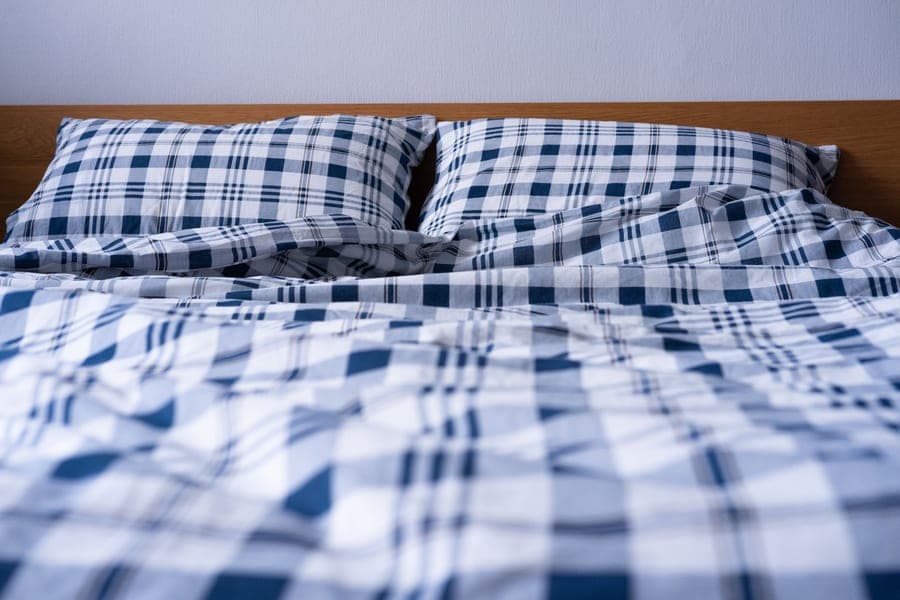
Make the bed twice. Waterproof protector, fitted sheet, second waterproof protector, second fitted sheet. When the bed is wet at 3 a.m. you strip the top two layers, drop them on the floor, and a clean dry bed is already underneath. No hunting for sheets, no lights, no fully awake child.
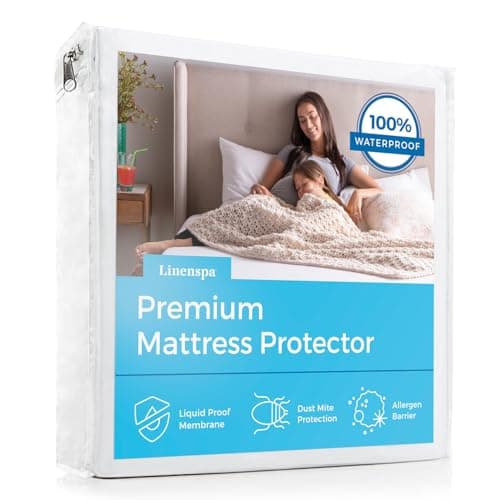
The layer that does the work is the protector, and the one to buy is the Linenspa Waterproof Mattress Protector — it publishes a fit up to 14 inches, which means it will not pop off a corner mid-night, and it washes without the crackle of a cheap vinyl sheet. Buy at least three per bed if accidents are nightly.
Why the double layer is the whole technique
Bedwetting is not a hygiene problem, it is a logistics problem at the worst hour of the day. The reason parents dread it is not the laundry — it is standing in a cold room at 3 a.m. with a crying child, a wet mattress, and no idea where the clean fitted sheet went.
Layering solves exactly that. You do the work once, in the evening, when you are awake, and the night-time job becomes: pull the top sheet and protector off together, put them in the hamper, put the child back in a dry bed. Two minutes, lights off, and most children go straight back to sleep.
It is also the single best thing you can do for a child’s feelings about it. A change that takes two minutes and causes no fuss reads very differently from one that takes twenty and wakes the house.
The layers, bottom to top
| Layer | What it is | Why it is there |
|---|---|---|
| 1 (bottom) | Encasement, optional | Seals all six faces. Worth it if accidents are nightly or the mattress is secondhand |
| 2 | Waterproof protector | The layer that saves the mattress |
| 3 | Fitted sheet | The dry bed waiting underneath |
| 4 | Waterproof protector | The layer that gets wet tonight |
| 5 (top) | Fitted sheet | The one the child sleeps on |
Five layers sounds like a lot and adds perhaps half an inch in total. On a standard bed that is irrelevant. On a bunk it is not — see the guardrail note below.
Skip the flat sheet while this is going on. A flat sheet is one more thing to strip in the dark and it adds nothing a comforter does not. Use a washable comforter or a duvet with a cover, and keep a spare of whichever you choose.
What to look for in a protector that gets washed daily
A published depth. This is the spec that decides whether the protector stays on. Linenspa publishes a fit up to 14 inches and Utopia publishes deep pockets to 15 inches for a twin. A protector that barely reaches the corners will be off the mattress by morning, which defeats the point.
A quiet face. A brushed polyester or cotton-blend terry face over a membrane is quiet. A plain laminated sheet crackles, and a child already anxious about wetting the bed does not need a mattress that announces every turn.
Dryer tolerance. You are going to wash these two or three times a week for a year or more. High heat delaminates the waterproof backing, so tumble on low and expect to replace them annually rather than treating them as permanent.
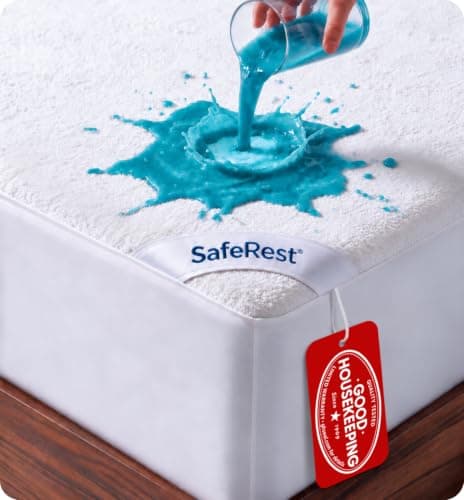
Absorbency on the face. The SafeRest has a cotton-blend terry face, and terry holds liquid rather than letting it run to the edge of the bed. On a bed that gets wet often, that is worth more than it sounds.
Sheets: buy cheap, buy several
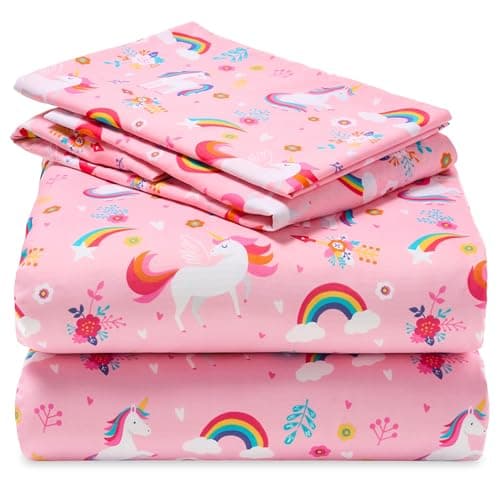
This is the one context where we would pick microfiber over cotton. The Joiedomi Kids Twin Sheet Set is brushed microfiber with a deep-pocket fitted sheet, it dries fast, and at this price you can own four sets without thinking about it. Cotton percale is the better sheet in every other respect and it takes twice as long in the dryer, which during a bedwetting phase is the only quality that matters.
Four fitted sheets and three protectors per bed is the number we would aim at. It means a wet night never meets an empty closet, and it means you can run the laundry on your schedule instead of at 6 a.m. The sheet quality trade-offs for everything outside this phase are in cotton vs microfiber kids sheets.
On a bunk, count the thickness
Every layer you add sits between the mattress and the top of the guardrail, and federal rules for children’s bunk beds want at least 5 inches of rail above the top of the mattress. Five layers will not break that on their own, but a thick mattress plus an encasement plus a double make-up can. Measure once with the bed made up, and if you are close to the line, drop the encasement and keep the two protectors.
Setting the room up around it
Keep the spares in the bedroom. A basket of folded protectors and sheets under the bed or in the closet of the room itself. Walking to a linen closet in another part of the house at 3 a.m. is how a two-minute job becomes a ten-minute one.
Put a light on the route. A motion-sensor night light between the bed and the bathroom does two jobs: it makes the trip possible without waking up fully, and it stops the overhead light going on, which ends sleep for the night. On a bunk this is not optional — a child descending a ladder in the dark to reach a bathroom is the exact scenario we worry about in best bunk bed safety accessories.
Have a laundry basket in the room. Wet bedding goes straight in, the lid goes on, and nobody deals with it until morning.
Keep a spare pair of pajamas within reach of the bed. Same logic as the sheets.
What not to do
Do not use a plastic sheet or a shower curtain. It crackles, it traps heat, it slides, and it is not designed to be slept on. A proper protector costs little more and works.
Do not restrict fluids late in the day as the main strategy. Bedwetting at these ages is overwhelmingly a developmental matter rather than a behavioral one, and a child who is thirsty at bedtime should drink. If it is persisting past the age you expected, that is a conversation for your pediatrician, not a reason to change the bedding again.
Do not make the bed a subject. The point of the layered setup is that the change is unremarkable. A bed that gets dealt with quietly and quickly takes the weight out of the whole thing.
Key takeaways
- Build the bed as protector, sheet, protector, sheet - so a 3 a.m. change is strip two layers and go back to bed.
- Buy a protector with a published depth. One that does not reach the corners will be off by morning.
- Three protectors and four fitted sheets per bed is the number that stops the closet running empty.
- Tumble protectors on low. High dryer heat destroys the waterproof backing with no visible warning.
- Keep the spares, a laundry basket and a night light in the bedroom itself.
What we'd buy
Every pick below carries the same spec block, so you can compare the numbers across this page and every other page on the site.
Any bed, and the only sane choice on a top bunk
Linenspa Waterproof Mattress Protector
Linenspa
A thin fitted protector that adds almost nothing to the mattress height, which is the spec that matters on a bunk.
| Guardrail height above mattress | Not applicable |
|---|---|
| Stated weight limit (per bunk) | Not applicable |
| Manufacturer minimum age | Not published by the manufacturer |
| Mattress thickness ceiling | Fits mattresses up to 14 in thick (published) |
| Materials / construction | Brushed polyester face over a published waterproof barrier layer |
What works
- Fitted-sheet style with no quilting, so it adds negligible loft above the mattress
- Listing publishes both a depth limit (14 in) and a 10-year limited warranty
- Brushed polyester face is specified as noiseless, which is the complaint that gets protectors thrown away
- Cheap enough to own two and keep one in the closet for a 2 a.m. change
What doesn’t
- Polyester face sleeps warmer than a cotton-terry top
- Barrier film is not described in material terms, so you cannot compare it to a TPU-backed rival
- Fitted style leaves the mattress sides and base exposed
- No published age guidance of any kind
The catch: Fitted protectors only protect the top. A toddler accident that runs off the side of the mattress reaches the foam anyway, and the first time that happens you will wish you had bought the zippered encasement instead.
Nightly accidents through the potty-training years
SafeRest Waterproof Twin Mattress Protector
SafeRest
The protector most parents end up with, and it earns it on the one thing that decides repeat use: it is quiet.
| Guardrail height above mattress | Not applicable |
|---|---|
| Stated weight limit (per bunk) | Not applicable |
| Manufacturer minimum age | Not published by the manufacturer |
| Mattress thickness ceiling | Not published by the manufacturer |
| Materials / construction | Cotton-blend terry face over a waterproof membrane |
What works
- Cotton-blend terry face breathes better than a plain polyester one
- Stretch pockets grip a thin bunk mattress and a standard twin equally well
- Listing is explicit that it is quiet and breathable, and the fabric backs that up
- Machine wash cold and tumble dry, which is the cycle you will run most
What doesn’t
- Publishes no depth limit at all, so a very deep mattress is a gamble
- Roughly twice the price of the thinnest fitted option
- Terry face adds a little more loft than a smooth polyester protector
- Fitted, so the mattress sides stay unprotected
The catch: SafeRest does not publish a pocket depth on this model. On a thin bunk mattress that is fine - the stretch takes up the slack - but if you are protecting a 12 in twin, measure before you commit, because there is no stated number to check against.
A deep twin mattress, or a second spare in the closet
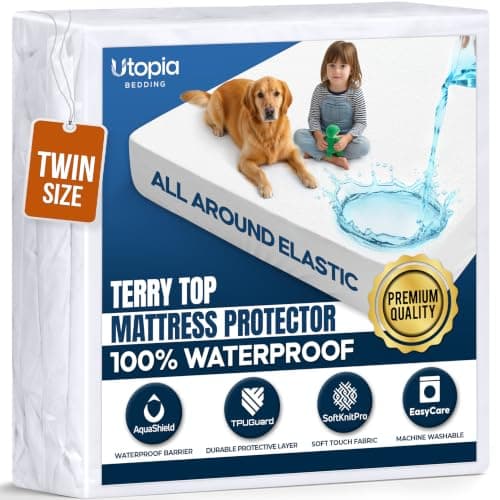
Utopia Bedding Deep Pocket Waterproof Mattress Protector
Utopia Bedding
The one entry here that names its barrier material, and the only one with pockets deep enough for a thick twin.
| Guardrail height above mattress | Not applicable |
|---|---|
| Stated weight limit (per bunk) | Not applicable |
| Manufacturer minimum age | Not published by the manufacturer |
| Mattress thickness ceiling | Published deep pockets for a twin mattress up to 15 in |
| Materials / construction | Absorbent blended face over a published TPU backing |
What works
- Names TPU as the barrier, which almost no listing in this category does
- 15 in pockets cover the deepest twin mattress a kids' room is likely to have
- Absorbent face holds a spill on the surface instead of spreading it
- The cheapest protector we would put on a child's bed
What doesn’t
- Those deep pockets are slack and noisy on a thin bunk mattress
- Blended absorbent face is warmer than a smooth polyester one
- Do not use fabric softener, per the care label, which is easy to forget
- Fitted, so the sides are unprotected
The catch: Deep pockets are a feature on a thick mattress and a defect on a thin one. On a 6 in bunk mattress this protector has nine inches of slack to gather up, and gathered slack under a child is exactly the crinkling that gets a protector removed and never put back.
Younger children, and anyone mid-potty-training
Joiedomi Kids Twin Sheet Set
Joiedomi
Soft microfiber in the patterns children actually ask for, cheap enough to own three sets.
| Guardrail height above mattress | Not applicable |
|---|---|
| Stated weight limit (per bunk) | Not applicable |
| Manufacturer minimum age | Not published by the manufacturer |
| Mattress thickness ceiling | Deep pocket fitted sheet |
| Materials / construction | Brushed microfiber, three-piece set |
What works
- Cheap enough that a 3 a.m. change is not a crisis
- Microfiber dries fast, which matters when you need the set back tonight
- Soft from the first wash with no break-in period
- Patterns children will choose themselves
What doesn’t
- Microfiber sleeps hotter than cotton
- Pills after enough wash cycles
- Polyester, which some parents avoid on principle
The catch: Microfiber traps heat. On a top bunk — where the warm air in the room already collects — a hot sleeper in microfiber sheets will be awake, and cotton is the fix.
Questions parents actually ask
What do you put on a bed for bedwetting?
A waterproof mattress protector, a fitted sheet, a second protector and a second fitted sheet — in that order. When the top pair gets wet you strip both together and a clean dry bed is already made underneath.
How many mattress protectors do you need for a bedwetting child?
Three per bed if accidents are nightly: one on the bed, one in the double-layer stack and one clean in the closet. Pair them with about four fitted sheets so laundry never becomes urgent.
Is a mattress protector or an encasement better for bedwetting?
Both, in combination. The encasement seals the mattress permanently and the protectors are the washable layers you change at night. If you only buy one, buy protectors — they are the layer that actually gets used.
Can you use a waterproof protector on a top bunk?
Yes, and it is more important there than anywhere else, because stripping a top-bunk mattress in the middle of the night is close to impossible. Keep the total stack thin enough that at least 5 inches of guardrail still clears the top of the mattress.
How do you wash a waterproof mattress protector?
Normal wash to the care label, then tumble dry on low or line dry. High dryer heat delaminates the waterproof membrane, and the failure is invisible until the night the mattress gets wet.
Do waterproof mattress protectors make a child hot?
A membrane-backed protector adds some warmth, which is one more reason to pair it with a breathable sheet and a lighter comforter. Vinyl sheets are far worse for this, which is part of why we would not use one.
Sources
Read next
- Best kids mattress protectors
The five we would buy, with published depths.
- Mattress protector vs encasement
Which layer does which job.
- Cotton vs microfiber kids sheets
Why microfiber wins during a bedwetting phase.
- Toddler bed transition troubleshooting
The other things that go wrong at 3 a.m.
Back to Kids Bedding.