Kids Bedding
Mattress protector vs encasement
They look like the same product and they are not. One is a fitted sheet with a barrier; the other is a sealed bag. The difference decides what the mattress survives.

We earn a commission from qualifying purchases made through links on this page, at no extra cost to you. How this site is funded.
How we chose
We are a small publisher, not a testing lab. We don’t buy, assemble or sleep in the beds we write about, and we won’t pretend otherwise. What we do instead is read the published specifications and check them against the rules that actually govern children’s beds in the United States: the federal standard for children’s bunk beds (16 CFR Part 1513), the ASTM F1427 requirements it incorporates, and the American Academy of Pediatrics’ guidance on upper-bunk age. Where a manufacturer publishes no number, we write “not published by the manufacturer” rather than guess — that absence is itself worth knowing. We read owner feedback at volume for the things specs can’t tell you, and we label it as signal, not proof.
We earn a commission when you buy through our links. It never changes an ordering. Our full editorial policy.
The short answer
Buy a fitted protector for a child who has occasional accidents and whose mattress needs to be strippable in the dark. The Linenspa Waterproof Mattress Protector publishes a fit up to 14 inches and goes on and off like a fitted sheet, which on a top bunk at 3 a.m. is the whole argument.
Buy an encasement — a six-sided zip-around cover like the Hospitology Sleep Defense System Low Profile Zippered Encasement — when the mattress needs sealing rather than covering: nightly bedwetting, a dust-mite allergy, or a secondhand mattress you want fully isolated. It protects six sides instead of three, and you will almost never take it off.
The physical difference, in one paragraph
A protector is a fitted sheet with a waterproof membrane laminated to the back of it. It covers the sleeping surface and the sides down to the elastic hem; the underside of the mattress is open. An encasement is a bag with a zipper that runs around three edges, so the mattress goes inside and every surface, including the bottom, is enclosed.
Everything else follows from that. A protector comes off in seconds and goes in the wash with the sheets. An encasement is a two-person job to fit and is not something you strip at night. A protector leaves the bottom and the lower side seams exposed to anything that soaks through; an encasement does not.
| Product | Type | Published fit | Where it belongs |
|---|---|---|---|
| Linenspa Waterproof Mattress Protector | Fitted protector | Mattresses up to 14 in thick | Any bed, and the default on a top bunk |
| SafeRest Waterproof Twin Mattress Protector | Fitted protector, terry face | Depth not published | Nightly accidents through potty training |
| Hospitology Sleep Defense System Low Profile Zippered Encasement | Six-sided encasement | Stretches over a 9 to 11 in twin | Bunk and loft mattresses, allergy cases |
| Utopia Bedding Zippered Twin Mattress Protector | Six-sided encasement | Twin mattress up to 13 in deep | Full coverage on a budget |
What a protector actually stops
Liquid from above, which is the overwhelming majority of what happens on a child’s bed. A night-time accident, a spilled drink, a nosebleed, a sick child — all of it lands on the top surface and a fitted protector handles all of it, provided the barrier layer genuinely runs to the edges rather than stopping as a panel in the middle.
What it does not stop is liquid that runs down past the elastic hem and under the mattress, which happens with volume. If your child floods the bed rather than dampens it, the protector keeps the sleeping surface clean and the underside still gets wet.
The practical advantage is speed. Pull one corner, roll everything up in the sheet, put the spare on, go back to bed. On a top bunk that matters more than any spec, because the alternative is wrestling a mattress out of a guardrailed deck at 3 a.m.
What an encasement actually stops
Everything the protector stops, plus three things it cannot: liquid running round the sides, dust mites living in the mattress fill, and bed bugs crossing in either direction. A sealed zip is what makes all three work, and a cheap encasement with a gappy zipper at the corner does none of them properly.
The dust-mite case is the one people underrate. A mattress is the densest mite habitat in a child’s room, and for a child with allergic asthma or persistent night-time congestion, sealing the mattress is one of the few environmental interventions with a straightforward mechanism behind it. If that is your reason for buying, read the zipper description carefully — a product that does not describe a sealed or micro-zip closure is probably just a waterproof bag.
Depth matters more than with a protector, because a bag has to fit rather than stretch. The Hospitology is published for a 9 to 11 in twin and the Utopia for up to 13 in, and getting this wrong means either a zipper that will not close or a loose cover that bunches under the sheet.

The bunk bed question
Bunks change the calculus in both directions, which is why this section exists at all.
Argument for a protector: on a top bunk you cannot easily remove the mattress, you are working around a guardrail, and the person doing it is half asleep. Anything you can change in the dark beats anything you cannot.
Argument for an encasement: on a top bunk you also cannot easily get at the underside to dry it out, so a leak that gets past a protector is a problem you will not discover for weeks. A low-profile encasement is specifically made for this — it is thin enough not to add meaningful height, which on a bunk is not cosmetic. Every inch you add to the mattress stack takes an inch off the guardrail, and federal rules want 5 inches of rail above the mattress.
Our answer: encase the mattress once, and put a washable protector on top of it. The encasement handles the six-sided problem permanently and the protector is what you strip at night. It costs about the price of one extra set of sheets and it is the setup we would use on any bunk. The thickness consequences are worked through in mattress thickness and guardrails.
Check the noise before you check anything else
The cheapest waterproof layers are a sheet of polyethylene with fabric glued to one side, and they crackle every time the child rolls over. A sensitive sleeper will notice it for weeks. Look for a brushed or terry face over a TPU or membrane backing, and treat “quiet” or “noiseless” in the listing as a claim worth testing on the first night while the return window is open.
Laundry, which decides whether either one gets used
A protector washes with the sheets at whatever temperature the care label allows, and the only rule that matters is the dryer: high heat delaminates the barrier layer, so tumble low or line dry. A protector washed hot and dried hot for a year stops being waterproof, and the first you know is a wet mattress.
An encasement washes perhaps twice a year, because you have to take the mattress out of it. That is fine in a house with one child and occasional accidents; it is not fine as your only line of defense in a house with nightly ones, which is exactly why the two-layer setup exists.
Buy two protectors per bed, not one. The second one is the whole point — if the spare is not in the closet, the midnight change becomes a bare mattress and a towel. We make the same argument about spare sheets in best kids sheet sets.
Which to buy, by situation
Potty training, occasional accidents: two fitted protectors. Linenspa for a deep mattress, SafeRest if you want the softer terry face.
Nightly bedwetting: encasement underneath, protector on top, two spares. The method is in what to put on a bed for bedwetting.
Allergies or asthma: encasement, chosen on the zipper description rather than the price.
Secondhand mattress: encasement, fitted before the mattress goes in the room.
Top bunk, no particular problem: a fitted protector is enough, and it is the one you will actually keep using.
Key takeaways
- A protector covers the top and sides; an encasement zips around all six faces of the mattress.
- Protectors come off in the dark. Encasements do not - that is the whole trade.
- Only an encasement addresses dust mites, bed bugs and liquid running under the mattress.
- On a bunk, encase once and put a washable protector over it. Keep the stack thin so the guardrail still clears 5 in.
- High dryer heat delaminates waterproof backing. Tumble low, and own two protectors per bed.
Two of the five here are encasements rather than fitted protectors, and the difference decides which one belongs on your bed - see mattress protector vs encasement.
A top bunk is the one bed where we would use both a sealed encasement and a washable protector over it, for the reasons in mattress protector vs encasement.
Once the bed is kitted out, the spares you actually need are fitted sheets rather than more comforters - the sheet-only shortlist is in best toddler sheets.
For a toddler bed specifically, the pocket depth matters more than the length, and the sets that publish one are in best toddler sheets.
If you are buying spares because of night-time accidents rather than laundry cycles, the layered bed method in what to put on a bed for bedwetting will save you more time than any sheet will.
Drying time is the deciding factor during potty training, and the full setup for that phase is in what to put on a bed for bedwetting.
What we'd buy
Every pick below carries the same spec block, so you can compare the numbers across this page and every other page on the site.
Any bed, and the only sane choice on a top bunk
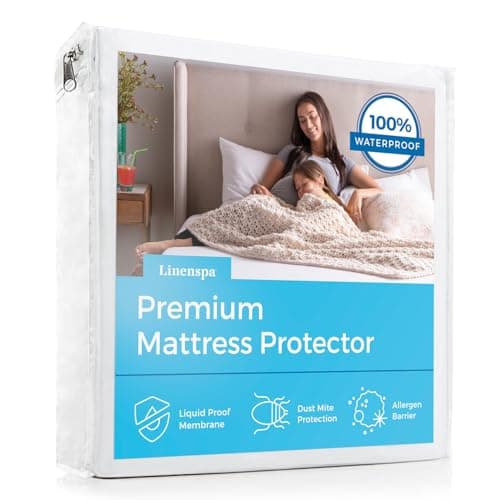
Linenspa Waterproof Mattress Protector
Linenspa
A thin fitted protector that adds almost nothing to the mattress height, which is the spec that matters on a bunk.
| Guardrail height above mattress | Not applicable |
|---|---|
| Stated weight limit (per bunk) | Not applicable |
| Manufacturer minimum age | Not published by the manufacturer |
| Mattress thickness ceiling | Fits mattresses up to 14 in thick (published) |
| Materials / construction | Brushed polyester face over a published waterproof barrier layer |
What works
- Fitted-sheet style with no quilting, so it adds negligible loft above the mattress
- Listing publishes both a depth limit (14 in) and a 10-year limited warranty
- Brushed polyester face is specified as noiseless, which is the complaint that gets protectors thrown away
- Cheap enough to own two and keep one in the closet for a 2 a.m. change
What doesn’t
- Polyester face sleeps warmer than a cotton-terry top
- Barrier film is not described in material terms, so you cannot compare it to a TPU-backed rival
- Fitted style leaves the mattress sides and base exposed
- No published age guidance of any kind
The catch: Fitted protectors only protect the top. A toddler accident that runs off the side of the mattress reaches the foam anyway, and the first time that happens you will wish you had bought the zippered encasement instead.
Bunk and loft mattresses, and anything 9 to 11 in deep
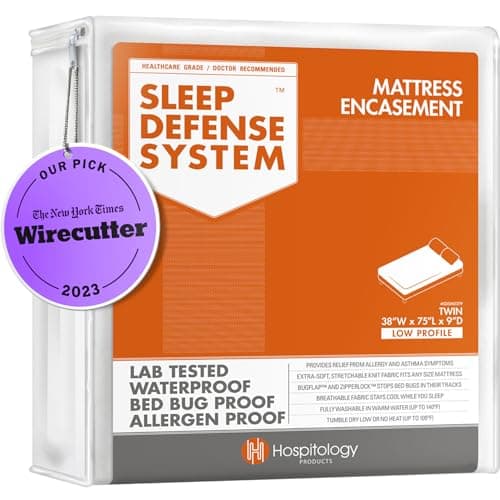
Hospitology Sleep Defense System Low Profile Zippered Encasement
Hospitology Products
The only protector here built for a thin mattress on purpose, and the only one that covers all six sides of it.
| Guardrail height above mattress | Not applicable |
|---|---|
| Stated weight limit (per bunk) | Not applicable |
| Manufacturer minimum age | Not published by the manufacturer |
| Mattress thickness ceiling | Published to stretch over a 9 to 11 in twin mattress |
| Materials / construction | Polyester knit face over a lab-tested waterproof membrane, zip closure |
What works
- Publishes a depth RANGE rather than a maximum, which is the figure a thin-mattress buyer actually needs
- Six-sided waterproof coverage, so a side-running accident never reaches the foam
- Manufacturer states the barrier is lab-tested and the knit face is breathable
- Five-year limited warranty, published
What doesn’t
- A zip encasement has to come off the mattress completely to wash, which is a job, not a chore
- The 9 in floor means it is too big for the thinnest 5 and 6 in bunk mattresses
- Costs around three times the cheapest fitted protector
- Zip teeth sit at the mattress edge where a child's hand goes
The catch: Encasements are sized by a range, and this one starts at 9 in. Plenty of bunk mattresses are 6 in or less precisely because the guardrail rule caps them, and on one of those this cover is loose - which defeats the dust-mite claim and makes it rustle. Measure the mattress, not the bed.
Full coverage on a budget
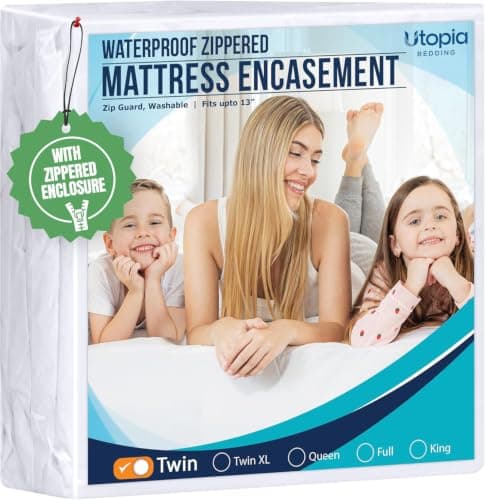
Utopia Bedding Zippered Twin Mattress Protector
Utopia Bedding
Six-sided coverage at a fitted-protector price, which is an unusual thing to be able to write.
| Guardrail height above mattress | Not applicable |
|---|---|
| Stated weight limit (per bunk) | Not applicable |
| Manufacturer minimum age | Not published by the manufacturer |
| Mattress thickness ceiling | Published to fit a twin mattress up to 13 in deep |
| Materials / construction | Knitted polyester with a waterproof liquid barrier, wrap-around zip |
What works
- Publishes both the mattress dimensions it fits and a 13 in depth limit
- Encases all sides for close to what a top-only protector costs
- Described as non-crinkling, and the knit face is the reason
- Machine wash and tumble dry low with the rest of the bedding
What doesn’t
- No stated lower depth limit, so it bags on a very thin bunk mattress
- Thinner fabric than the premium encasements and it shows at the seams
- Zip pull is plastic and is the part that fails first
- No warranty length published
The catch: It is cheap because the fabric is thin, and thin knit over a membrane is the combination that starts to feel plasticky after a dozen hot washes. Buy it for a child who is likely to grow out of accidents within a year or two, not as a five-year purchase.
Nightly accidents through the potty-training years
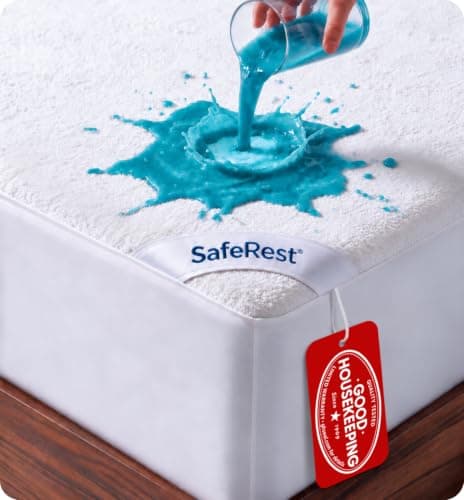
SafeRest Waterproof Twin Mattress Protector
SafeRest
The protector most parents end up with, and it earns it on the one thing that decides repeat use: it is quiet.
| Guardrail height above mattress | Not applicable |
|---|---|
| Stated weight limit (per bunk) | Not applicable |
| Manufacturer minimum age | Not published by the manufacturer |
| Mattress thickness ceiling | Not published by the manufacturer |
| Materials / construction | Cotton-blend terry face over a waterproof membrane |
What works
- Cotton-blend terry face breathes better than a plain polyester one
- Stretch pockets grip a thin bunk mattress and a standard twin equally well
- Listing is explicit that it is quiet and breathable, and the fabric backs that up
- Machine wash cold and tumble dry, which is the cycle you will run most
What doesn’t
- Publishes no depth limit at all, so a very deep mattress is a gamble
- Roughly twice the price of the thinnest fitted option
- Terry face adds a little more loft than a smooth polyester protector
- Fitted, so the mattress sides stay unprotected
The catch: SafeRest does not publish a pocket depth on this model. On a thin bunk mattress that is fine - the stretch takes up the slack - but if you are protecting a 12 in twin, measure before you commit, because there is no stated number to check against.
Questions parents actually ask
What is the difference between a mattress protector and an encasement?
A protector is a fitted sheet with a waterproof backing — it covers the top and the sides but leaves the underside open. An encasement is a zip-around bag that encloses all six faces of the mattress, including the bottom.
Do you need both a protector and an encasement?
On a bed with nightly accidents, yes, and it is our standard advice for bunks: encase the mattress permanently, then put a washable protector over the top as the layer you strip at night. For occasional accidents a protector alone is enough.
Does an encasement make a mattress too thick for a bunk bed?
A low-profile one should not, which is why the category exists. Any thickness you add reduces the clearance between the mattress top and the guardrail, and federal rules for children’s bunks require at least 5 inches. Measure after fitting rather than assuming.
Are mattress encasements good for allergies?
They are the main reason people buy them. Sealing the mattress isolates the dust-mite population living in the fill, which is the densest in the room. The seal is what does the work, so read the zipper description rather than buying on price.
How often should you wash a mattress protector?
With the sheets, or immediately after any accident. Wash to the care label and dry on low — high dryer heat is what destroys the waterproof backing, usually without any visible sign until the mattress gets wet.
Sources
Read next
- Best kids mattress protectors
The five we would buy, ranked.
- What to put on a bed for bedwetting
The layered setup that makes 3 a.m. a two-minute job.
- Mattress thickness and guardrails
Why every layer on a bunk mattress counts.
- Bedding for a top bunk
Making a bed you cannot stand beside.
Back to Kids Bedding.