Kids Bedding
The best kids mattress protectors
A protector is a cheap product with one genuinely consequential spec: how much height it adds above the mattress. On a bunk or a loft, that number is borrowed from the guardrail.

We earn a commission from qualifying purchases made through links on this page, at no extra cost to you. How this site is funded.
Quick picks
The short version. Tap any row for the full write-up and its spec block.
| # | Product | Best for | Score | Price |
|---|---|---|---|---|
| 1 | 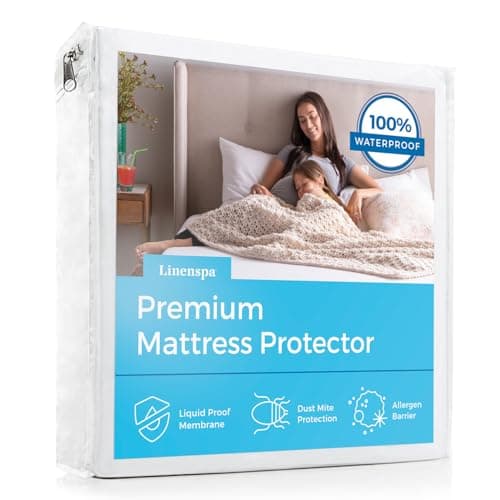 Linenspa Waterproof Mattress Protector A thin fitted protector that adds almost nothing to the mattress height, which is the spec that matters on a bunk. | Any bed, and the only sane choice on a top bunk | 8.6 | |
| 2 | 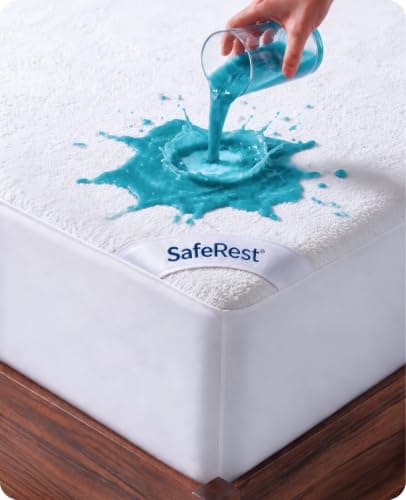 SafeRest Waterproof Twin Mattress Protector The protector most parents end up with, and it earns it on the one thing that decides repeat use: it is quiet. | Nightly accidents through the potty-training years | 8.1 | |
| 3 | 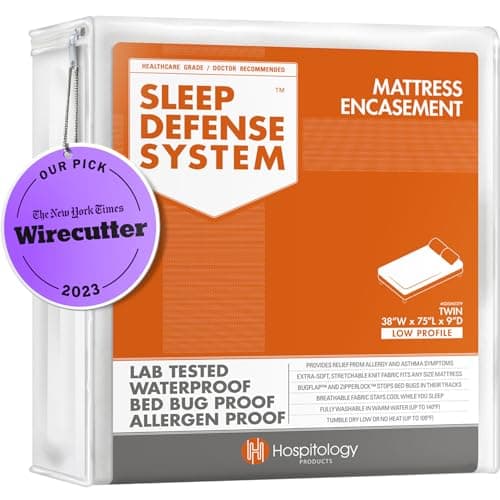 Hospitology Sleep Defense System Low Profile Zippered Encasement The only protector here built for a thin mattress on purpose, and the only one that covers all six sides of it. | Bunk and loft mattresses, and anything 9 to 11 in deep | 8.2 | |
| 4 | 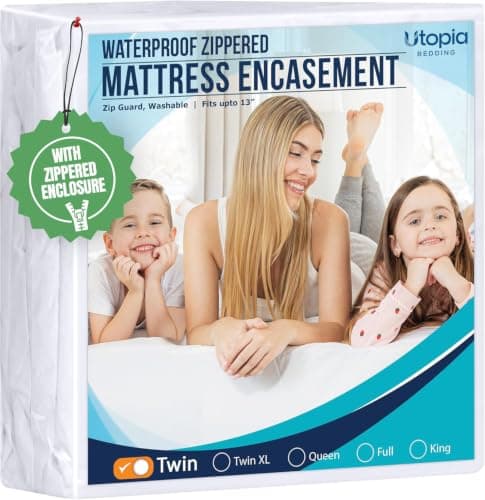 Utopia Bedding Zippered Twin Mattress Protector Six-sided coverage at a fitted-protector price, which is an unusual thing to be able to write. | Full coverage on a budget | 8.0 | |
| 5 | 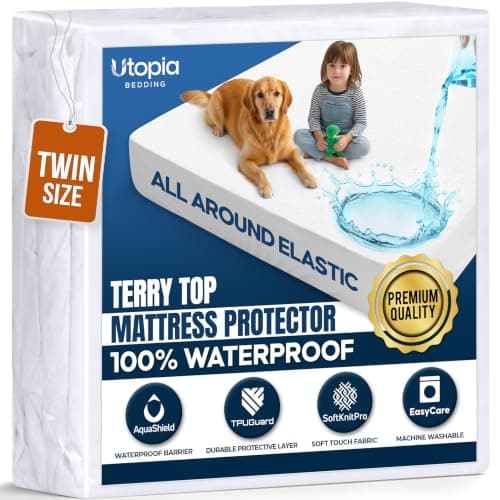 Utopia Bedding Deep Pocket Waterproof Mattress Protector The one entry here that names its barrier material, and the only one with pockets deep enough for a thick twin. | A deep twin mattress, or a second spare in the closet | 7.8 |
How we chose
We are a small publisher, not a testing lab. We don’t buy, assemble or sleep in the beds we write about, and we won’t pretend otherwise. What we do instead is read the published specifications and check them against the rules that actually govern children’s beds in the United States: the federal standard for children’s bunk beds (16 CFR Part 1513), the ASTM F1427 requirements it incorporates, and the American Academy of Pediatrics’ guidance on upper-bunk age. Where a manufacturer publishes no number, we write “not published by the manufacturer” rather than guess — that absence is itself worth knowing. We read owner feedback at volume for the things specs can’t tell you, and we label it as signal, not proof.
We earn a commission when you buy through our links. It never changes an ordering. Our full editorial policy.
The short answer
For most children’s beds the protector to buy is the Linenspa Waterproof Mattress Protector. It is a plain fitted sheet with a barrier film, it is not quilted, and that matters more than anything else on the listing: a protector with no loft adds almost nothing to the height of the mattress, which is the only spec that can make a protector unsafe.
If the accidents are nightly rather than occasional, buy a zippered encasement instead of a fitted protector, because a fitted one only covers the top and urine runs off the sides. For a thin bunk or loft mattress the Hospitology Sleep Defense System low-profile encasement is the one built for the job — it is the only product here that publishes a depth range rather than a maximum.
The criterion that decides this category: added height
Everything else about a mattress protector is a preference. Height is not. On any raised bed, the federal construction rule for children’s bunk beds requires the guardrail to stand at least five inches above the top surface of the mattress, and that clearance is measured from whatever the child is actually lying on. Add a half-inch quilted pad and you have taken a half inch out of the guardrail. Add a two-inch mattress topper with a protector over it and you may have taken the bed out of compliance altogether.
This is why we rank thin protectors above thick ones even though the thick ones feel nicer in the hand. A quilted waterproof pad — the kind with batting stitched into it — is a comfortable product and the wrong product for a top bunk. A plain fitted protector with a film backing is perhaps a millimetre of fabric and does not change the arithmetic at all. Our mattress thickness and guardrails page has the full calculation, and guardrail height requirements has the rule itself with the source.
On a toddler bed or a floor-level twin none of this applies, and you can buy whichever protector you prefer. It is worth knowing which situation you are in before you start reading listings, because the category sells almost entirely on softness and that is the wrong thing to shop on for half the beds in this site’s subject matter.
Fitted or encasement: the decision that actually costs money
A fitted protector goes on like a sheet and covers the top surface and a few inches down the sides. A zippered encasement goes around the whole mattress, all six faces, and closes with a zip. They are not competing products so much as answers to different problems.
The honest case for fitted: it is cheap, it takes thirty seconds to change at two in the morning, and it goes in a normal wash with the sheets. The honest case against: liquid that reaches the edge of the mattress goes over the side and into the foam, and that is exactly what happens with a child who wets through. Once urine is inside a mattress you are not getting it out, and the smell comes back every humid week for the rest of the mattress’s life.
The honest case for an encasement: it is the only thing that genuinely protects the asset. The case against: washing one means stripping the mattress completely, which on a top bunk means wrestling a mattress down a ladder. For a child having two accidents a week, an encasement plus a cheap fitted protector over it is the setup that actually works — the fitted one takes the hit and gets washed, the encasement sits underneath as the thing that never fails.
| The situation | What to buy | Why |
|---|---|---|
| Occasional spills, floor-level bed | A fitted protector | Cheap, quiet, washes with the sheets |
| Top bunk or loft bed | The thinnest fitted protector you can find | Every millimetre comes out of the guardrail clearance |
| Nightly bedwetting | A zippered encasement, plus a fitted one over it | Side coverage is the whole point, and only one layer needs washing |
| Thin bunk mattress, 9 in or under | A low-profile encasement sized by range | A standard 12-15 in encasement bags and rustles on a thin mattress |
| Allergies or dust mites | A six-sided encasement | A fitted protector leaves five faces of the mattress open |
| Mattress still under warranty | Whatever is waterproof, immediately | A stain voids most mattress warranties outright |

Noise is the spec nobody lists and everybody notices
The single commonest reason a mattress protector ends up in a cupboard is that it crinkles. A child who can hear the bed every time they roll over will not settle, and a parent who hears it through the wall will take it off the bed by the end of the week — which means the mattress is then unprotected, which is worse than a slightly noisy protector.
The noise comes from the barrier layer, not the face fabric. Older and cheaper protectors use a vinyl or PVC film that behaves like a carrier bag. The current generation uses a thin polyurethane membrane, usually described as TPU, which is quieter, more flexible and survives more hot washes. Only one of the five products here actually names TPU on the listing, which tells you how little this category likes publishing anything.
Two things make noise worse regardless of membrane. The first is slack: a deep-pocket protector on a thin mattress has inches of spare fabric to gather up, and gathered fabric under a sleeper is what rustles. The second is age — every hot wash stiffens the membrane slightly, and a protector that was quiet when new will be audible in its third year. Treat a cheap protector as a two-year item, not a permanent one.
Depth numbers, and how to read them honestly
Protectors are sold with a maximum: “fits up to 14 inches”, “deep pockets fit 15 inches”. That number tells you when the protector will be too small. It tells you nothing about when it will be too big, and on children’s beds too big is the commoner problem, because bunk mattresses are deliberately thin — often six inches or less, precisely so the guardrail rule still works.
A fitted protector copes with being too big: the elastic takes up the slack and you accept some rustle. A zippered encasement does not. An encasement cut for a 12-inch mattress on a 6-inch one is a loose bag, the zip does not sit at the edge, and the dust-mite claim that justified the price stops being true. That is why the low-profile Hospitology model earns its place here: a published 9-to-11-inch range is a number you can measure against, and almost nothing else in the category offers one.
Measure the mattress itself with a tape, at the middle of the side rather than at a corner, and write the number down. Then shop against it. Our kids bedding sizes guide has the same approach for sheets, where the identical slack problem produces the identical complaints, and bedding for a top bunk covers what goes on top of the protector.
Do the guardrail arithmetic before you add any layer
Measure from the top of whatever the child lies on to the top of the guardrail. If that figure is under five inches, the bed does not meet the federal construction rule for children’s bunk beds — and a mattress pad, a topper or a thick protector can be what pushed it there. The mattress thickness guide works the sums for the common cases.
“Waterproof” is a claim with grades
Three different phrases appear on these listings and they mean three different things. Waterproof should mean a continuous barrier layer — nothing passes through. Water-resistant means a treated fabric that buys you time to get there with a towel. Absorbent means the face fabric holds the liquid in place, which is useful on top of a barrier and useless on its own.
The listings we read for this roundup are mostly careful about this, and all five picks claim a genuine barrier. What almost none of them do is say how the barrier was tested; one says “lab-tested” without naming a method. So the sensible way to buy is on the physical description — a named membrane material, a stated depth, a published warranty length — rather than on the strength of the adjective. A ten-year warranty on a twelve-dollar protector is a more useful signal than any claim about technology.
How many you need, and the thing nobody tells you
Two. For any child who has accidents at all, own two protectors, and keep the spare made up on the shelf with a sheet folded inside it. The alternative is stripping a bed at 2 a.m., running a wash, and putting a child in with you for the rest of the night — which is how a twelve-dollar product turns into a lost night’s sleep for everybody.
Wash at the temperature the care label gives, not hotter. The temptation after an accident is to run everything at the highest setting, and heat is what kills a waterproof membrane: it delaminates slowly, invisibly, and one day the protector simply stops working without looking any different. Skip fabric softener as well — several of these labels say so explicitly, because softener leaves a film on the face fabric that stops it absorbing.
And tumble dry low rather than hot for the same reason. A protector that has been hot-dried fifty times is not a protector any more, which is worth knowing before you conclude that a mattress stain means the product was no good.
What we did not include, and why
No quilted mattress pads. They are comfortable, they are genuinely popular, and they are the wrong recommendation on a site whose subject is raised beds — the batting is exactly the added height that eats guardrail clearance. If the bed is a floor-level twin and comfort is the priority, a quilted pad over a thin protector is a perfectly reasonable choice; we are not going to lead a roundup with it.
No crib-size protectors either. A crib mattress is its own sizing problem and the relevant safety advice is different — the sleep surface has to stay firm and flat, which rules out several products that would be fine on a twin. Our crib mattress guide covers the transition case.
Key takeaways
- Added height is the only spec that can make a protector unsafe. Thin and unquilted wins on any raised bed.
- Fitted protects the top. An encasement protects the mattress. Nightly accidents need the encasement.
- Depth limits tell you when a protector is too small, never when it is too big - and too big is the bunk-bed problem.
- Noise comes from the barrier film and from slack fabric, not from the face. Measure the mattress first.
- Own two, wash cool, no softener, tumble low. Heat destroys a waterproof membrane without changing how it looks.
The picks, in full
Every pick below carries the same spec block, so you can compare the numbers across this page and every other page on the site.
#1 · Any bed, and the only sane choice on a top bunk
Linenspa Waterproof Mattress Protector
Linenspa
A thin fitted protector that adds almost nothing to the mattress height, which is the spec that matters on a bunk.
| Guardrail height above mattress | Not applicable |
|---|---|
| Stated weight limit (per bunk) | Not applicable |
| Manufacturer minimum age | Not published by the manufacturer |
| Mattress thickness ceiling | Fits mattresses up to 14 in thick (published) |
| Materials / construction | Brushed polyester face over a published waterproof barrier layer |
What works
- Fitted-sheet style with no quilting, so it adds negligible loft above the mattress
- Listing publishes both a depth limit (14 in) and a 10-year limited warranty
- Brushed polyester face is specified as noiseless, which is the complaint that gets protectors thrown away
- Cheap enough to own two and keep one in the closet for a 2 a.m. change
What doesn’t
- Polyester face sleeps warmer than a cotton-terry top
- Barrier film is not described in material terms, so you cannot compare it to a TPU-backed rival
- Fitted style leaves the mattress sides and base exposed
- No published age guidance of any kind
The catch: Fitted protectors only protect the top. A toddler accident that runs off the side of the mattress reaches the foam anyway, and the first time that happens you will wish you had bought the zippered encasement instead.
#2 · Nightly accidents through the potty-training years
SafeRest Waterproof Twin Mattress Protector
SafeRest
The protector most parents end up with, and it earns it on the one thing that decides repeat use: it is quiet.
| Guardrail height above mattress | Not applicable |
|---|---|
| Stated weight limit (per bunk) | Not applicable |
| Manufacturer minimum age | Not published by the manufacturer |
| Mattress thickness ceiling | Not published by the manufacturer |
| Materials / construction | Cotton-blend terry face over a waterproof membrane |
What works
- Cotton-blend terry face breathes better than a plain polyester one
- Stretch pockets grip a thin bunk mattress and a standard twin equally well
- Listing is explicit that it is quiet and breathable, and the fabric backs that up
- Machine wash cold and tumble dry, which is the cycle you will run most
What doesn’t
- Publishes no depth limit at all, so a very deep mattress is a gamble
- Roughly twice the price of the thinnest fitted option
- Terry face adds a little more loft than a smooth polyester protector
- Fitted, so the mattress sides stay unprotected
The catch: SafeRest does not publish a pocket depth on this model. On a thin bunk mattress that is fine - the stretch takes up the slack - but if you are protecting a 12 in twin, measure before you commit, because there is no stated number to check against.
#3 · Bunk and loft mattresses, and anything 9 to 11 in deep
Hospitology Sleep Defense System Low Profile Zippered Encasement
Hospitology Products
The only protector here built for a thin mattress on purpose, and the only one that covers all six sides of it.
| Guardrail height above mattress | Not applicable |
|---|---|
| Stated weight limit (per bunk) | Not applicable |
| Manufacturer minimum age | Not published by the manufacturer |
| Mattress thickness ceiling | Published to stretch over a 9 to 11 in twin mattress |
| Materials / construction | Polyester knit face over a lab-tested waterproof membrane, zip closure |
What works
- Publishes a depth RANGE rather than a maximum, which is the figure a thin-mattress buyer actually needs
- Six-sided waterproof coverage, so a side-running accident never reaches the foam
- Manufacturer states the barrier is lab-tested and the knit face is breathable
- Five-year limited warranty, published
What doesn’t
- A zip encasement has to come off the mattress completely to wash, which is a job, not a chore
- The 9 in floor means it is too big for the thinnest 5 and 6 in bunk mattresses
- Costs around three times the cheapest fitted protector
- Zip teeth sit at the mattress edge where a child's hand goes
The catch: Encasements are sized by a range, and this one starts at 9 in. Plenty of bunk mattresses are 6 in or less precisely because the guardrail rule caps them, and on one of those this cover is loose - which defeats the dust-mite claim and makes it rustle. Measure the mattress, not the bed.
#4 · Full coverage on a budget
Utopia Bedding Zippered Twin Mattress Protector
Utopia Bedding
Six-sided coverage at a fitted-protector price, which is an unusual thing to be able to write.
| Guardrail height above mattress | Not applicable |
|---|---|
| Stated weight limit (per bunk) | Not applicable |
| Manufacturer minimum age | Not published by the manufacturer |
| Mattress thickness ceiling | Published to fit a twin mattress up to 13 in deep |
| Materials / construction | Knitted polyester with a waterproof liquid barrier, wrap-around zip |
What works
- Publishes both the mattress dimensions it fits and a 13 in depth limit
- Encases all sides for close to what a top-only protector costs
- Described as non-crinkling, and the knit face is the reason
- Machine wash and tumble dry low with the rest of the bedding
What doesn’t
- No stated lower depth limit, so it bags on a very thin bunk mattress
- Thinner fabric than the premium encasements and it shows at the seams
- Zip pull is plastic and is the part that fails first
- No warranty length published
The catch: It is cheap because the fabric is thin, and thin knit over a membrane is the combination that starts to feel plasticky after a dozen hot washes. Buy it for a child who is likely to grow out of accidents within a year or two, not as a five-year purchase.
#5 · A deep twin mattress, or a second spare in the closet
Utopia Bedding Deep Pocket Waterproof Mattress Protector
Utopia Bedding
The one entry here that names its barrier material, and the only one with pockets deep enough for a thick twin.
| Guardrail height above mattress | Not applicable |
|---|---|
| Stated weight limit (per bunk) | Not applicable |
| Manufacturer minimum age | Not published by the manufacturer |
| Mattress thickness ceiling | Published deep pockets for a twin mattress up to 15 in |
| Materials / construction | Absorbent blended face over a published TPU backing |
What works
- Names TPU as the barrier, which almost no listing in this category does
- 15 in pockets cover the deepest twin mattress a kids' room is likely to have
- Absorbent face holds a spill on the surface instead of spreading it
- The cheapest protector we would put on a child's bed
What doesn’t
- Those deep pockets are slack and noisy on a thin bunk mattress
- Blended absorbent face is warmer than a smooth polyester one
- Do not use fabric softener, per the care label, which is easy to forget
- Fitted, so the sides are unprotected
The catch: Deep pockets are a feature on a thick mattress and a defect on a thin one. On a 6 in bunk mattress this protector has nine inches of slack to gather up, and gathered slack under a child is exactly the crinkling that gets a protector removed and never put back.
Questions parents actually ask
Does a mattress protector affect bunk bed safety?
It can. The guardrail on a children’s bunk bed has to stand at least five inches above the top of the mattress, and that clearance is measured from the surface the child lies on. A thin fitted protector is irrelevant; a quilted pad or a protector over a topper can take the bed below the line. Measure after you add any layer.
Fitted protector or zippered encasement for a bedwetting child?
Encasement, with a cheap fitted protector over the top of it. A fitted protector alone only covers the top surface, and liquid that reaches the edge of the mattress runs down the side into the foam. The two-layer setup means only the easy layer needs washing.
Will a mattress protector make my child's bed noisy?
It depends on the barrier layer and on fit. A polyurethane (TPU) membrane is much quieter than an older vinyl film, and most rustle actually comes from slack — a deep-pocket protector on a thin bunk mattress has inches of spare fabric to gather up. Buy the depth that matches the mattress you measured.
How often should you wash a kids mattress protector?
With the sheets, so roughly weekly, and immediately after any accident. Use the temperature on the care label rather than the hottest cycle: heat delaminates a waterproof membrane gradually and invisibly, so a protector that has been boiled repeatedly can stop working while still looking perfect.
Do I need a waterproof protector if my child is past potty training?
Most mattress warranties are voided by a stain, and children spill drinks, get nosebleeds and are sick in bed long after they stop wetting. A thin protector is cheap insurance on a mattress that cost twenty times as much, and once a child is dry you can choose on comfort rather than on coverage.
What depth mattress protector do I need for a bunk bed?
Measure the mattress at the middle of the side — bunk mattresses are commonly six to eight inches, because the guardrail rule caps them. Then buy a fitted protector whose maximum comfortably covers that, or a low-profile encasement sold with a stated depth range rather than just a maximum.
Sources
Read next
- Mattress thickness and guardrails
The five-inch arithmetic, worked for the common cases.
- Kids bedding sizes guide
Pocket depths and sizes, measured rather than assumed.
- Bedding for a top bunk
What goes on top of the protector, and why zip bedding exists.
- Best toddler mattresses
The thing the protector is protecting.
Back to Kids Bedding.