Sleep Safety
Toddler bed safety standards
A toddler bed is a regulated product with its own federal rule, its own ASTM standard and its own size definition. Almost nobody selling one explains any of that.

We earn a commission from qualifying purchases made through links on this page, at no extra cost to you. How this site is funded.
The short answer
Toddler beds in the United States are governed by 16 CFR part 1217, which incorporates ASTM F1821 with CPSC modifications. The CPSC defines a toddler bed as a bed sized to take a full-size crib mattress of at least 51-5/8 by 27-1/4 inches, intended for children 15 months and older weighing no more than 50 lb.
That definition does most of the work. If a bed takes a crib mattress and is sold for a child in that range, it is a toddler bed and the rule applies — which means guardrails, mattress support, opening dimensions and labeling have all been tested. A compliant bed will carry a label with the manufacturer, a model number and a date of manufacture.
Which rule applies to which bed
This is where most confusion starts, because three different federal rules cover three different children’s beds and they say different things.
| Product | Rule | Mattress | Key published limit |
|---|---|---|---|
| Toddler bed | 16 CFR 1217, incorporating ASTM F1821 | Full-size crib mattress, at least 51-5/8 x 27-1/4 in | Children 15 months and up, no more than 50 lb |
| Children's bunk bed | 16 CFR 1513, with 16 CFR 1213 for entrapment; ASTM F1427 | Twin or full, thickness capped by the guardrail rule | Guardrail at least 5 in above the top of the mattress |
| Crib | Separate federal crib standards | Full-size crib mattress | Not covered on this page |
The practical consequence: never apply a bunk-bed figure to a toddler bed or the reverse. The 5-inch guardrail rule is a bunk-bed rule. The 50 lb limit is a toddler-bed figure. The CPSC publishes separate guidance for each, and the two documents do not mention one another.
What the toddler bed rule actually tests
CPSC’s guidance lists the requirement areas, and they divide into general construction and performance.
General requirements cover hazardous sharp points and edges, small parts, paint and surface coatings, wood parts, scissoring and pinching hazards, protective components, openings, corner post extensions, and labeling. The openings requirement is the one that matters most to a parent: it is the rule that stops a gap in the side structure being the size that traps a head or a limb.
Performance requirements cover mattress support system integrity, mattress support attachment and side rail integrity, guardrails, end structures and side rails, partially bounded openings, and spindle or slat static load strength. In plain terms: the bed has to hold the mattress up under load, the rails have to stay attached, and the slats have to not break.
None of this is something you can verify by looking. What you can verify is that the manufacturer is operating inside the system, and the label is how you do it.
The label is the check you can actually run
Under 16 CFR § 1130.4, the bed must carry the name of the manufacturer or importer, contact information with a US address and phone number, a model name or number, and a date of manufacture — at minimum month and year, which may be coded. A bed with no such label is a bed you cannot trace, cannot check against a recall, and cannot identify to a manufacturer if a part fails. That is the single most useful thing to look for on a secondhand toddler bed.
The 50 lb figure, and what it means in practice
The CPSC definition names children 15 months and older weighing no more than 50 lb. The upper figure is the one parents misread: it is not a structural failure point, it is the population the product was designed and tested for.
Fifty pounds arrives for most children somewhere around six, and in practice the length of the bed runs out at about the same time — a crib mattress is 52 inches, and a tall five-year-old is close to it. Both of those are signals rather than deadlines. The Dream On Me Emma 3-in-1 Convertible Toddler Bed publishes a 50 lb weight limit explicitly, which is more than most brands do; Delta Children publish none on either of the beds in our registry.
When those signals arrive, the next bed is a twin. We cover the timing and what to buy in when to move from a toddler bed to a twin.

Guardrails: integrated versus added
A toddler bed’s guardrails are part of the tested structure. The Dream On Me Emma has four integrated side safety rails, which means they were present when the bed was certified rather than added afterward.
An aftermarket bed rail is a different product with a different purpose: it exists to retrofit a bed that has no rails, usually a twin or a converted crib. It is not covered by the toddler bed rule, it is not tested as part of any bed, and fit is entirely on the buyer. That does not make it a bad product — for a child who has moved to a twin, a rail is often exactly the right answer — but it is not equivalent to an integrated rail and should not be treated as one. The distinction is worked through in bed rail vs guardrail extension.
Four checks before you buy
1. Does the listing name a mattress size? It should say the bed takes a standard crib mattress. A bed sized to anything else is not a toddler bed in the federal sense, whatever the title calls it.
2. Is there a label with a model number and a date? Look for it in the listing photographs on a new bed, and look for it on the frame of a secondhand one. No label, no purchase, on a used bed.
3. Has it been recalled? The CPSC recalls database is searchable by product and brand, and it takes under a minute. This matters most for beds bought secondhand or inherited.
4. Does the mattress fit snugly? This is the one check the standard cannot do for you, because you supply the mattress. Any gap at the edge of a toddler bed is a gap a small child can roll into. Push the mattress to one side and look at the other.
What the standard does not cover
Bedding. Nothing in 16 CFR 1217 says anything about pillows, comforters or bumpers, and the sleep-surface guidance for young children comes from pediatric sources rather than from the product rule — see when can a toddler use a pillow and blanket.
Placement. The rule tests the bed, not the room. Keeping a toddler bed away from windows, blind cords, radiators and anything climbable is entirely on you, as is anchoring the furniture around it — anchoring kids furniture to the wall covers the dressers and bookcases that share the room.
Assembly. A tested bed assembled with two bolts missing is not a tested bed. Follow the instructions, keep them, and re-tighten everything twice a year.
Key takeaways
- Toddler beds are governed by 16 CFR part 1217, which incorporates ASTM F1821 with CPSC modifications.
- The federal definition is a bed sized for a full-size crib mattress of at least 51-5/8 x 27-1/4 in, for children 15 months and up to 50 lb.
- The required label - manufacturer, contact, model, date of manufacture - is the one compliance check you can run yourself.
- Integrated guardrails are part of the tested bed. An aftermarket rail is a separate product and is not.
- Never apply bunk-bed figures to a toddler bed. The 5 in guardrail rule belongs to 16 CFR 1513 and says nothing about toddler beds.
What we'd buy
Every pick below carries the same spec block, so you can compare the numbers across this page and every other page on the site.
The first bed out of the crib
Dream On Me Emma 3-in-1 Convertible Toddler Bed
Dream On Me
Publishes a weight limit, runs four side rails and sits low enough that falling out is barely an event.
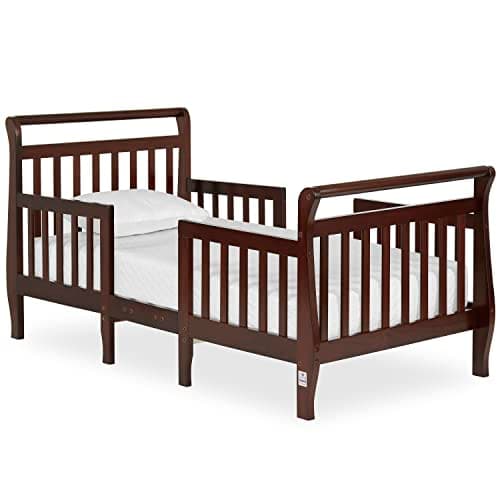
| Guardrail height above mattress | Four integrated side safety rails (height not published) |
|---|---|
| Stated weight limit (per bunk) | 50 lb |
| Manufacturer minimum age | Not published by the manufacturer |
| Mattress thickness ceiling | Uses a standard crib mattress |
| Materials / construction | Solid pinewood, GREENGUARD Gold certified |
What works
- Low-to-floor design means a roll-out is inches, not feet
- Four side rails come with the bed rather than as an accessory
- Takes the crib mattress you already own
- Converts to a table and two chairs when the bed is outgrown
What doesn’t
- 50 lb limit is reached by a lot of five-year-olds
- Crib-mattress footprint is genuinely small for a tall four-year-old
- Conversion to table and chairs is charming but rarely used
The catch: The 50 lb limit is the real lifespan of this bed, and it is shorter than the marketing implies. Plenty of children hit 50 lb around age five, which is well before they are ready for a twin.
A straightforward crib-to-bed step
Delta Children Canton Toddler Bed
Delta Children
The plain, sturdy wooden toddler bed that shows up on every shortlist, and it earns the spot on build rather than features.
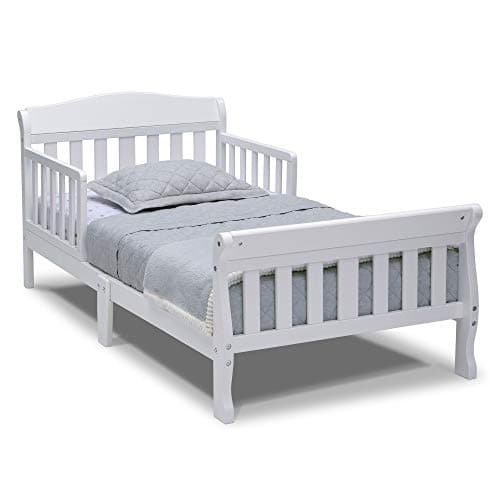
| Guardrail height above mattress | Not published by the manufacturer |
|---|---|
| Stated weight limit (per bunk) | Not published by the manufacturer |
| Manufacturer minimum age | Not published by the manufacturer |
| Mattress thickness ceiling | Uses a standard crib mattress |
| Materials / construction | Wood frame with non-toxic finish |
What works
- Low, simple and unfussy — nothing to break
- Takes the crib mattress already in the room
- Integrated side rails on both sides
- Widely stocked, so replacement parts are findable
What doesn’t
- Neither a guardrail height nor a weight limit is published
- No conversion path — it is a toddler bed and then it is done
- Plain styling, if that matters to you
The catch: Delta does not publish a weight limit for this bed anywhere we could find. For a low toddler frame that matters less than it would on a bunk, but it is still a number a manufacturer should be willing to state.
A second bedroom, or a tight budget
Delta Children Fancy Toddler Bed
Delta Children
The budget pick that still gets the important part right: it is low, and it has rails on both sides.
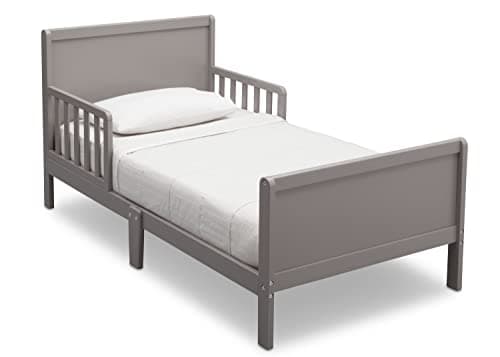
| Guardrail height above mattress | Not published by the manufacturer |
|---|---|
| Stated weight limit (per bunk) | Not published by the manufacturer |
| Manufacturer minimum age | Not published by the manufacturer |
| Mattress thickness ceiling | Uses a standard crib mattress |
| Materials / construction | Wood frame with non-toxic finish |
What works
- One of the least expensive real wooden toddler beds available
- Side rails included on both sides
- Low deck height
- Simple enough to assemble in under an hour
What doesn’t
- No published specs of any kind
- Lighter construction than the Canton
- Short useful life, like all crib-mattress beds
The catch: This is a budget frame and it feels like one when you move it. That is a fair trade at the price, but do not expect it to survive being passed to a second child.
Questions parents actually ask
What safety standard applies to toddler beds?
16 CFR part 1217, which incorporates ASTM F1821 with CPSC modifications. It covers construction, openings, mattress support, guardrails, slat strength and labeling. It is a different rule from the bunk bed standard and the two should never be mixed.
What is the weight limit on a toddler bed?
The CPSC definition describes toddler beds as intended for children 15 months and older weighing no more than 50 lb. Individual manufacturers may publish their own figure — Dream On Me states 50 lb for the Emma — and many publish none at all.
What size mattress does a toddler bed take?
A full-size crib mattress. The federal definition specifies minimum dimensions of 51-5/8 by 27-1/4 inches, which is why a crib mattress carries straight over to a toddler bed when a child moves.
Do toddler beds have to have guardrails?
Guardrails are one of the performance areas the standard tests, and toddler beds are sold with integrated side rails as a matter of course. Those rails are part of the certified product; an aftermarket rail bought separately is not covered by the same rule.
How do you tell if a toddler bed is safe?
Check that it takes a standard crib mattress, that it carries a label with the manufacturer, model and date of manufacture, that it has not been recalled, and that your mattress fits with no gap at the edges. Those four cover what a buyer can actually verify.
Is a toddler bed safer than a twin with a bed rail?
They are different trades. A toddler bed is a complete product tested as a unit, sized low to the ground. A twin with a rail lasts far longer but puts the child higher and relies on a rail that is not part of the bed’s certification and that you have to fit correctly.
Sources
Read next
- Bunk bed safety standards
The separate rule that governs bunks.
- Best toddler beds
The beds we would buy, with published specs.
- Bed rail vs guardrail extension
Why an added rail is a different product.
- When to move from a toddler bed to a twin
What happens when the 50 lb figure arrives.
Back to Sleep Safety.