Bunk Beds
How much ceiling height do you need for a bunk bed?
Nobody publishes the number you actually need, because it depends on three measurements only you have. Here is the subtraction, with the beds that pass it.
We earn a commission from qualifying purchases made through links on this page, at no extra cost to you. How this site is funded.
The short answer
Take your ceiling height, subtract the bunk’s published deck height, and subtract the thickness of the mattress going on the top deck. What is left is the headroom the child has sitting up in bed. Aim for 30 inches or more; 24 inches is livable; under 24 and they will hit their head regularly.
In practice a standard twin-over-twin bunk is 60 to 68 inches tall, so an 8-foot (96-inch) ceiling leaves roughly 25 to 35 inches once a 6-inch mattress is on the deck — workable. A low bunk at 38 to 48 inches tall leaves far more and is the answer for a room with a 7-foot ceiling, a sloped roof or a ceiling fan.
The three numbers, and where to find them
1. Your ceiling height. Measure it, do not assume it. Standard US ceilings are 8 feet, but a finished basement is often 7 feet or less, an older house can be anything, and a room with a sloped ceiling has two different numbers depending on where the bed goes. Measure at the exact spot the bed will stand.
2. The bed’s height. Listings publish an overall height, which is the figure from the floor to the top of the guardrail rather than to the top deck. What the arithmetic wants is the deck height — the surface the mattress sits on. If only the overall height is given, subtract the published guardrail height from it, and if neither is published, ask before ordering.
3. The mattress thickness. Not the one you want — the one the manufacturer permits. Most bunks publish a mattress ceiling between 5 and 8 inches, and it exists for a safety reason rather than a fit reason, which we come back to below.
| Ceiling | Bed type | Mattress | Headroom left |
|---|---|---|---|
| 96 in (8 ft) | Standard twin-over-twin, 60 in deck | 6 in | 30 in - comfortable |
| 96 in (8 ft) | Low bunk, 38 in deck | 6 in | 52 in - generous |
| 84 in (7 ft) | Standard twin-over-twin, 60 in deck | 6 in | 18 in - do not |
| 84 in (7 ft) | Low bunk, 38 in deck | 6 in | 40 in - comfortable |
| 108 in (9 ft) | Standard twin-over-twin, 60 in deck | 8 in | 40 in - comfortable |
A ceiling fan changes the number entirely
Measure to the bottom of the fan blades, not to the ceiling, and then add a margin — a child sitting up fast on a top bunk moves further than you expect. If the fan is over the bed position and the blades sit at 84 inches, treat the room as an 84-inch room. The honest answer in most fan rooms is to move the bed, move the fan, or buy a low bunk.
Why the mattress ceiling is a safety number, not a fit number
Federal construction rules for children’s bunk beds require the top of the guardrail to sit no less than 5 inches above the top of the mattress. Every inch of mattress you add eats an inch of that clearance. The Max & Lily Twin Over Twin Low Bunk Bed publishes a 14 in guardrail and an 8 in mattress maximum — put a 10 in mattress on it and the rail drops to 4 inches of effective height, which is below the federal minimum. The bed stops complying and nothing warns you.
That is why a bunk mattress is a thin mattress, and why a bunk that publishes both a rail height and a mattress ceiling is worth more than one that publishes neither. The full version of this calculation is in mattress thickness and guardrails.
What to buy under a low ceiling
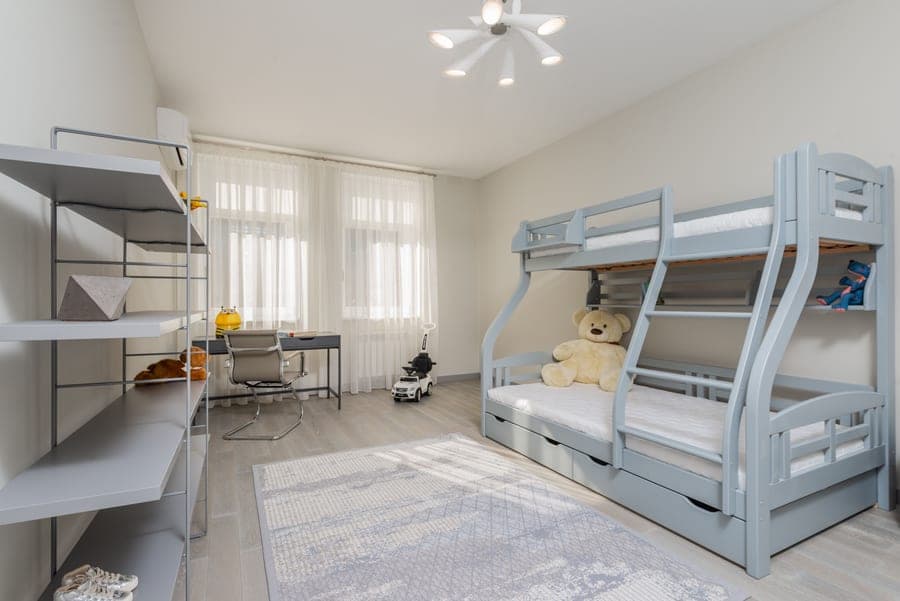
The Max & Lily Twin Over Twin Low Bunk Bed is the one we point people at most often. It publishes a 14 in guardrail, 400 lb per sleeping surface and an 8 in mattress ceiling, and the low deck means both the headroom problem and the fall-distance problem get smaller at the same time.
The DHP Miles Low Metal Bunk Bed is the budget version of the same idea: a 12.5 in guardrail, 200 lb top and 250 lb bottom, and a frame specified for 6 in mattresses. The lower weight limit is the trade, and it is the reason we would not buy it for two teenagers.
If your ceiling is 8 feet or better and nothing hangs from it, the full-height Max & Lily Twin Over Twin Bunk Bed is the better buy, because the standing clearance under the bottom bunk becomes usable storage or play space. That space is the entire reason to pay for the extra height.
The checks that come after the ceiling
Door swing. A bunk against the wall beside a door can block it at the top even when the floor plan looks fine. Check the door opens fully past the guardrail.
Light fixtures. A flush ceiling light over a top bunk is a burn risk and a head risk. Same test as the fan: measure to the bottom of the fixture.
Sloped ceilings. Put the bed with the high side over the sleeper’s head and the low side over their feet. A child can live with 18 inches over their ankles and cannot live with 18 inches over their face.
Smoke alarms and sprinklers. Do not block either. A sprinkler head needs clear space below it to work, and a smoke alarm directly above a mattress is both less effective and easier for a child to disable.
Getting it up the stairs. The assembled height is not your only problem — the longest single component usually is. Check the box dimensions against your stairwell turn before ordering a solid pine bunk, and read bunk bed assembly and stability for what the build actually involves.
If the ceiling will not take a bunk at all
Under about 7 feet, with a fan or a light in the way, a full-height bunk is simply the wrong product. The alternatives in order of how often we recommend them: a low bunk, a trundle under a standard twin, or two beds arranged in an L with storage in the corner. A low loft is also worth a look if only one child sleeps in the room.
Key takeaways
- Ceiling height minus deck height minus mattress thickness equals sitting headroom. Aim for 30 in, accept 24 in.
- Measure to the bottom of a ceiling fan or light fixture, not to the ceiling.
- A standard twin-over-twin needs about 8 ft. A low bunk works comfortably at 7 ft.
- The mattress ceiling on the listing is a guardrail-clearance rule, not a comfort suggestion - exceeding it breaks the 5 in federal minimum.
- On a sloped ceiling, put the high side over the sleeper's head and the low side over their feet.
What we'd buy
Every pick below carries the same spec block, so you can compare the numbers across this page and every other page on the site.
Younger siblings sharing a room
Max & Lily Twin Over Twin Low Bunk Bed
Max & Lily
The clearest published safety numbers of any bunk we looked at, on a frame low enough that a fall is a short one.
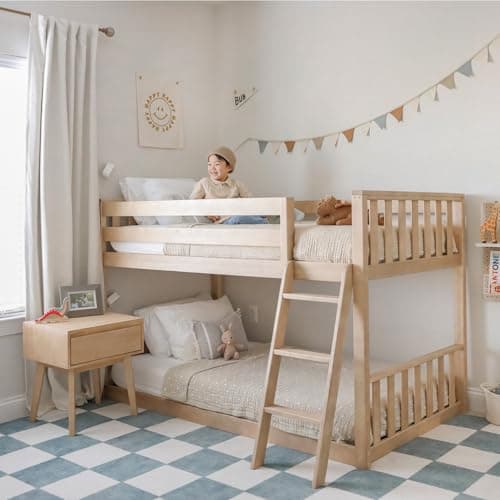
| Guardrail height above mattress | 14 in above the deck |
|---|---|
| Stated weight limit (per bunk) | 400 lb per sleeping surface |
| Manufacturer minimum age | Not published by the manufacturer |
| Mattress thickness ceiling | 8 in maximum (5 in recommended) |
| Materials / construction | Solid New Zealand pine, GREENGUARD Gold certified finish |
What works
- Publishes a guardrail height, a weight limit and a mattress ceiling — most brands publish one of the three
- 400 lb per surface is the highest stated capacity in this roundup, and it holds through the teen years
- Low overall height means the top deck sits well under a standard bunk
- Reversible, removable ladder with grooved treads and rounded edges
What doesn’t
- The 8 in mattress ceiling rules out most plush mattresses
- Solid pine is heavy to move once assembled
- No minimum age published, so the AAP's under-6 guidance is the only age rule you get
The catch: That 8 in ceiling is not a suggestion. Put a 10 in mattress on the top deck and the 14 in rail drops to 4 in of clearance, which is below the federal 5 in minimum. The bed stops being compliant and nobody tells you.
Small rooms on a budget
DHP Miles Low Metal Bunk Bed, Twin Over Twin
DHP
Publishes its guardrail height and both weight limits, which is more than most metal frames manage, and the bottom bunk sits on the floor.

| Guardrail height above mattress | 12.5 in above the deck |
|---|---|
| Stated weight limit (per bunk) | 200 lb top bunk / 250 lb bottom bunk |
| Manufacturer minimum age | Not published by the manufacturer |
| Mattress thickness ceiling | 6 in (the frame is specified for 6 in mattresses) |
| Materials / construction | Powder-coated metal frame with metal slats, no box spring required |
What works
- Publishes a guardrail height and separate top and bottom weight limits
- Metal slats support the mattress without a box spring
- Low profile with the bottom bunk close to the floor
- One of the least expensive bunks that still publishes real numbers
What doesn’t
- 200 lb top-bunk limit is half what the solid-wood options state
- Metal frames are more prone to creaking than pine as fasteners loosen
- The 6 in mattress specification is tight for an older child
The catch: The 200 lb top-bunk limit is the one to watch. It is fine for a child and it is not fine for a parent who climbs up to read at bedtime, which is a thing parents do without thinking about the sticker.
Rooms where the space under the bottom bunk has a job
Max & Lily Twin Over Twin Bunk Bed
Max & Lily
Full-height version of the low bunk, same 400 lb frame, and the extra clearance underneath is the whole reason to buy it.
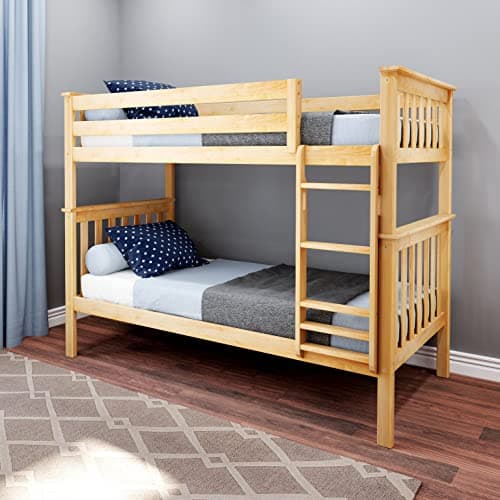
| Guardrail height above mattress | Not published by the manufacturer |
|---|---|
| Stated weight limit (per bunk) | 400 lb per sleeping surface |
| Manufacturer minimum age | Not published by the manufacturer |
| Mattress thickness ceiling | Not published by the manufacturer |
| Materials / construction | Solid New Zealand pine, GREENGUARD Gold certified finish |
What works
- Same 400 lb per-surface capacity as the low bunk
- Full standing clearance under the bottom bunk for storage or play
- Knot-free solid pine rather than particleboard
- Reversible ladder works on either side of the room
What doesn’t
- Guardrail height is not published for this model, so you have to measure it yourself on arrival
- A full-height top deck is a longer fall than the low bunk version
- Heavier and more awkward to assemble than the low bunk
The catch: Max & Lily publish a clear guardrail number on their low bunks and not on this one. That is not a reason to avoid the bed, but it does mean the 5 in clearance check is yours to run with a tape measure rather than theirs to guarantee on the listing.
Questions parents actually ask
How much ceiling height do you need for a bunk bed?
Enough that the child has 24 to 30 inches between the top of the mattress and the ceiling. A standard twin-over-twin bunk is 60 to 68 inches tall, so an 8-foot ceiling works with a 6-inch mattress. Under 8 feet, look at low bunks instead.
Can you put a bunk bed in a room with a 7 foot ceiling?
A low bunk, yes — a 38-inch deck with a 6-inch mattress leaves about 40 inches of headroom under an 84-inch ceiling, which is comfortable. A full-height bunk in the same room leaves under 20 inches, which is not usable.
Can a bunk bed go under a ceiling fan?
Only if you measure to the bottom of the blades and still have 24 to 30 inches of headroom above the mattress. A fan hanging at 84 inches turns an 8-foot room into a 7-foot room for this purpose. Most of the time the right answer is to move the bed or fit a low bunk.
How tall is a standard bunk bed?
Most twin-over-twin bunks measure 60 to 68 inches from floor to the top of the guardrail. Low bunks run roughly 38 to 48 inches. Always use the manufacturer’s published height for your own room rather than a category average.
Does a thicker mattress affect bunk bed ceiling clearance?
Yes, twice over. It raises the sleeper closer to the ceiling, and it lowers the effective guardrail height. Federal rules require 5 inches of rail above the mattress on a child’s bunk, so the manufacturer’s published mattress ceiling is a hard limit, not a preference.
What ceiling height do you need for a triple bunk?
More than most rooms have — three decks plus three mattresses plus headroom for the middle and top sleepers. Treat a 9-foot ceiling as the realistic starting point and run the same subtraction for each deck in turn.
Sources
Read next
- Best low bunk beds
The answer to most low-ceiling rooms.
- Mattress thickness and guardrails
Why the mattress ceiling is a safety limit.
- Loft bed ceiling height
The same arithmetic, with a desk underneath.
- Triple bunk beds explained
When three decks are on the table.
Back to Bunk Beds.