Desks & Storage
The best kids bookshelves
Front-facing display is the right answer at three and the wrong one at nine. Here is where the switch happens — and the wall anchor that is not optional either way.
We earn a commission from qualifying purchases made through links on this page, at no extra cost to you. How this site is funded.
Quick picks
The short version. Tap any row for the full write-up and its spec block.
| # | Product | Best for | Score | Price |
|---|---|---|---|---|
| 1 | Humble Crew Kids Bookshelf, 6-Tier Front-facing tiers at toddler height, which is the difference between books being read and books being shelved. | Pre-readers and early readers | 8.1 | |
| 2 |  Humble Crew Toy Storage Organizer with Shelf and 9 Bins Nine removable bins and an anti-tip kit in the box — the storage unit that publishes a per-shelf load and ships the anchor. | Toy chaos at floor level | 8.4 | |
| 3 |  Kids Desk with Hutch and Shelving Vertical storage above the work surface, for a room where the desk has to hold everything. | A desk that is also the bookshelf | 8.0 |
How we chose
We are a small publisher, not a testing lab. We don’t buy, assemble or sleep in the beds we write about, and we won’t pretend otherwise. What we do instead is read the published specifications and check them against the rules that actually govern children’s beds in the United States: the federal standard for children’s bunk beds (16 CFR Part 1513), the ASTM F1427 requirements it incorporates, and the American Academy of Pediatrics’ guidance on upper-bunk age. Where a manufacturer publishes no number, we write “not published by the manufacturer” rather than guess — that absence is itself worth knowing. We read owner feedback at volume for the things specs can’t tell you, and we label it as signal, not proof.
We earn a commission when you buy through our links. It never changes an ordering. Our full editorial policy.
There are two kinds of children’s bookshelf and they are for different children.
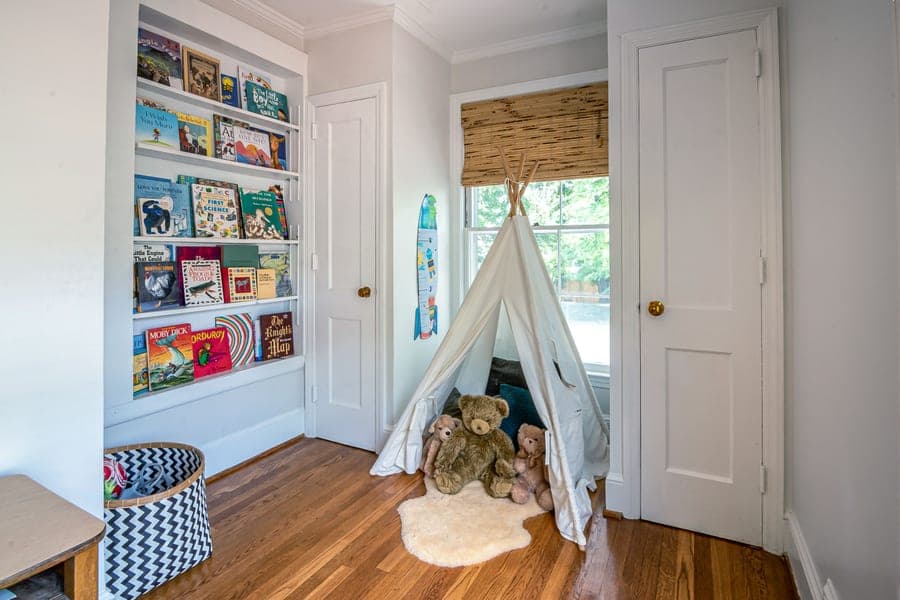
Front-facing shelves display covers. A pre-reader picks a book by its picture, so covers facing out is the difference between books being read and books being stored. The cost is capacity — front-facing storage holds a fraction of what spine-out shelving holds per foot of wall.
Spine-out shelving is ordinary shelving. It holds far more, and it requires a child who can read a spine and remember what is behind it.
The switch happens somewhere around six or seven, when a child starts reading chapter books and the covers stop doing the selecting.
| Front-facing | Spine-out | |
|---|---|---|
| Books per foot of wall | Few | Many |
| Child picks independently | Yes, from age 2 | From around 6-7 |
| Tidying is child-sized | Yes | Yes |
| Suits picture books | Ideally | Poorly — they slump |
| Suits chapter books | Wastefully | Yes |
| Outgrown around | 6-7 | Not really |
Anchor it. Every one of them.
A bookshelf in a child’s room gets strapped to the wall, without exception, and you do it before you put a single book on it. Furniture tip-over is one of the genuinely serious hazards in a bedroom, and a bookcase is the classic case because a child climbing it loads the top shelf while standing on the bottom one. If a unit ships without an anti-tip kit, buy a strap. If you are renting and worried about the wall, fix a small batten and patch it when you leave — this is not the thing to skip.
The other specification worth having
A published per-shelf load. Almost nothing in this category states one — Humble Crew’s toy organizer states 20 lb per level, which is unusual and useful, and also lower than people assume. A single bin of wooden blocks gets close to it.
Books are heavier than they look. A foot of hardback picture books is easily ten pounds, so a four-foot shelf of them is well past what an engineered-wood unit rated at 20 lb per level is designed for. That overload is how a shelf starts to bow and a frame starts to lean.
Height, and why low is better
A shelf a child cannot reach is a shelf a parent manages. Low, open shelving means a child serves themselves and — more importantly — tidies up themselves, because putting something back is as easy as taking it out.
It also removes the climbing incentive, which is the safety half of the same argument. A unit whose top shelf is at a child’s eye level is a unit nobody needs to climb.
Bookshelves in odd places
Under a loft bed. A front-facing shelf works particularly well in an under-deck reading nook, because the books face a child sitting on the floor. Anchor it — out of sight does not mean out of danger. See what fits under a loft bed.
Beside a bunk bed. Wall-mounted shelving at top-bunk height replaces the bedside table a bunk cannot have. Mount to the wall, never to the bed frame, and never to the guardrail.
Above a desk. That is a hutch, and it comes with the same anchoring requirement plus a more enclosed working feeling.
The picks, in full
Every pick below carries the same spec block, so you can compare the numbers across this page and every other page on the site.
#1 · Pre-readers and early readers
Humble Crew Kids Bookshelf, 6-Tier
Humble Crew
Front-facing tiers at toddler height, which is the difference between books being read and books being shelved.
| Guardrail height above mattress | Not applicable |
|---|---|
| Stated weight limit (per bunk) | Not published by the manufacturer |
| Manufacturer minimum age | Not published by the manufacturer |
| Mattress thickness ceiling | Not applicable |
| Materials / construction | Engineered wood frame with reinforced steel dowels |
What works
- Front-facing display means a child picks by cover, not by spine
- Low enough for a two-year-old to serve themselves
- Narrow footprint against a wall
- Holds a genuinely useful number of picture books
What doesn’t
- Front-facing storage is inefficient — it holds fewer books per foot
- Outgrown once a child reads chapter books
- Engineered wood, not solid
The catch: Front-facing shelving trades capacity for visibility. It is the right trade for a three-year-old and the wrong one for a nine-year-old with a hundred books.
#2 · Toy chaos at floor level
Humble Crew Toy Storage Organizer with Shelf and 9 Bins
Humble Crew
Nine removable bins and an anti-tip kit in the box — the storage unit that publishes a per-shelf load and ships the anchor.
| Guardrail height above mattress | Not applicable |
|---|---|
| Stated weight limit (per bunk) | Each level supports up to 20 lb |
| Manufacturer minimum age | Not published by the manufacturer |
| Mattress thickness ceiling | Not applicable |
| Materials / construction | Engineered wood frame with reinforced steel dowels; BPA- and phthalate-free bins; wall anchor anti-tip kit included |
What works
- Publishes a per-level weight limit, which storage furniture rarely does
- Anti-tip wall anchor kit is in the box
- Bins lift out, so tidying is a child-sized job
- BPA- and phthalate-free bins
What doesn’t
- 20 lb per level is reached fast by wooden blocks or die-cast cars
- Bins hide what is inside, so things get lost in them
- Engineered wood frame flexes if it is not anchored
The catch: 20 lb per level is not a lot. A single bin of wooden blocks can get close, and overloading an engineered-wood frame is exactly how it starts to lean — which is also why the anchor is in the box.
#3 · A desk that is also the bookshelf
Kids Desk with Hutch and Shelving
Various (search by configuration)
Vertical storage above the work surface, for a room where the desk has to hold everything.
| Guardrail height above mattress | Not applicable |
|---|---|
| Stated weight limit (per bunk) | Not published by the manufacturer |
| Manufacturer minimum age | Not published by the manufacturer |
| Mattress thickness ceiling | Not applicable |
| Materials / construction | Engineered wood with laminate finish; wall anchor typically included |
What works
- Shelves above the desk replace a separate bookcase
- Keeps the working surface clear because there is somewhere for things to go
- Usually includes an anti-tip wall anchor
- Fits a narrow wall better than a desk plus a bookcase side by side
What doesn’t
- The hutch makes the desk feel enclosed for a small child
- Tall furniture must be anchored, without exception
- Rarely adjustable in height
The catch: Anything this tall in a child's room gets anchored to the wall, every time, no exceptions. Tip-over is one of the genuinely serious furniture risks in a bedroom and the anchor in the box is not optional.
Questions parents actually ask
What is the best bookshelf for a toddler?
A low front-facing unit, so a child picks by cover and can reach every shelf themselves. Anchor it to the wall before loading it.
When should you switch from front-facing to normal shelves?
Around six or seven, when a child starts reading chapter books and selecting by spine.
Do bookshelves need to be anchored to the wall?
Yes, every one in a child’s room, before you put anything on them. Tip-over is a serious and preventable hazard.
How much weight can a kids bookshelf hold?
Rarely published. Where it is, 20 lb per level is typical for engineered wood — less than a foot of hardback picture books.
How tall should a kids bookshelf be?
Low enough that the child can reach the top shelf. That makes tidying possible and removes the reason to climb.
Can you put a bookshelf under a loft bed?
Yes, and a front-facing one works well there. Anchor it — being out of sight does not reduce the risk.
Sources
Read next
- Toy storage that works
The same principle applied to everything that isn't a book.
- What fits under a loft bed
Where a front-facing shelf earns its space.
- Desk with hutch vs open desk
Shelving above the work surface.
Back to Desks & Storage.