Desks & Storage
The best kids storage benches
A storage bench is a box with a heavy lid and a child leaning into it. The CPSC has counted 34 deaths in chests since 1996, so this is a category where the hinge outranks the finish.

We earn a commission from qualifying purchases made through links on this page, at no extra cost to you. How this site is funded.
Quick picks
The short version. Tap any row for the full write-up and its spec block.
| # | Product | Best for | Score | Price |
|---|---|---|---|---|
| 1 | 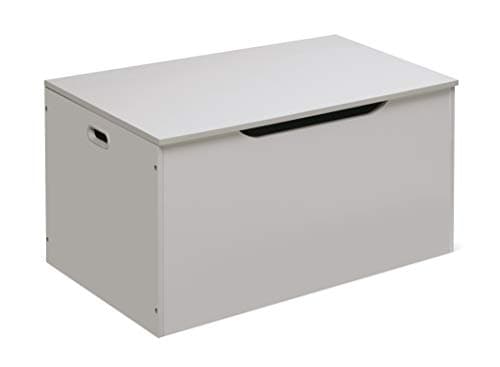 Badger Basket Kids Toy Box Bench The only bench here whose listing says the lid stays open at any angle - which is the exact wording the CPSC asks for. | A bench a child can open and close unsupervised | 8.6 | |
| 2 | 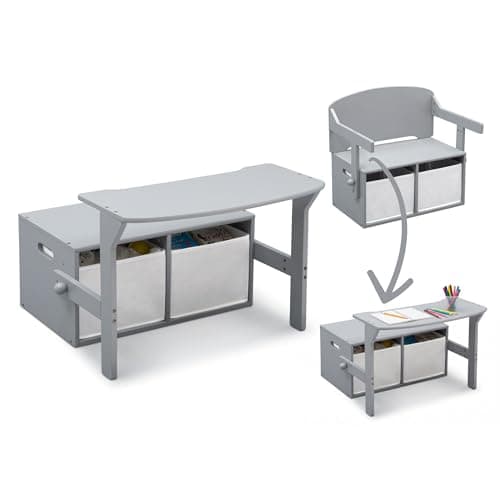 Delta Children MySize Kids Convertible Activity Bench Two fabric bins under the seat instead of one deep chest with a heavy lid, which sidesteps the hazard rather than managing it. | The youngest children, and rooms where nobody will supervise the lid | 8.1 | |
| 3 | 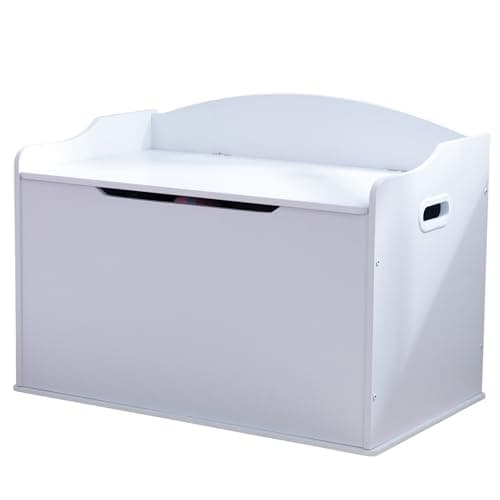 KidKraft Austin Wooden Toy Box Bench Solid wood, a safety hinge and a hand cutout instead of a knob - the design decisions are the right ones throughout. | A bench that survives being a bench | 8.0 | |
| 4 | 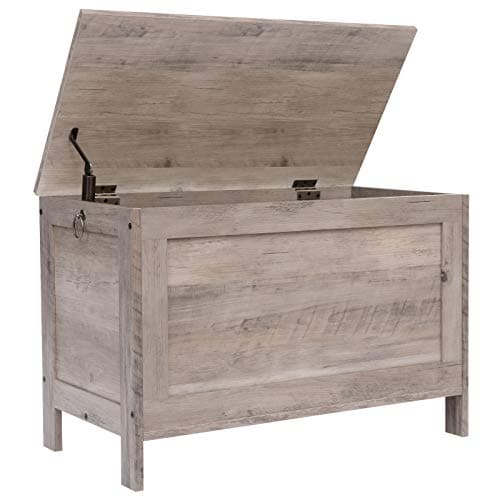 HOOBRO Toy Box Storage Chest Bench Publishes a 330 lb top capacity, which is the highest stated figure here and the only one that comfortably covers an adult. | A bench adults will actually sit on | 7.7 | |
| 5 | 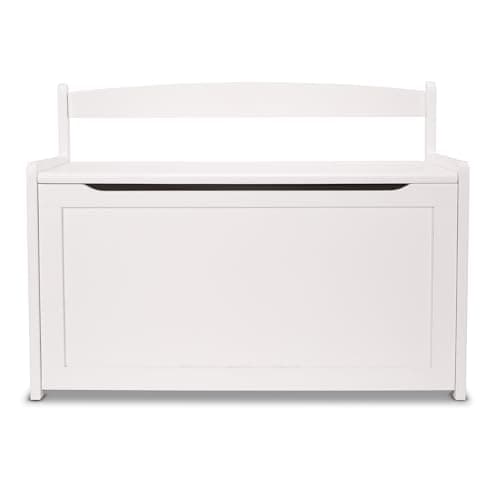 Melissa & Doug Wooden Toy Chest The biggest cavity here by a wide margin, and the published figures say to treat it as a chest rather than a seat. | A playroom with more toys than floor | 7.5 |
How we chose
We are a small publisher, not a testing lab. We don’t buy, assemble or sleep in the beds we write about, and we won’t pretend otherwise. What we do instead is read the published specifications and check them against the rules that actually govern children’s beds in the United States: the federal standard for children’s bunk beds (16 CFR Part 1513), the ASTM F1427 requirements it incorporates, and the American Academy of Pediatrics’ guidance on upper-bunk age. Where a manufacturer publishes no number, we write “not published by the manufacturer” rather than guess — that absence is itself worth knowing. We read owner feedback at volume for the things specs can’t tell you, and we label it as signal, not proof.
We earn a commission when you buy through our links. It never changes an ordering. Our full editorial policy.
The short answer
The bench to buy is the Badger Basket Kids Toy Box Bench, and it wins on one sentence in its listing: the lid stays open at any angle. That is the exact behavior the CPSC asks for from a lid support, and it is the only listing in this roundup that states it in those terms. It also publishes a 175 lb seat capacity and 4.5 cubic feet of storage, which puts it ahead of better-known boxes that publish neither.
For a child under about four, the Delta Children MySize Convertible Activity Bench is the safer shape — two fabric bins under the seat rather than one deep cavity with a lid, so the hazard is designed out rather than managed. It also stores a fraction as much, which is the trade you are making.
Why the lid comes first in this category
The CPSC has received reports of 34 deaths since 1996 involving children younger than 18 in storage and toy chests, and roughly 27 companies have corrected more than 14 million chests between them. Those are not deaths from falling over or from splinters. They are children whose heads and necks were caught by a lid that came down, and children who climbed into a chest and could not get air.
That gives you three things to check, and the CPSC names all three. First, the lid support: if it does not hold the lid open in every position, the agency says to remove it or replace it with a spring-loaded support that will keep the lid open in any position. Second, latches and locks: a chest that can fasten shut is a chest a child can be shut inside, and the advice on unrecalled chests with automatic latches is to disable or remove the lock. Third, ventilation: all toy chests should have air holes that are not blocked by the floor or by being pushed against a wall. The CPSC attributes the lid and ventilation provisions to the federal toy standard, ASTM F963-07.
Read that list against a product page and the category sorts itself very quickly. Almost every bench sold today says “safety hinge”, and “safety hinge” is not a specification — it is a phrase. The useful listings say what the hinge does. “Stays open at any angle” is a claim you can test the day it arrives; “prevents the lid from dropping accidentally” is softer and might only mean the lid is slow.
Test the lid before the bench holds anything
Open the lid to a third, let go, and watch. It should stay exactly where you left it. Then do it at halfway and at two-thirds. If the lid creeps shut at any point in the travel, the support is not doing the job the CPSC describes, and the bench is not ready for a child to use unsupervised. The same ten-second test is worth repeating twice a year, because gas and friction supports weaken.
The second spec: a published seat capacity
A storage bench is sold as seating, and most of them never say what they can seat. Of the five picks here, three publish a number and two do not, and the spread is enormous: 330 lb for the HOOBRO, 175 lb for the Badger Basket, and 81 lb for the Melissa & Doug — which, read honestly, means the Melissa & Doug is a toy chest that is not intended to be sat on by an adult at all.
That matters more than it sounds. In a child’s bedroom, the thing at the foot of the bed is where a parent sits to read a bedtime story, where a grandparent sits to put shoes on, and where two eight-year-olds will both stand at once during a game. A number under about 150 lb means the bench is a lid with storage under it, and the day it fails is the day somebody sits down heavily.
| Bench | Seat capacity | Storage | Lid claim |
|---|---|---|---|
| Badger Basket Toy Box Bench | 175 lb | 4.5 cu ft | Stays open at any angle |
| Delta Children MySize | Not published | Two fabric bins | No chest lid - open bins |
| KidKraft Austin | Not published | Not published | Prevents accidental drop |
| HOOBRO Storage Chest | 330 lb | Not published | Prevents sudden closure |
| Melissa & Doug Toy Chest | 81 lb (tested) | 8.25 cu ft | Safety-hinged, smooth |
The third spec: ventilation, which nobody advertises
Not one of the five listings we read mentions ventilation holes. That is not evidence the boxes lack them — plenty of chests have holes drilled in the base or the back that the marketing copy never mentions — but it does mean you cannot shop for it, and you have to check the box in front of you.
There are two things to do on delivery day. Look for air holes, and if there are none in a fully enclosed chest, drill a pair in the back near the top. Then place the bench so the holes stay clear: pushed flat against a wall or sat on carpet, a hole in the back or the base does nothing at all, which is precisely the failure mode the CPSC calls out.
The other reason to leave a gap behind a bench is tip-over. Anything in a child’s room with a lid they will lean into and a top they will climb on belongs anchored, and the brackets are cheap. Our furniture anchoring guide covers how to do it in a rental without losing the deposit.
Bench, chest, or ottoman: three different products
The search term covers three shapes and they are not interchangeable. A storage bench is low and long, the seat is the lid, and the height is set so a child’s feet reach the floor — around 15 to 19 inches. A toy chest is taller and deeper, is not really intended as seating, and buys you far more volume: the tallest box here is 33 inches and holds 8.25 cubic feet. A storage ottoman is upholstered, usually fabric over a frame, and the lid is light enough that the hinge question mostly goes away — along with the strength to be stood on.
Pick by where it is going. At the foot of a bed in a small room, a low bench earns its place twice because it is also the place to sit to put socks on. In a playroom, volume wins and a tall chest is the better buy. In a shared bedroom where the floor is the problem, our toy storage guide makes the case for open bins over any box with a lid — a child tidies into a bin and does not tidy into a chest.
What the deep cavity costs you in practice
One big box is the least useful storage shape for a child, and it is worth being honest about that before buying the biggest one available. Everything ends up at the bottom, nothing is findable, and the “tidy up” instruction turns into sweeping toys into a pit. Within a month the top three inches is the only part in use.
Two things fix it. Put bins inside the box — fabric cubes or plastic totes that lift out, so a category of toy comes out as a unit. Or buy the smaller box and add a shelving unit with bins for the things used daily, which is the case our bookshelf picks make at length. The bench then stores the bulky, occasional things — dress-up clothes, spare bedding, the enormous soft toy — which is what a deep cavity is genuinely good at.
Materials, and what they mean for a bench specifically
Solid wood is the right material for anything that gets sat on, and two of these are wood. Engineered wood and particleboard are fine for a chest and marginal for a seat, because the failure point is the joint where the top panel meets the sides and the fastener in a particleboard edge is only ever as good as the glue around it. The HOOBRO publishes the highest capacity here on particleboard, which is plausible for a static load and worth treating with more caution than the same number on solid pine.
The one certification worth paying for is GREENGUARD Gold, which the Delta Children bench carries. It is an audited low-emissions certification rather than a marketing adjective, and in a closed box full of soft toys in a small bedroom, low-emission finish is a reasonable thing to care about. Nothing else in this roundup names a certification at all.
Secondhand chests: the one place to be properly careful
Old chests are the reason this category has a death toll. Many of the CPSC’s cases involve decades-old cedar chests whose lids latch automatically, and replacement parts for the recalled Lane and Virginia Maid chests are no longer available — the agency’s advice there is to remove the locks completely. A handsome hand-me-down chest with a working latch is not a storage bench for a child’s room, and no amount of refinishing changes that.
If you do buy used, the rules are the same as for a used bed: check the CPSC recall database by brand before money changes hands, remove any lock or latch, test the lid support through its full travel, and drill ventilation if there is none. Our secondhand buying guide has the same checklist for beds, where the stakes are comparable.
Key takeaways
- The lid support is the spec. It must hold the lid open in ANY position, not just fully open - test it on delivery.
- Remove or disable any latch or lock. A chest that fastens shut is a chest a child can be shut inside.
- Ventilation holes must stay unblocked by the floor or the wall. No listing here mentions them, so check the box yourself.
- A published seat capacity separates a bench from a toy chest. 81 lb is a chest; 175 lb and up is a seat.
- One deep cavity is the least useful shape for a child. Put lift-out bins inside it, or buy less box and more shelf.
The picks, in full
Every pick below carries the same spec block, so you can compare the numbers across this page and every other page on the site.
#1 · A bench a child can open and close unsupervised
Badger Basket Kids Toy Box Bench
Badger Basket
The only bench here whose listing says the lid stays open at any angle - which is the exact wording the CPSC asks for.
| Guardrail height above mattress | Not applicable |
|---|---|
| Stated weight limit (per bunk) | 175 lb seat capacity, 4.5 cu ft storage |
| Manufacturer minimum age | Not published by the manufacturer |
| Mattress thickness ceiling | Not applicable |
| Materials / construction | Wood with a no-slam safety hinge |
What works
- Lid is published as staying open at any angle, not just fully open
- Publishes a seat capacity (175 lb) and a storage volume (4.5 cu ft)
- 31.5 x 19 x 15.75 in puts the seat at a height a small child can use
- No latch, no lock, no knob to grab
What doesn’t
- No ventilation holes mentioned anywhere in the listing
- 175 lb is fine for children and marginal for an adult sitting down hard
- Wood finish marks easily at the front edge where feet land
- No published minimum age
The catch: A hinge that holds the lid at any angle is the single safety feature that matters here, and this listing is the only one that states it in those terms. What it does not state is ventilation, and the CPSC asks for air holes that are not blocked by the floor or a wall. Check the shell has them before it holds a child's weight on the lid.
#2 · The youngest children, and rooms where nobody will supervise the lid
Delta Children MySize Kids Convertible Activity Bench
Delta Children
Two fabric bins under the seat instead of one deep chest with a heavy lid, which sidesteps the hazard rather than managing it.
| Guardrail height above mattress | Not applicable |
|---|---|
| Stated weight limit (per bunk) | Not published by the manufacturer |
| Manufacturer minimum age | Manufacturer states ages 3+ |
| Mattress thickness ceiling | Not applicable |
| Materials / construction | Engineered wood and fabric, GREENGUARD Gold certified, lead and phthalate safe finish |
What works
- Two removable fabric bins rather than one deep cavity, so there is nothing for a child to climb into
- GREENGUARD Gold certified, which is an audited emissions certification rather than a marketing word
- Converts from bench to desk, so it earns its floor space twice
- 26.5 x 17.25 x 22.75 in, published - small enough for a shared room
What doesn’t
- Publishes no seat weight capacity
- Fabric bins hold far less than a 4.5 cu ft wooden chest
- Engineered wood, not solid, and the edges chip
- Converting it is a two-hand job an adult has to do
The catch: The reason this is the safest design here is also the reason it stores the least: there is no deep chest. If the problem you are solving is a floor covered in toys, two fabric bins will not solve it, and you will be back for a bigger box within a year.
#3 · A bench that survives being a bench
KidKraft Austin Wooden Toy Box Bench
KidKraft
Solid wood, a safety hinge and a hand cutout instead of a knob - the design decisions are the right ones throughout.
| Guardrail height above mattress | Not applicable |
|---|---|
| Stated weight limit (per bunk) | Not published by the manufacturer |
| Manufacturer minimum age | Manufacturer states ages 3+ |
| Mattress thickness ceiling | Not applicable |
| Materials / construction | Premium wood with a safety hinge lid support |
What works
- Front cutout notch instead of a handle or knob, so there is nothing to pinch a hand
- Safety hinge published as preventing the lid dropping accidentally
- Curved back and sloped sides mean it reads as furniture rather than a crate
- Side cutout handles make it movable by one adult
What doesn’t
- Publishes no seat weight capacity, which is an odd omission on something sold as a bench
- The most expensive bench in this roundup by a clear margin
- Assembly is quoted at around an hour
- No ventilation holes mentioned
The catch: KidKraft says the hinge prevents the lid dropping accidentally. It does not say the lid holds at every angle, and those are different claims - the CPSC's test is that the support keeps the lid open in ANY position. Open it halfway and let go before a child uses it unsupervised.
#4 · A bench adults will actually sit on
HOOBRO Toy Box Storage Chest Bench
HOOBRO
Publishes a 330 lb top capacity, which is the highest stated figure here and the only one that comfortably covers an adult.
| Guardrail height above mattress | Not applicable |
|---|---|
| Stated weight limit (per bunk) | 330 lb upper surface capacity, published |
| Manufacturer minimum age | Not published by the manufacturer |
| Mattress thickness ceiling | Not applicable |
| Materials / construction | Thick particleboard with reinforced construction and safety hinges |
What works
- 330 lb published top capacity is roughly double the nearest stated figure
- Safety hinges described as preventing sudden closures
- Two side rings for carrying it loaded
- 29.9 x 15.7 x 18.9 in, published, and shallow enough for a hallway or a bed foot
What doesn’t
- Particleboard, which does not survive being soaked or dropped
- No published minimum age and no child-specific safety testing claimed
- Sold as general furniture, so the toy-chest provisions are not its design brief
- No ventilation holes mentioned
The catch: It is the strongest seat here and the least child-specific product here. The listing sells it as a shoe bench and an entryway chest as readily as a toy box, which tells you where the design attention went. Check the hinge holds mid-travel yourself before it goes in a toddler's room.
#5 · A playroom with more toys than floor
Melissa & Doug Wooden Toy Chest
Melissa & Doug
The biggest cavity here by a wide margin, and the published figures say to treat it as a chest rather than a seat.
| Guardrail height above mattress | Not applicable |
|---|---|
| Stated weight limit (per bunk) | Weight tested to 81 lb, 8.25 cu ft storage |
| Manufacturer minimum age | Manufacturer states ages 3+ |
| Mattress thickness ceiling | Not applicable |
| Materials / construction | Sturdy wood with a safety-hinged lid |
What works
- 8.25 cu ft is nearly twice the storage of the next-biggest box here
- Publishes an age range AND a tested weight figure, which is rare candor
- Safety-hinged lid described as opening and closing smoothly to protect fingers
- Assembles with one Phillips screwdriver
What doesn’t
- 81 lb is a low tested figure for anything a child will stand on, let alone an adult
- 33 in tall, so a small child reaching in is leaning over a deep drop
- Screwdriver not included, and the fasteners are the fiddly kind
- No ventilation holes mentioned
The catch: Read the 81 lb figure as the answer to whether this is a bench: it is not. It is a tall toy chest with a safe lid, and a 33 in box with 8 cu ft inside is a cavity a determined three-year-old can get into. Keep it against a wall it cannot be climbed from and do not let it become the seat.
Questions parents actually ask
Are toy box benches safe for kids?
They are, with three conditions the CPSC sets out: the lid support has to hold the lid open in any position, any latch or lock has to be removed or disabled, and the chest needs ventilation holes that are not blocked by the floor or a wall. A bench that fails any of those is not safe, regardless of brand.
What weight can a kids storage bench hold?
It varies far more than you would expect, and most listings do not say. Among the picks here the published figures run from 81 lb (weight-tested, on a tall toy chest) to 330 lb. Treat anything under about 150 lb as a chest rather than a seat, and look for the number before you buy.
Does a storage bench need to be anchored to the wall?
A low bench is not a tip-over risk in the way a dresser is, but a tall toy chest a child leans into or climbs on should be anchored, and the bracket usually costs a couple of dollars. Our anchoring guide covers the cases.
What is the difference between a storage bench and a toy chest?
Height and intent. A bench is 15 to 19 inches tall so a child’s feet reach the floor, and the lid is designed to be sat on. A toy chest is taller, holds much more, and is often not rated for seating at all — the tallest box in this roundup is 33 inches and publishes an 81 lb tested figure.
Is a secondhand toy chest safe to use?
Only after you have checked it. Older chests are the source of most of the CPSC’s reported deaths, replacement parts for the recalled Lane and Virginia Maid chests are no longer available, and the agency’s advice is to remove those locks entirely. Check the recall database by brand, remove any latch, test the lid, and add ventilation if there is none.
What size storage bench fits at the end of a twin bed?
A twin is 38 inches wide, so a bench of roughly 29 to 32 inches sits neatly at the foot without overhanging. All but one of the picks here fall in that range. Check the depth too — 15 to 19 inches is typical, and it is depth that decides whether the door still opens.
Sources
Read next
- Toy storage that works
Why open bins beat any box with a lid for daily tidying.
- Anchoring kids furniture to the wall
The tip-over job, including how to do it in a rental.
- Best kids bookshelves
Storage that uses wall instead of floor.
- Best kids desk lamps
The other thing the desk corner needs.
Back to Desks & Storage.