Sleep Safety
Bunk bed ladder safety
The ladder is the part of a bunk bed a child uses twice a day for years, and the only part that is used half asleep.

We earn a commission from qualifying purchases made through links on this page, at no extra cost to you. How this site is funded.
The short answer
A bunk ladder is safe when four things are true: it is bolted to the frame rather than hooked over it, the rungs are flat or grooved rather than round, it leans rather than standing vertical, and the route down is lit. The last one is the cheapest to fix and the most often skipped — a rechargeable motion-sensor night light at the foot of the ladder costs almost nothing and addresses the single condition that makes the climb hard.
If the ladder on your bed fails any of the first three and cannot be changed, the realistic alternative is a stair bunk. No aftermarket product turns a bad ladder into a good one.
Why the ladder is the part that matters
Everything else on a bunk bed is static. The guardrail sits there, the frame sits there, the mattress sits there, and once they are right they stay right. The ladder is the only moving part of the system, and the person operating it is a child, barefoot, in the dark, often less than fully awake and sometimes in a hurry.
That is why a ladder that is perfectly adequate at 7 p.m. can be the weak point at 2 a.m., and why almost everything useful you can do about bunk safety after the bed is assembled concerns the climb rather than the bed.
Check 1: how the ladder attaches
There are two systems. A bolted or integrated ladder is part of the frame — it cannot shift, slide sideways or be pulled away. A hook-over ladder rests on the top rail with two J-hooks and relies on gravity and friction.
Hook-over ladders are not inherently unsafe and they are easier to move from one side of the bed to the other, which is a real advantage when the room layout changes. The failure mode is specific: a child pulling the ladder toward them as they step on, or the foot of the ladder sliding out on a hard floor. If your bed uses hooks, check that both engage fully, and put something under the feet that grips — ladder feet on laminate are the most common complaint in this category.
A reversible ladder, which many Max & Lily and DHP frames use, is worth having for a different reason: you can put the ladder on the side of the bed that faces the door, which shortens the trip in the dark.
Check 2: rung shape and spacing
A round rung concentrates the child’s weight into a narrow line across the arch of a bare foot, and it hurts. A child who finds the ladder painful rushes it, and rushing is the problem. Flat, grooved or ribbed treads spread the load and give grip, and this is one of the few places where a more expensive bed is reliably better — the Max & Lily frames specify grooved treads with rounded edges, and it shows in how children use them.
Spacing matters less than shape but is worth a look. Rungs too far apart make a short child stretch; rungs too close make a tall one hurry. There is no useful universal number here, so the practical test is to watch the actual child climb it twice and see whether they look comfortable.
If the rungs are round and the bed is otherwise fine, foam or fabric ladder covers exist and do help with comfort. They do nothing for grip and some reduce it, so treat them as a comfort fix rather than a safety one.

Check 3: the angle
A ladder that leans is easier to come down than one that is vertical, because a leaning ladder lets a child descend facing forward or semi-sideways rather than committing fully to a backward climb. It also puts the body weight over the rungs instead of hanging off them.
The cost of a leaning ladder is floor length, which is the same trade stairs make on a larger scale. Vertical ladders exist because they are compact, and on a bed for an older child that is a reasonable choice. On a bed for a six or seven-year-old it is the configuration we would avoid where there is an alternative.
If the bed has a vertical ladder and a younger child, the honest options are to put that child on the bottom bunk or to buy a stair bunk. Our stair bunk roundup covers the beds, and stairs vs ladder bunk beds covers the trade in floor space.
Check 4: light, and the floor at the bottom
The climb that goes wrong is the one to the bathroom. Two night lights fix most of it: one where the foot of the ladder meets the floor, and one between the bed and the bedroom door. Motion-sensor and rechargeable is the combination that actually stays in service, because a light that needs batteries changed is a light that is dead within a year.
Do not use a bright overhead light on a switch for this. A child who turns on a ceiling light at 2 a.m. is awake for the next hour, and the whole point is to make the trip survivable without properly waking up.
The floor at the bottom is the other half. A clear landing zone matters more than almost anything about the ladder itself, and the thing most often in it is toys. This is a storage problem disguised as a safety one, and the fix is a bin or a bench the child can actually use — see toy storage that works.
Do not hang anything on the ladder
Bags, dressing gowns, skipping ropes, backpack straps — a ladder is not a hook, and anything looped over a rung is both a trip hazard on the climb and a strangulation hazard on a bed. The same goes for anything tied to the guardrail. Put a hook on the wall instead.
Rules worth having, beyond the hardware
One child on the ladder at a time. Obvious, routinely ignored, and the cause of a lot of minor falls.
No playing on the ladder. A ladder is transport. A child who treats it as climbing equipment will eventually do it when nobody is watching.
Nothing carried up. A child needs both hands. Drinks, books and tablets go up after the child does, handed over the rail, or they do not go up.
Shoes off, socks a question. Bare feet grip better than socks on most treads. If your child insists on socks, grip socks are a genuinely useful purchase.
Re-tighten with the rest of the bed. Ladder bolts back out faster than frame bolts, because the ladder takes the most frequent dynamic load. Put them on the same schedule as the frame — the method is in bunk bed assembly and stability.
The one thing the ladder cannot fix
A ladder cannot make a child old enough. The American Academy of Pediatrics advises against children under six on the top bunk, and ladder quality does not enter into that recommendation — it is about coordination and about staying put while asleep. A superb ladder on a bed with a four-year-old on top is still the wrong arrangement. The signals that matter alongside the birthday are in top bunk age readiness.
Key takeaways
- Bolted or integrated ladders cannot shift. Hook-over ladders can - check both hooks engage and the feet grip the floor.
- Flat or grooved treads beat round rungs, because a painful ladder is a rushed ladder.
- A leaning ladder is easier to descend than a vertical one; the cost is floor length.
- Two motion-sensor night lights - one at the foot of the ladder, one by the door - are the cheapest safety buy available.
- Never hang anything on a ladder or a guardrail, and keep the landing zone clear of toys.
What we'd buy
Every pick below carries the same spec block, so you can compare the numbers across this page and every other page on the site.
A lit route down from the top bunk
Rechargeable Motion-Sensor Night Light
Various (search by spec)
The cheapest safety upgrade for a bunk: light on the ladder before a foot goes on it.
| Guardrail height above mattress | Not applicable |
|---|---|
| Stated weight limit (per bunk) | Not applicable |
| Manufacturer minimum age | Not published by the manufacturer |
| Mattress thickness ceiling | Not applicable |
| Materials / construction | Rechargeable LED with adhesive or magnetic mount |
What works
- Lights the ladder and the floor at the bottom of it automatically
- Warm color temperature does not wake the room the way a white light does
- No wiring, so it mounts anywhere on the frame
- Costs less than almost any other change you can make to a bunk
What doesn’t
- Rechargeable means remembering to recharge it
- Adhesive mounts fail on textured or painted surfaces
- Motion sensors can trigger from the bed and wake the sleeper
The catch: This is a generic category rather than a single model — search on the specification (rechargeable, motion sensor, warm white) rather than on a brand, because the brands turn over constantly and the spec does not.
Adding a rail to a bed that came without one
Max & Lily Add-On Guardrail
Max & Lily
A matching wooden rail that bolts to the frame — the right answer when the bed is a Max & Lily and the rail is missing.
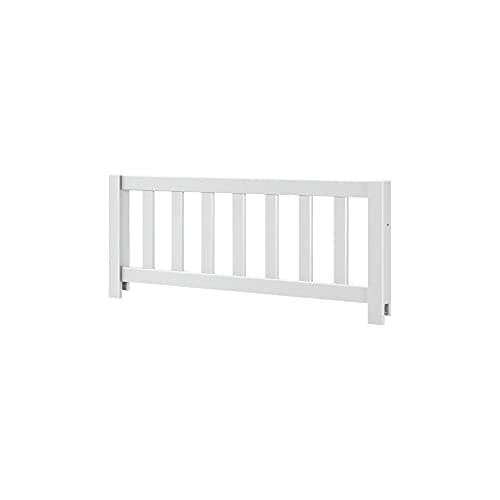
| Guardrail height above mattress | 13.25 in from the point of attachment |
|---|---|
| Stated weight limit (per bunk) | Not applicable |
| Manufacturer minimum age | Not published by the manufacturer |
| Mattress thickness ceiling | Determined by the bed it attaches to |
| Materials / construction | Solid New Zealand pine to match the bed frames |
What works
- Publishes its height, which almost no aftermarket rail does
- Bolts to the frame rather than clamping under the mattress
- Matches the finish of the beds it is designed for
- Solid wood, so it does not flex the way a fabric rail does
What doesn’t
- Only fits Max & Lily frames — this is not a universal rail
- 13.25 in of rail is consumed fast by a thick mattress
- Costs more than a generic clamp-on rail
The catch: 13.25 in measured from the attachment point is not 13.25 in above your mattress. Subtract the mattress thickness and check that at least 5 in of rail is still standing proud, per the federal rule.
Children who resist a rail
hiccapop Toddler Bed Bumpers
hiccapop
Foam bolsters that slide under the fitted sheet — a soft edge rather than a cage, for the child a metal rail upsets.
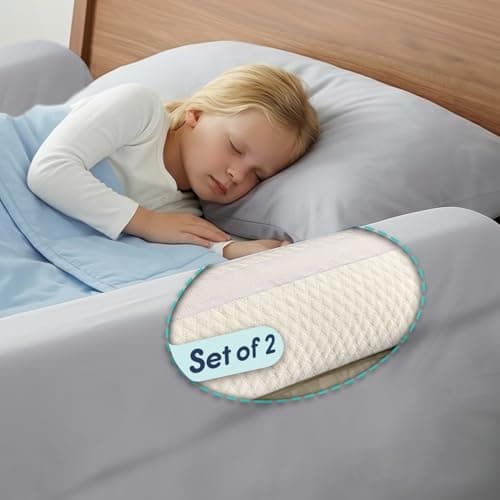
| Guardrail height above mattress | Foam bolster, low profile (height not published) |
|---|---|
| Stated weight limit (per bunk) | Not published by the manufacturer |
| Manufacturer minimum age | Not published by the manufacturer |
| Mattress thickness ceiling | Sits under the fitted sheet on any mattress |
| Materials / construction | CertiPUR-US certified foam with washable cover |
What works
- No hardware, no frame compatibility question — it goes under the sheet
- Far less confining than a full rail, which some children genuinely need
- CertiPUR-US certified foam
- Packs flat for travel
What doesn’t
- A bolster is a speed bump, not a barrier — a determined roll clears it
- Not a substitute for a rail on a raised bed of any kind
- Takes up mattress width
The catch: Be clear about what this is. It is a passive edge that makes rolling out less likely, not a guardrail that prevents a fall, and it has no business anywhere near a bunk or a loft.
Questions parents actually ask
Are bunk bed ladders safe?
A ladder that is fixed to the frame, has flat or grooved treads, leans rather than standing vertical, and has a lit route at the bottom is safe for a child over six. The conditions that make it unsafe are darkness, clutter on the floor, and carrying things up.
Should a bunk bed ladder be attached to the bed?
A bolted or integrated ladder is the safer design because it cannot slide or be pulled away. Hook-over ladders are acceptable if both hooks fully engage and the feet grip the floor, and they have the advantage of being movable to either side of the bed.
Are bunk bed ladder covers or pads worth buying?
As a comfort fix for round rungs, yes — they stop the ladder hurting bare feet, and a comfortable ladder is one a child takes slowly. They do not improve grip and some reduce it, so do not treat them as a safety upgrade.
What is better than a bunk bed ladder?
Stairs. A child comes down stairs facing forward with a handrail, which is a fundamentally easier action than a backward ladder descent. The cost is about 30 inches of extra room length, which is why ladders still exist.
How do you stop a child falling off a bunk bed ladder at night?
Light the route with motion-sensor night lights at the foot of the ladder and by the door, keep the floor underneath clear, and make it a rule that nothing is carried up or down. Those three cover most night-time ladder falls.
Sources
Read next
- Stairs vs ladder bunk beds
The bigger version of the same decision.
- Best bunk bed safety accessories
The night lights and rails worth buying.
- Are bunk beds dangerous?
Where the climb sits among the four failure modes.
- Top bunk age readiness
The thing no ladder can fix.
Back to Sleep Safety.