Sleep Safety
Are bunk beds dangerous?
A compliant bunk, correctly assembled, with the right child on top, is a safe bed. Almost every word in that sentence is doing work.

We earn a commission from qualifying purchases made through links on this page, at no extra cost to you. How this site is funded.
The short answer
A bunk bed is not inherently dangerous, but it concentrates four specific hazards that a flat bed does not have: falls from height, head and limb entrapment, the climb up and down, and structural collapse. The federal standard for children’s bunk beds addresses all four at the point of manufacture, and three of them come back to the owner the moment the bed is assembled, loaded with a mattress, and slept in by a particular child.
The three that are yours: keeping at least 5 inches of guardrail above the mattress, keeping children under six off the top bunk per AAP guidance, and keeping the bolts tight. Get those right and the remaining risk is ordinary.
Failure mode 1: falling from the top bunk
The obvious one, and the one the guardrail exists for. Federal construction rules for children’s bunk beds require guardrails on the upper bunk, with the wall-side rail continuous, and with the top of the rail sitting no less than 5 inches above the top of the mattress.
The reason this is still the number one real-world problem is that the rule is written about the mattress, and the manufacturer does not supply the mattress. A bed that leaves the factory compliant stops being compliant the day someone puts a 10-inch mattress on a deck designed for a 6-inch one. Nothing warns you, nothing looks wrong, and the guardrail is now four inches of decoration.
The fix is arithmetic you do once: find the published guardrail height, subtract your mattress thickness, confirm the answer is 5 or more. Where the brand publishes nothing — and plenty do not — measure the rail yourself. If you are short, the realistic options are a thinner mattress or an add-on rail like the Max & Lily Add-On Guardrail, which publishes 13.25 inches from its point of attachment.
Failure mode 2: entrapment
Less obvious and more serious. The hazard is a gap big enough for a child’s body to pass through but not their head, or a gap that traps a limb. There is a separate federal standard for exactly this — 16 CFR Part 1213 addresses entrapment hazards in bunk beds — and the AAP guidance adds a 3.5 inch figure for the openings parents should be checking.
In practice, the gaps that matter are the one between the guardrail and the mattress, the one between the mattress and the bed frame, and any space in the end structures. All three get worse rather than better over time: mattresses compress and shift, frames loosen, and a bed that was tight in year one has a two-inch gap along one side in year three.
The practical check: push the mattress firmly to one side and look at the gap that opens on the other. If a child’s arm or leg could drop into it, close it — a foam bolster such as the hiccapop Toddler Bed Bumpers sits under the fitted sheet and fills the edge, and it is the one legitimate use of a bumper product on a bed of this kind.

Failure mode 3: the climb
This is the hazard that happens most often and gets the least attention, because it is not a design defect — it is a nightly event. A child descends a ladder backward, in the dark, half asleep, barefoot, usually to reach a bathroom. Every one of those conditions makes the descent harder than the one they manage perfectly well in daylight.
Three things measurably improve it. Stairs instead of a ladder, because a child comes down them facing forward with a handrail — the trade is floor space, covered in stairs vs ladder bunk beds. Light on the route, which is the cheapest intervention available: a rechargeable motion-sensor night light at the foot of the ladder and another between the bed and the door. A rule about what is on the floor, because the landing zone being clear matters more than the ladder being perfect.
The ladder itself is worth checking properly, and we go through the rung spacing, the angle and the grip in bunk bed ladder safety.
Failure mode 4: collapse
Rare on a bed that is assembled correctly and checked, and not rare at all on one that is not. Bunk beds are bolted structures that carry a dynamic load — children do not lie still, and a top bunk takes impact every time someone climbs into it. Bolts back out. Slats crack. Connectors on a cheap frame wear oval.
The published weight limit is the first defense and it is worth reading per surface rather than as a total. A 175 lb upper deck is a real constraint on a teenager; a 400 lb per-surface frame effectively is not. The second defense is a bolt check on a schedule — our assembly and stability guide sets one out. The third is anchoring the frame, which matters most on narrow or stair-fitted bunks.
A secondhand bed deserves more scrutiny than a new one on every count here, because you inherit an unknown assembly history and possibly a recalled model. The checklist is in buying a secondhand bunk bed.
The age rule is the one that is not negotiable
The American Academy of Pediatrics advises that children younger than six should not sleep on the top bunk. It is not about maturity or how sensible a particular child is — it is about coordination on a ladder and the ability to stay put while asleep, and no amount of guardrail compensates for either. If the only available sleeping place for a four-year-old is a top bunk, the answer is a different bed, not a better rail.
What the standard covers and what it does not
| Hazard | Handled by the standard | Left to you |
|---|---|---|
| Falls | Guardrails required; 5 in minimum above the mattress | Choosing a mattress thin enough that the 5 in still exists |
| Entrapment | Opening dimensions specified under 16 CFR 1213 | Re-checking gaps as the mattress and frame settle |
| The climb | Ladder construction requirements | Lighting the route, keeping the floor clear, choosing stairs for a younger child |
| Collapse | Structural testing at manufacture | Correct assembly, bolt checks, staying inside the published weight limit |
| Age of the sleeper | Nothing - the construction standard says nothing about age | Everything. The AAP's under-6 guidance is the rule that exists |
So should you buy one?
In most shared rooms, yes. The honest framing is that a bunk bed trades a small, manageable increase in risk for a large, permanent gain in floor space, and that both halves of that trade are real. A family that buys a compliant bed, assembles it properly, keeps a thin mattress on it, puts a child over six on top and checks the bolts twice a year has done essentially everything available to them.
A family that cannot meet those conditions — a four-year-old who has to be upstairs, a ceiling that forces a thick mattress onto a low rail, a secondhand frame with no manual — should buy a different bed. That is not a counsel of perfection; those are the specific conditions under which the risk stops being ordinary.
The longer version of the value question, including when two separate beds win outright, is in are bunk beds worth it.
Key takeaways
- Four failure modes: falls, entrapment, the climb, and collapse. The standard addresses all four at manufacture.
- The 5 in guardrail rule is written about the mattress - which the manufacturer does not supply, so it is your check.
- Entrapment gaps open up over years as mattresses shift and frames loosen. Re-check, do not assume.
- The climb is the most frequent hazard and the cheapest to improve: light the route and keep the floor clear.
- No construction standard says anything about age. The AAP's under-6 top-bunk guidance is the only rule there is.
If you are at the stage of working out what else the bed needs beyond the frame, start with do bunk beds come with mattresses.
For the practical version of this - which hazards the standard covers and which three come back to you - read are bunk beds dangerous.
Most of what these accessories are compensating for happens on the climb, which we take apart separately in bunk bed ladder safety.
The question behind most of these conversations is what a child sleeps on until the birthday arrives, which we answer in best bed for a 5 year old.
What we'd buy
Every pick below carries the same spec block, so you can compare the numbers across this page and every other page on the site.
Adding a rail to a bed that came without one
Max & Lily Add-On Guardrail
Max & Lily
A matching wooden rail that bolts to the frame — the right answer when the bed is a Max & Lily and the rail is missing.
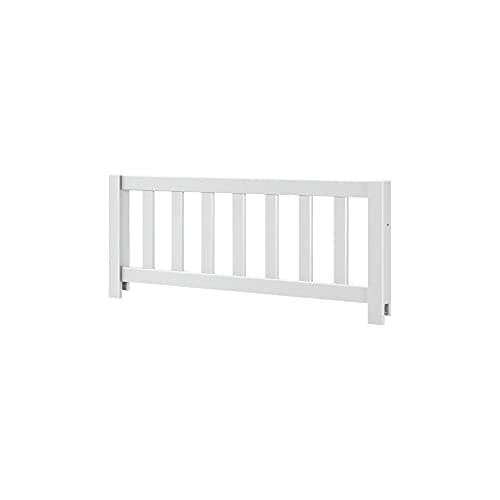
| Guardrail height above mattress | 13.25 in from the point of attachment |
|---|---|
| Stated weight limit (per bunk) | Not applicable |
| Manufacturer minimum age | Not published by the manufacturer |
| Mattress thickness ceiling | Determined by the bed it attaches to |
| Materials / construction | Solid New Zealand pine to match the bed frames |
What works
- Publishes its height, which almost no aftermarket rail does
- Bolts to the frame rather than clamping under the mattress
- Matches the finish of the beds it is designed for
- Solid wood, so it does not flex the way a fabric rail does
What doesn’t
- Only fits Max & Lily frames — this is not a universal rail
- 13.25 in of rail is consumed fast by a thick mattress
- Costs more than a generic clamp-on rail
The catch: 13.25 in measured from the attachment point is not 13.25 in above your mattress. Subtract the mattress thickness and check that at least 5 in of rail is still standing proud, per the federal rule.
Children who resist a rail
hiccapop Toddler Bed Bumpers
hiccapop
Foam bolsters that slide under the fitted sheet — a soft edge rather than a cage, for the child a metal rail upsets.
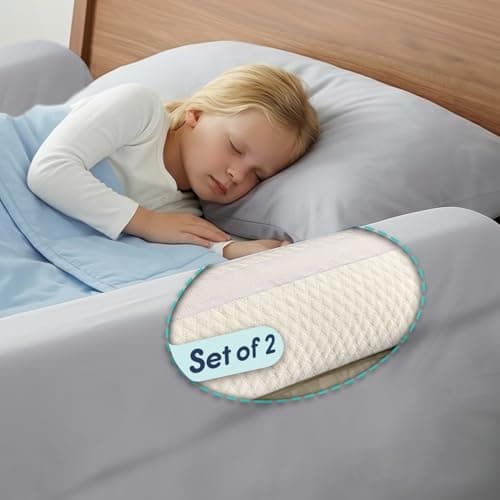
| Guardrail height above mattress | Foam bolster, low profile (height not published) |
|---|---|
| Stated weight limit (per bunk) | Not published by the manufacturer |
| Manufacturer minimum age | Not published by the manufacturer |
| Mattress thickness ceiling | Sits under the fitted sheet on any mattress |
| Materials / construction | CertiPUR-US certified foam with washable cover |
What works
- No hardware, no frame compatibility question — it goes under the sheet
- Far less confining than a full rail, which some children genuinely need
- CertiPUR-US certified foam
- Packs flat for travel
What doesn’t
- A bolster is a speed bump, not a barrier — a determined roll clears it
- Not a substitute for a rail on a raised bed of any kind
- Takes up mattress width
The catch: Be clear about what this is. It is a passive edge that makes rolling out less likely, not a guardrail that prevents a fall, and it has no business anywhere near a bunk or a loft.
A lit route down from the top bunk
Rechargeable Motion-Sensor Night Light
Various (search by spec)
The cheapest safety upgrade for a bunk: light on the ladder before a foot goes on it.

| Guardrail height above mattress | Not applicable |
|---|---|
| Stated weight limit (per bunk) | Not applicable |
| Manufacturer minimum age | Not published by the manufacturer |
| Mattress thickness ceiling | Not applicable |
| Materials / construction | Rechargeable LED with adhesive or magnetic mount |
What works
- Lights the ladder and the floor at the bottom of it automatically
- Warm color temperature does not wake the room the way a white light does
- No wiring, so it mounts anywhere on the frame
- Costs less than almost any other change you can make to a bunk
What doesn’t
- Rechargeable means remembering to recharge it
- Adhesive mounts fail on textured or painted surfaces
- Motion sensors can trigger from the bed and wake the sleeper
The catch: This is a generic category rather than a single model — search on the specification (rechargeable, motion sensor, warm white) rather than on a brand, because the brands turn over constantly and the spec does not.
Questions parents actually ask
Are bunk beds dangerous for children?
A compliant bunk, assembled correctly, with a mattress thin enough to leave 5 inches of guardrail and a child over six on top, is a safe bed. The danger comes from specific failures: too thick a mattress, loose bolts, an unlit climb, or a child too young for the upper deck.
What is the most common bunk bed injury?
Falls, and the climb is where most of them start — a child descending a ladder backward in the dark is in a harder situation than the same child climbing in daylight. That is why lighting the route and keeping the floor clear matter as much as the guardrail.
At what age is a bunk bed safe?
The American Academy of Pediatrics advises no child under six on the top bunk. The lower bunk is usable as soon as the child is out of a crib. No federal construction standard sets an age at all, so the AAP guidance is the operative rule.
Do bunk beds collapse?
Correctly assembled frames within their published weight limit very rarely do. The failures that happen involve bolts that were never fully tightened, bolts that backed out over years without a check, cracked slats, or a load well beyond the stated limit.
How can I make a bunk bed safer?
Five things, in order: keep 5 inches of rail above the mattress, close any gap a limb could drop into, light the climb route, tighten every bolt twice a year, and anchor the frame to a stud. All five are cheap, and together they cover most of what goes wrong.
Sources
- U.S. Consumer Product Safety Commission — Bunk Beds business guidance
- American Academy of Pediatrics (HealthyChildren.org) — Bunk Beds: Safety Information for Parents
- 16 CFR Part 1513 — Requirements for Bunk Beds (children's)
- 16 CFR Part 1213 — Safety Standard for Entrapment Hazards in Bunk Beds
- ASTM F1427 — Standard Consumer Safety Specification for Bunk Beds
Read next
- Bunk bed safety standards
The three documents that govern the bed.
- Top bunk age readiness
The age rule and the signals around it.
- Bunk bed ladder safety
The climb, checked properly.
- Are bunk beds worth it?
The value side of the same question.
Back to Sleep Safety.