Bunk Beds
Do bunk beds come with mattresses?
Almost never - and the two mattresses you have to buy separately are governed by a number most people never read on the listing.
We earn a commission from qualifying purchases made through links on this page, at no extra cost to you. How this site is funded.
The short answer
No. Almost no bunk bed sold online includes mattresses. The box contains the frame, the slats or a slat roll, the ladder or stairs, the guardrails and the hardware. You buy two mattresses separately — two twins for a twin-over-twin, or a twin and a full for a twin-over-full — plus a third thin one if the bed has a trundle.
The number that decides which mattresses you can buy is the mattress ceiling published by the bed manufacturer, typically 5 to 8 inches for a top bunk. It is a guardrail-clearance rule rather than a fit rule, and exceeding it makes the bed non-compliant with the federal 5-inch rail minimum.
What is actually in the box
Every bunk bed we have looked at ships as a frame kit. The contents are consistent enough to list.
The frame — posts, side rails, end panels, and on a wood bunk a set of bolts and barrel nuts. Slats, either loose and numbered or pre-attached in a roll; Harper & Bright Designs publish 14 slats per deck on some models and a 7.6 in slat spacing on others, and that spacing is worth reading, because wide spacing means a mattress sags between the slats. Guardrails, usually two full-length rails for the top bunk, with the wall-side one required to be continuous on a children’s bunk. A ladder or stairs, often reversible. Hardware and an Allen key, and on better beds a metal center support bar.
What is not in the box: mattresses, bedding, a bunkie board, mattress protectors, or in most cases wall-anchor hardware. The anchoring kit being absent is the one that catches people out, and it matters — see do bunk beds need to be anchored to the wall.
Which mattresses to buy, by bunk size
| Bunk | Top deck | Bottom deck | Trundle, if fitted |
|---|---|---|---|
| Twin over twin | Twin, 38 x 75 in | Twin, 38 x 75 in | Twin, 5-6 in thick |
| Twin over full | Twin, 38 x 75 in | Full, 54 x 75 in | Twin, 5-6 in thick |
| Low bunk (twin over twin) | Twin, 38 x 75 in | Twin, 38 x 75 in | Usually none |
| Twin XL over queen | Twin XL, 38 x 80 in | Queen, 60 x 80 in | Rare |
The sizes are standard; the thickness is not. Our full size chart, including what a mattress has to measure to sit inside the rails without a gap, is in bunk bed sizes and dimensions.
The thickness rule, and why it is not advice
A children’s bunk bed has to keep 5 inches of guardrail above the top of the mattress. That is a federal construction requirement, and it is the reason manufacturers publish a mattress ceiling at all.
Work it backwards. The Max & Lily Twin Over Twin Low Bunk Bed publishes a 14 in guardrail and an 8 in mattress maximum: 14 minus 8 leaves 6 inches of rail, comfortably over the minimum. Fit a 10 in mattress and you are left with 4 inches — under the federal floor, on a bed that was compliant when it left the factory. Nobody flags this, and the bed looks exactly the same.
So the sequence is: read the published mattress ceiling before you shop for mattresses, not after. If the manufacturer publishes no ceiling, measure the rail height yourself when the bed arrives and subtract 5 inches — whatever is left is your maximum.
The bottom bunk has a ceiling too, and it is a different one
On the lower deck the limit is not the guardrail, it is the clearance to the underside of the top bunk. Too thick a mattress and the child below cannot sit up. Manufacturers often publish two different figures — the Harper & Bright Designs metal trundle bunk states 6 in for the top and 8 in for the bottom — and the two are not interchangeable.
Do you need a box spring or a bunkie board?
Not usually, and often not allowed. A bunk deck is a slat system designed to support a mattress directly, and a box spring on a top bunk raises the sleeper by another 7 to 9 inches — which destroys the rail clearance in a single step. Most manufacturers explicitly say no box spring.
A bunkie board is the thin alternative, usually an inch or two, and whether you need one depends on slat spacing rather than on the mattress. We work through when it is genuinely required in do bunk beds need a bunkie board.
What about toddler and trundle mattresses?
A trundle takes a twin, but a thin one — commonly 5 to 6 inches, because the whole assembly has to roll back under the main frame. The Max & Lily trundle bunks publish 5 in recommended with a 6 in maximum, and that is the figure to shop to.
Toddler beds are a different product with a different standard: they take a standard crib mattress rather than a twin, and the Graco Premium Foam Crib & Toddler Mattress in our registry is sized for exactly that handover. If you are moving a child from a crib and wondering whether the crib mattress carries over, the answer is usually yes — see can you use a crib mattress in a toddler bed.
The rest of what you have to buy
Budget for more than the frame. Two mattresses, two mattress protectors — a top bunk is the worst place in the house to strip a bed at 3 a.m., so the protector is not optional — and two sets of sheets each. The Mellanni 100% Cotton Percale Sheet Set is our default for a top bunk because percale breathes and a top bunk is the hottest place in the room.
Then the small things that make the bed livable: a clip light or a motion-sensor night light for the climb, and wall-anchor hardware if the bed did not ship with it. The accessories worth buying and the ones that are decoration are sorted out in best bunk bed safety accessories.
Key takeaways
- Bunk beds ship as frame kits. Mattresses, bedding and usually wall anchors are all extra.
- Buy to the published mattress ceiling, not to your preference - it is a guardrail-clearance rule with a federal 5 in minimum behind it.
- The top and bottom decks often have different thickness limits. Read both.
- No box spring on a bunk. A bunkie board is the thin alternative, and only if slat spacing needs it.
- Trundle mattresses are thinner again - typically 5 to 6 in so the trundle can roll back under the bed.
What we'd buy
Every pick below carries the same spec block, so you can compare the numbers across this page and every other page on the site.
The crib-to-toddler-bed handover
Graco Premium Foam Crib & Toddler Mattress
Graco
A firm, washable, dual-use crib and toddler mattress with both of the certifications parents actually look for.
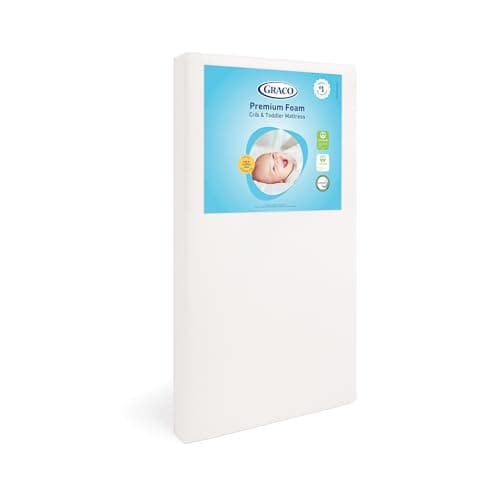
| Guardrail height above mattress | Not applicable |
|---|---|
| Stated weight limit (per bunk) | Not published by the manufacturer |
| Manufacturer minimum age | Not published by the manufacturer |
| Mattress thickness ceiling | Not applicable |
| Materials / construction | Foam core, waterproof machine-washable OEKO-TEX Standard 100 certified cover, GREENGUARD Gold certified |
What works
- The cover comes off and goes in the washing machine, which matters more than anything else at this age
- Firm support appropriate for infants and toddlers
- GREENGUARD Gold and OEKO-TEX Standard 100 certified
- Fits both the crib and the toddler bed it converts into
What doesn’t
- Foam traps more heat than a breathable-core mattress
- Firm enough that older toddlers may find it unforgiving
- Thin relative to a twin mattress, which is by design but still a surprise
The catch: Foam holds heat. If your child sleeps hot, a breathable-core mattress handles it better, and you will pay roughly twice as much for that.
Younger siblings sharing a room
Max & Lily Twin Over Twin Low Bunk Bed
Max & Lily
The clearest published safety numbers of any bunk we looked at, on a frame low enough that a fall is a short one.
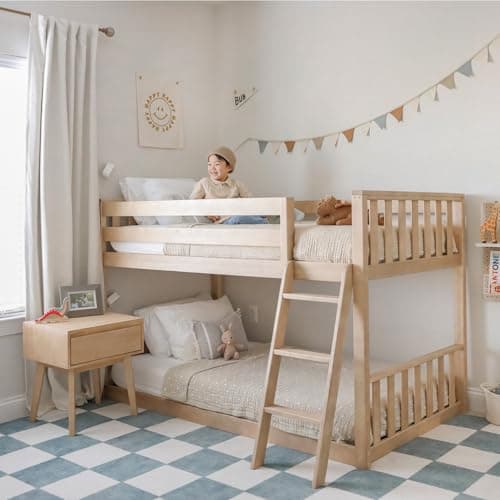
| Guardrail height above mattress | 14 in above the deck |
|---|---|
| Stated weight limit (per bunk) | 400 lb per sleeping surface |
| Manufacturer minimum age | Not published by the manufacturer |
| Mattress thickness ceiling | 8 in maximum (5 in recommended) |
| Materials / construction | Solid New Zealand pine, GREENGUARD Gold certified finish |
What works
- Publishes a guardrail height, a weight limit and a mattress ceiling — most brands publish one of the three
- 400 lb per surface is the highest stated capacity in this roundup, and it holds through the teen years
- Low overall height means the top deck sits well under a standard bunk
- Reversible, removable ladder with grooved treads and rounded edges
What doesn’t
- The 8 in mattress ceiling rules out most plush mattresses
- Solid pine is heavy to move once assembled
- No minimum age published, so the AAP's under-6 guidance is the only age rule you get
The catch: That 8 in ceiling is not a suggestion. Put a 10 in mattress on the top deck and the 14 in rail drops to 4 in of clearance, which is below the federal 5 in minimum. The bed stops being compliant and nobody tells you.
Hot sleepers and top bunks
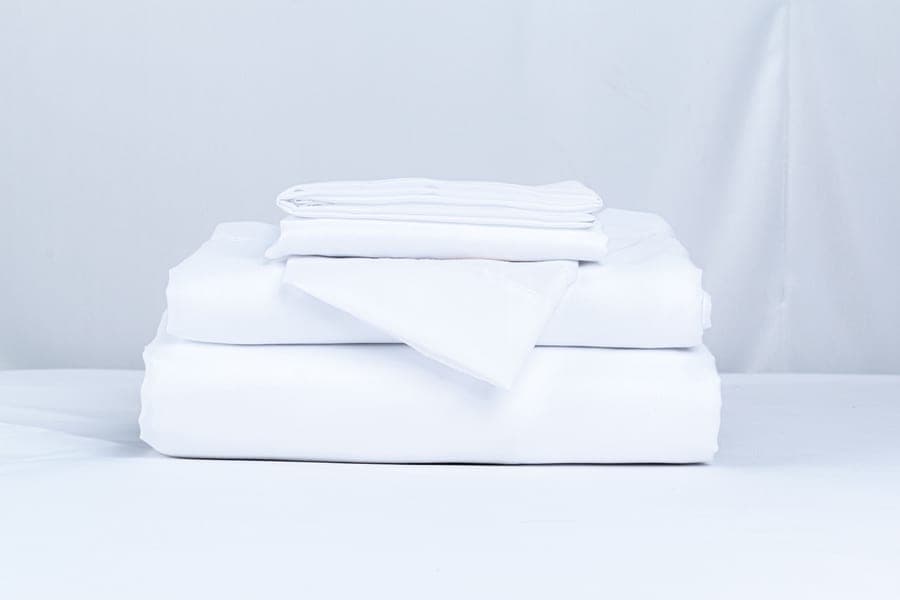
Mellanni 100% Cotton Percale Sheet Set
Mellanni
Percale cotton, 300 thread count, deep pockets — the sheet to buy if your child sleeps hot.
| Guardrail height above mattress | Not applicable |
|---|---|
| Stated weight limit (per bunk) | Not applicable |
| Manufacturer minimum age | Not published by the manufacturer |
| Mattress thickness ceiling | Deep pocket; confirm against your mattress depth |
| Materials / construction | 100% cotton, 300 thread count percale weave |
What works
- Percale weave breathes far better than microfiber
- Real cotton rather than a polyester blend
- Deep pockets stay on through a restless night
- Gets softer with washing instead of pilling
What doesn’t
- Percale wrinkles; it comes out of the dryer looking lived-in
- Crisper than microfiber, which some children dislike at first
- Costs more than a microfiber set
The catch: Deep pockets are a problem on a bunk, not a feature. Bunk mattresses are thin, so a deep-pocket fitted sheet has a lot of slack to gather — check the pocket depth against your actual mattress before ordering.
Questions parents actually ask
Do bunk beds come with mattresses included?
Almost never. The box contains the frame, slats, guardrails, ladder or stairs and hardware. You buy the mattresses separately — two for a standard bunk, three if it has a trundle.
What size mattress do you need for a bunk bed?
A twin-over-twin takes two standard twins at 38 by 75 inches. A twin-over-full takes a twin on top and a full at 54 by 75 inches below. A trundle takes a twin, but one thin enough to roll back under the frame.
How thick can a bunk bed mattress be?
Whatever the manufacturer publishes, which is typically 5 to 8 inches for a top bunk. The limit exists so that at least 5 inches of guardrail remains above the top of the mattress, as federal rules for children’s bunk beds require.
Do you need a box spring on a bunk bed?
No, and most manufacturers prohibit it. A bunk deck supports the mattress directly on slats, and a box spring would raise the sleeper by another 7 to 9 inches, wiping out the guardrail clearance.
What else do you need to buy with a bunk bed?
Two mattresses, two waterproof mattress protectors, sheets for both decks, and wall-anchoring hardware if the bed did not include it. A night light on the climb route is the one accessory we would always add.
Sources
Read next
- Bunk bed sizes and dimensions
The full size chart, deck by deck.
- Mattress thickness and guardrails
The 5-inch rule, worked through.
- Do bunk beds need a bunkie board?
When the slats are not enough on their own.
- Bedding for a top bunk
What to put on it once the mattress is in.
- Best bunk bed mattresses
The two you will have to buy separately.
Back to Bunk Beds.