Bunk Beds
The best bunk bed mattresses
A bunk bed mattress is the one purchase where comfort is capped by a safety rule. Here are five that fit the rule, and the measurement to take before you buy any of them.
We earn a commission from qualifying purchases made through links on this page, at no extra cost to you. How this site is funded.
Quick picks
The short version. Tap any row for the full write-up and its spec block.
| # | Product | Best for | Score | Price |
|---|---|---|---|---|
| 1 | 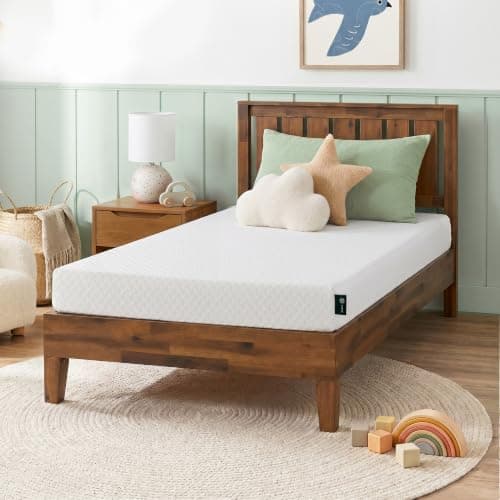 Zinus 6 Inch Twin Cooling Essential Memory Foam Mattress Six inches of fiberglass-free foam that publishes its weight limit, its certifications and its fire barrier - three things most bunk mattresses leave blank. | The top deck of most kids bunk beds | 8.8 | |
| 2 | 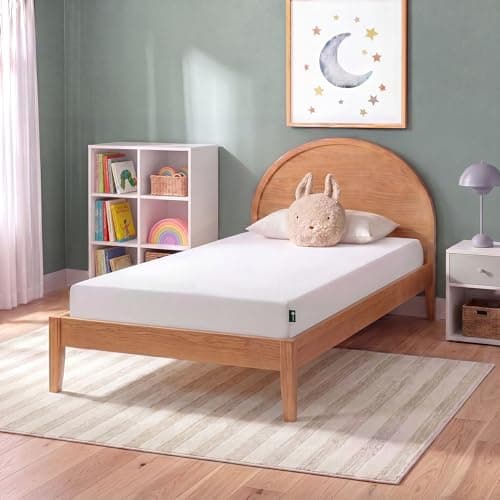 Zinus 5 Inch Twin Green Tea Memory Foam Mattress An inch thinner than everything else here, which on a bed with a short guardrail is the difference between legal and not. | Bunks with guardrails under 12 inches | 8.5 | |
| 3 | 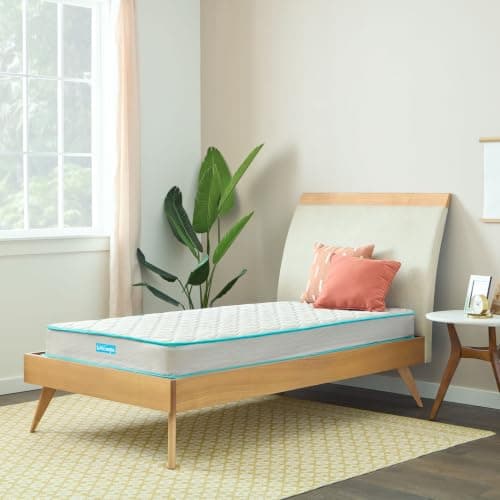 Linenspa 6 Inch Innerspring Mattress, Firm, Twin The firmest six-inch surface here, on bonnell coils rather than foam - the one that stays flat under a child who sleeps near the rail. | A top bunk where edge support matters most | 7.8 | |
| 4 | 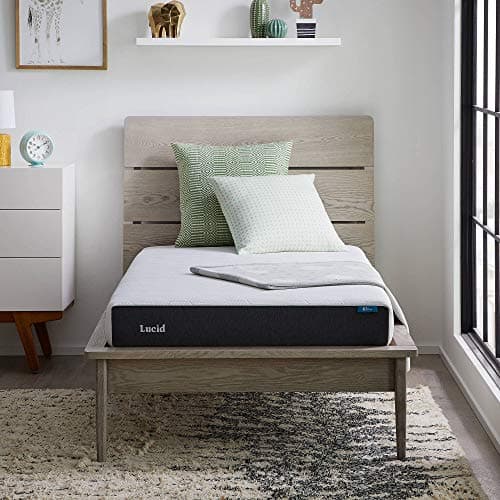 LUCID 6 Inch Gel Memory Foam Mattress, Twin The lightest mattress on this page by a wide margin, which matters more than it sounds when you are making a top bunk. | A child who changes their own sheets up top | 7.6 | |
| 5 | 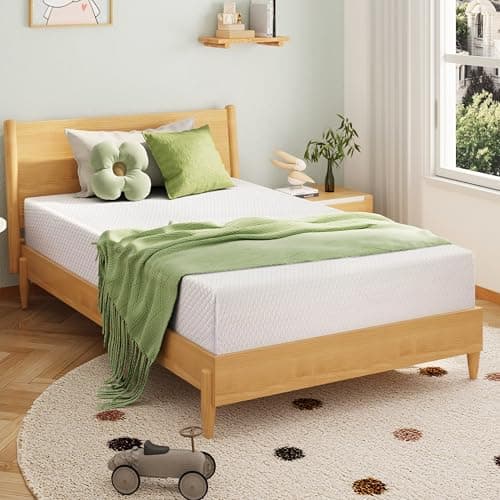 EGOHOME 6 Inch Twin Mattress for Kids Sold specifically as a kids mattress at a kids price, with the full 75-inch length the cheaper foam mattresses cut short. | A second bunk or a trundle on a budget | 7.4 |
How we chose
We are a small publisher, not a testing lab. We don’t buy, assemble or sleep in the beds we write about, and we won’t pretend otherwise. What we do instead is read the published specifications and check them against the rules that actually govern children’s beds in the United States: the federal standard for children’s bunk beds (16 CFR Part 1513), the ASTM F1427 requirements it incorporates, and the American Academy of Pediatrics’ guidance on upper-bunk age. Where a manufacturer publishes no number, we write “not published by the manufacturer” rather than guess — that absence is itself worth knowing. We read owner feedback at volume for the things specs can’t tell you, and we label it as signal, not proof.
We earn a commission when you buy through our links. It never changes an ordering. Our full editorial policy.
The short answer
For most bunk beds, buy the Zinus 6 Inch Twin Cooling Essential Memory Foam mattress. It is one of the very few mattresses at any price that publishes a weight limit, names its fire barrier instead of hiding it, and carries both CertiPUR-US and OEKO-TEX certification - and at six inches it leaves a 14-inch guardrail with 11 inches still standing above the sleeping surface.
If your bed has a short guardrail - anything under about 11 inches measured from the deck - buy the Zinus 5 Inch Twin Green Tea instead. It is the same certifications and the same published 250 lb limit in a profile that is one inch thinner, and that inch is the difference between a compliant bed and a bed that quietly stopped being one.
Why this is the one mattress decision with a hard ceiling
Everywhere else in the house, buying a thicker mattress is just spending more money. On a bunk bed it is a safety decision, because the federal construction standard for children’s bunk beds requires the top of the guardrail to sit at least five inches above the top of the mattress. The guardrail is fixed. The mattress is the variable. Every inch you add to the mattress is an inch taken off the rail that is supposed to keep a sleeping child on the bed.
So the usable ceiling is: guardrail height measured from the deck, minus five inches. On a bed with a 14-inch rail, nine inches. On a 12.5-inch rail, seven and a half. On a budget metal frame with a 10-inch rail, five inches - which rules out almost every mattress sold in a shop. Our mattress thickness and guardrails guide works the arithmetic through in full, including why a topper and a quilted protector spend from the same budget.
That is why every mattress on this page is five or six inches thick and why none of them is the plushest thing we could find. A ten-inch hybrid would be more comfortable in a guest room and wrong here. The ranking below is not “best twin mattress” - it is best mattress that still lets the guardrail do its job.
Take one measurement before you order
Measure from the surface the mattress will rest on - the slats or the solid deck, not the floor of the bed frame opening - up to the top edge of the guardrail. Subtract five inches. That number is your maximum, and it covers the mattress plus anything you put under or over it. If it comes out below five inches, no mattress on this page fits and the bed needs a guardrail extension before it needs a mattress.
How we ranked these
Five things, in this order, and comfort is deliberately not first.
Profile, published in inches. Not “low profile”, not “bunk friendly” - an actual number. A mattress that does not state its thickness cannot be checked against your guardrail, and every pick here states it.
A stated weight limit. This is rare and it matters. Two of these five publish a figure for the twin size; three publish nothing. A bunk bed has its own per-deck rating, and when the mattress also publishes one you can at least see whether the two agree. Our bunk bed weight limits page covers the frame side of that question.
Certification, named. CertiPUR-US covers the foam (emissions, no ozone depleters, no formaldehyde, no heavy metals). OEKO-TEX Standard 100 covers the textile cover. They are checkable marks rather than adjectives, and on a product a child breathes against for eight hours a night they are worth more than any comfort claim.
Fiberglass, declared. Cheap foam mattresses have used woven fiberglass as the fire barrier for years. It works, and it is a genuine mess if the cover is ever unzipped or torn. Three of these five state “fiberglass free” and two of those name what they use instead - a carbon-rayon barrier. A listing that says nothing about the barrier at all has told you nothing either way.
Firmness, and what it does to clearance. A soft mattress is a compliance problem as well as a comfort choice: a child who sinks two inches into a plush surface has given up two inches of guardrail that your tape measure said they had. Firm beats plush on a raised deck, every time.
| Mattress | Profile | Stated weight limit | Certification |
|---|---|---|---|
| Zinus 6 in Cooling Essential | 6 in | 250 lb (twin) | CertiPUR-US + OEKO-TEX |
| Zinus 5 in Green Tea | 5 in | 250 lb (twin) | CertiPUR-US + OEKO-TEX |
| Linenspa 6 in Innerspring | 6 in | Not published | None claimed |
| LUCID 6 in Gel Memory Foam | 6 in | Not published | CertiPUR-US |
| EGOHOME 6 in Kids | 6 in | Not published | CertiPUR-US |
Foam or coils on a top deck
At six inches there is not much room for either, which changes the usual argument. A six-inch all-foam mattress is typically an inch of comfort foam over five inches of support foam. A six-inch innerspring is five inches of coils under a thin foam layer and a quilted cover. Neither is a luxury construction; the question is which failure mode you prefer.
Foam wins on weight. The LUCID is 15.6 lb and the Linenspa is 34.2 lb, and the difference is real at the moment you are standing on a ladder trying to get a fitted sheet onto a top bunk. If your child is going to change their own bedding up there, buy foam.
Coils win on edge support, and edge support is the spec nobody thinks about on a bunk. A child sleeping right against the guardrail is sleeping on the part of the mattress that compresses most, and a coil base holds that edge flatter than polyfoam does. If the bed is for a restless sleeper who ends up pressed against the rail every night, the firm coil mattress is the better engineering answer even though it is the heavier, less certified one.
Foam also holds heat. All three foam picks here infuse something - cooling gel, green tea, bamboo charcoal - and those infusions are mostly odor and marketing rather than measurable temperature control. A top bunk is already the warmest part of the room because warm air rises, which is a better reason to pick breathable bedding than to pick an infusion.

The bottom bunk plays by different rules
The five-inch clearance rule exists because of a fall from height. The bottom deck of a bunk bed has no guardrail and nothing to fall from, so the only limits down there are physical: the mattress has to fit under the upper deck with enough headroom for a child to sit up, and it has to fit inside the frame.
In practice that means you can put a thicker, more comfortable mattress on the bottom - eight inches is usually fine on a full-height bunk - and it means the two decks do not have to match. Plenty of parents buy a six-inch mattress for the top and something better for the bottom, then swap them when the younger child moves up.
One caveat worth knowing: on a low bunk bed the vertical gap between decks is small to begin with, and a thick bottom mattress eats the headroom a child needs to sit up without hitting the upper frame. Measure the deck-to-deck gap and leave at least a couple of feet above the sleeping surface.
Size, and the gap nobody checks
A standard US twin mattress is 38 to 39 inches wide by 74 to 75 inches long, and bunk bed decks are built for that. The budget end of the mattress market quietly shaves it: the LUCID here is 37.5 by 74 inches, and the EGOHOME is 38 by 75.
An inch and a half of width sounds like nothing. On a bunk it is a gap between the mattress and the frame, and gaps are the entrapment hazard the bunk bed standard was written around in the first place - the space between a mattress and a guardrail is exactly where a small child’s head and body can go in different directions. If a mattress arrives undersized, the fix is not a rolled towel in the gap; the fix is the right mattress. Our bunk bed sizes and dimensions page has the deck figures to check yours against.
Boxed, compressed, and what the first 72 hours look like
All five of these ship compressed in a box, which is genuinely the only practical way to get a mattress up a flight of stairs and into a bunk frame. Two things follow from it.
First, the expansion window is real. Every listing here says 24 to 72 hours and means it, and a mattress that has not finished expanding is both thinner and firmer than the one you bought. Do not measure your guardrail clearance on day one and conclude you have spare room - measure it on day four.
Second, the smell. Foam mattresses off-gas for a day or two and it is at its most noticeable on a top bunk, where the air moves least. Unbox it in another room with a window open if you can, and do not put a mattress protector on it until the smell has gone, because the protector traps it.
A protector counts toward your ceiling
A quilted or terry-topped mattress protector adds real height - a quarter inch to a half inch - and it comes out of the same five-inch budget as the mattress. If your arithmetic is tight, use a thin fitted protector rather than a padded one. Our kids mattress protector picks are ranked on added height for exactly this reason.
What we would not buy for a bunk
A pillow-top or euro-top of any thickness. The whole construction is loft you do not have the clearance for, and the top layer compresses unevenly, which means your measured clearance changes depending on where the child is lying.
Anything described only as “bunk bed mattress” with no stated thickness. It is the single most common listing on the market and it is unusable, because the one number you need to do the arithmetic is the one it refuses to give you.
An air mattress, a folding tri-fold or a futon pad as a permanent sleeping surface on a raised deck. They are not designed for it, they do not sit flat in a frame, and none of them publishes anything you can check.
And a second-hand mattress, which is a separate argument from a second-hand frame - see buying a secondhand bunk bed for the frame side. You cannot verify the fire barrier, the certification or the condition of the core of a used mattress, and at eighty dollars for a new certified one there is no saving worth making.
Key takeaways
- Your ceiling is guardrail height above the deck minus five inches. Measure it before you shop, not after.
- Six inches fits most bunks; five inches is the answer when the guardrail is short. Nothing thicker belongs on a top deck.
- Firm beats plush up high - every inch a child sinks is an inch of guardrail they lose.
- Only two of these five publish a weight limit, and only two name a fire barrier. Those are the picks to prefer.
- Check the mattress width against your deck. An undersized mattress leaves the gap the bunk bed standard exists to prevent.
- The bottom bunk has no guardrail rule - put the thicker, more comfortable mattress down there.
The picks, in full
Every pick below carries the same spec block, so you can compare the numbers across this page and every other page on the site.
#1 · The top deck of most kids bunk beds
Zinus 6 Inch Twin Cooling Essential Memory Foam Mattress
Zinus
Six inches of fiberglass-free foam that publishes its weight limit, its certifications and its fire barrier - three things most bunk mattresses leave blank.
| Guardrail height above mattress | Not applicable |
|---|---|
| Stated weight limit (per bunk) | 250 lb stated for the twin size |
| Manufacturer minimum age | Not published by the manufacturer |
| Mattress thickness ceiling | 6 in profile - needs 11 in of guardrail above the deck |
| Materials / construction | Cooling gel memory foam over base foam, breathable knitted cover, carbon-rayon flame barrier; 39 x 75 in, 23.35 lb |
What works
- States a 250 lb twin weight limit, which almost no mattress listing does
- CertiPUR-US foam and an OEKO-TEX Standard 100 cover, both named on the listing
- Fiberglass free, with a carbon-rayon fire barrier named instead of hidden
- Six inches leaves 11 in of guardrail still doing its job on a 14 in rail
What doesn’t
- Medium feel, which is softer than the firm surface a raised deck wants
- 23.35 lb is heavy to wrestle onto a top bunk single-handed
- Needs 24 to 72 hours to expand before anyone sleeps on it
- No minimum age published, so the firmness call is yours
The catch: The medium feel is the compromise. On a top bunk you want a surface that does not let a child sink, because every inch they sink is an inch of guardrail they lose. This one contours more than the firm innerspring below it - fine for an older child, less ideal for the youngest sleeper the bed is rated for.
#2 · Bunks with guardrails under 12 inches
Zinus 5 Inch Twin Green Tea Memory Foam Mattress
Zinus
An inch thinner than everything else here, which on a bed with a short guardrail is the difference between legal and not.
| Guardrail height above mattress | Not applicable |
|---|---|
| Stated weight limit (per bunk) | 250 lb stated for the twin size |
| Manufacturer minimum age | Not published by the manufacturer |
| Mattress thickness ceiling | 5 in profile - needs 10 in of guardrail above the deck |
| Materials / construction | Zoned green-tea and charcoal infused memory foam over base foam, knitted cover, carbon-rayon fire barrier; 39 x 75 in, 20.5 lb |
What works
- Five inches works on a 10 in guardrail, where a six-inch mattress does not
- Lightest of the certified picks at 20.5 lb
- CertiPUR-US foam, OEKO-TEX Standard 100 cover, fiberglass free
- Medium firm, which suits a raised deck better than a medium feel
What doesn’t
- Five inches of foam is thin comfort for a child over about ten
- Green tea and charcoal infusion is an odor claim, not a support feature
- Mild off-gassing smell for the first day or two
- No minimum age published
The catch: Thin is the whole point and also the whole drawback. Buy this because your guardrail arithmetic demands five inches, not because you want it - on a bed with a 14 in rail the six-inch version is the more comfortable choice for the same money.
#3 · A top bunk where edge support matters most
Linenspa 6 Inch Innerspring Mattress, Firm, Twin
Linenspa
The firmest six-inch surface here, on bonnell coils rather than foam - the one that stays flat under a child who sleeps near the rail.
| Guardrail height above mattress | Not applicable |
|---|---|
| Stated weight limit (per bunk) | Not published by the manufacturer |
| Manufacturer minimum age | Not published by the manufacturer |
| Mattress thickness ceiling | 6 in profile - needs 11 in of guardrail above the deck |
| Materials / construction | Five inches of tempered steel bonnell coils under a comfort foam layer and a quilted cover; 34.2 lb |
What works
- Firm coil base does not let a child sink toward the rail
- The listing names bunk beds and trundle beds as intended uses
- Coils hold their shape for longer than budget polyfoam
- Six-inch profile with the firm feel a raised deck actually wants
What doesn’t
- No weight limit published anywhere on the listing
- No CertiPUR-US or OEKO-TEX certification claimed
- 34.2 lb - the heaviest mattress on this page to lift overhead
- Firm enough that a side-sleeping child may find it unforgiving
The catch: It is the only pick here with no certification claim at all. The coil construction is the right answer for a top bunk and the price is honest, but if a named foam or textile certification is on your list, the two Zinus mattresses publish theirs and this one does not.
#4 · A child who changes their own sheets up top
LUCID 6 Inch Gel Memory Foam Mattress, Twin
LUCID
The lightest mattress on this page by a wide margin, which matters more than it sounds when you are making a top bunk.
| Guardrail height above mattress | Not applicable |
|---|---|
| Stated weight limit (per bunk) | Not published by the manufacturer |
| Manufacturer minimum age | Not published by the manufacturer |
| Mattress thickness ceiling | 6 in profile - needs 11 in of guardrail above the deck |
| Materials / construction | One inch of gel and bamboo-charcoal infused memory foam over five inches of base foam; 37.5 x 74 in, 15.6 lb |
What works
- 15.6 lb, roughly half the weight of the innerspring pick
- CertiPUR-US certified and explicitly fiberglass free
- The listing names bunk beds and trundle beds as intended uses
- Light enough that a child can lift a corner to tuck a sheet
What doesn’t
- The title says firm and the description says medium firm - pick one
- 37.5 x 74 in is slightly under a standard 39 x 75 in twin
- No weight limit published
- The most expensive pick here by some distance
The catch: The dimensions are the thing to check. At 37.5 by 74 inches it is about an inch and a half narrower and an inch shorter than a standard twin, which on a bunk means a gap at the edge of the deck. The CPSC cares about gaps between mattress and frame, so measure your deck before ordering this one.
#5 · A second bunk or a trundle on a budget
EGOHOME 6 Inch Twin Mattress for Kids
EGOHOME
Sold specifically as a kids mattress at a kids price, with the full 75-inch length the cheaper foam mattresses cut short.
| Guardrail height above mattress | Not applicable |
|---|---|
| Stated weight limit (per bunk) | Not published by the manufacturer |
| Manufacturer minimum age | Not published by the manufacturer |
| Mattress thickness ceiling | 6 in profile - needs 11 in of guardrail above the deck |
| Materials / construction | Green-tea gel infused memory foam over base foam; 75 x 38 in, 22 lb |
What works
- Full 75 in length, unlike the shorter budget foam mattresses
- CertiPUR-US certified and fiberglass free per the listing
- Medium firm rather than plush, which is right for a raised deck
- Cheapest route to a matched pair for a twin-over-twin bunk
What doesn’t
- The thinnest listing detail of any pick here - three bullet points
- 38 in wide, an inch under a standard twin
- No weight limit, no fire-barrier material and no cover certification stated
- Supply chain described as multi-country, so batches may vary
The catch: It publishes the least of the five. The certification and the fiberglass-free claim are in the title, the dimensions are in the title, and after that the listing stops telling you things. For a bottom bunk or a trundle that is an acceptable trade at this price; for the deck a child sleeps on six feet up, buy the mattress that published more.
Questions parents actually ask
How thick should a bunk bed mattress be?
Five or six inches on a top bunk, unless your bed publishes a different ceiling. The rule that sets it is the five-inch guardrail clearance: the top of the rail must sit at least five inches above the top of the mattress, so subtract five from your measured guardrail height and that is your maximum. Most kids bunk beds land between six and eight inches by that arithmetic.
Can you put a regular twin mattress on a bunk bed?
A regular twin is the right size - 38 to 39 by 74 to 75 inches - but usually the wrong thickness. Standard twin mattresses are commonly eight to twelve inches deep, which on a bunk with a 12 or 14 inch guardrail leaves less than the required five inches of rail above the sleeping surface. Buy a twin in a five or six inch profile instead.
Do bunk beds need a special mattress?
Not a special type, just a specific thickness. Any twin mattress that fits your guardrail arithmetic and sits flat in the frame will do, which in practice means a low-profile foam or thin innerspring model. What a bunk does not need is a box spring - the slats or deck are the support.
Is memory foam or innerspring better for a bunk bed?
Foam is far lighter, which matters every time someone changes the sheets on a top bunk. An innerspring holds its edge better, which matters for a child who sleeps pressed against the guardrail. At the five-to-six inch profiles a bunk allows, neither is a luxury construction, so pick on weight and edge support rather than on feel.
What is the weight limit on a bunk bed mattress?
Most do not publish one. Of the five on this page, two state 250 lb for the twin size and three state nothing at all. The limit that actually governs the bed is the frame’s per-deck rating, which is usually between 150 and 250 lb on a kids bunk - the mattress figure, when it exists, is a durability guide rather than a safety cap.
Does a bunk bed mattress need a bunkie board?
Only if the slats are too widely spaced to support it, and a bunkie board adds one and a half to two inches that come straight out of your guardrail clearance. Check the slat spacing first - our bunkie board guide covers when it is genuinely needed and when it is just lost height.
How long do you have to wait before sleeping on a boxed mattress?
Every mattress here states 24 to 72 hours for full expansion, and that window is also the one where the off-gassing smell is worst. On a top bunk, where air moves least, give it the full three days with the window open if you can - and take your guardrail measurement after it has finished expanding, not before.
Sources
Read next
- Mattress thickness and guardrails
The five-inch rule and the arithmetic behind it.
- Bunk bed sizes and dimensions
Deck sizes to check a mattress against.
- Do bunk beds come with mattresses?
Almost never, and what that means for the budget.
- Best kids mattress protectors
Ranked on added height, because it counts toward the ceiling.
Back to Bunk Beds.