Bunk Beds
The best beds for two kids sharing a room
A shared room is a floor-area problem before it is a furniture problem. These five setups are ranked by what they publish about safety and what they give back in square feet.

We earn a commission from qualifying purchases made through links on this page, at no extra cost to you. How this site is funded.
Quick picks
The short version. Tap any row for the full write-up and its spec block.
| # | Product | Best for | Score | Price |
|---|---|---|---|---|
| 1 | 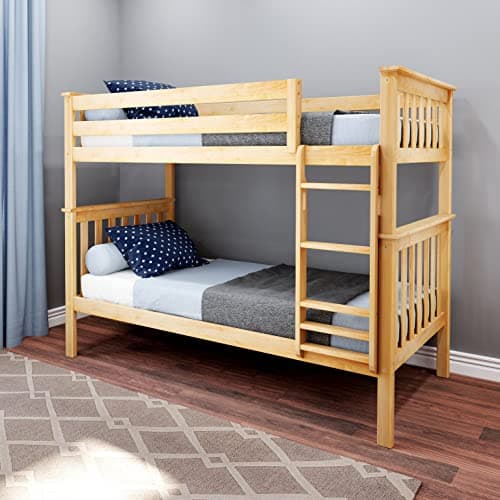 Max & Lily Twin Over Twin Bunk Bed Full-height version of the low bunk, same 400 lb frame, and the extra clearance underneath is the whole reason to buy it. | Rooms where the space under the bottom bunk has a job | 8.0 | |
| 2 | 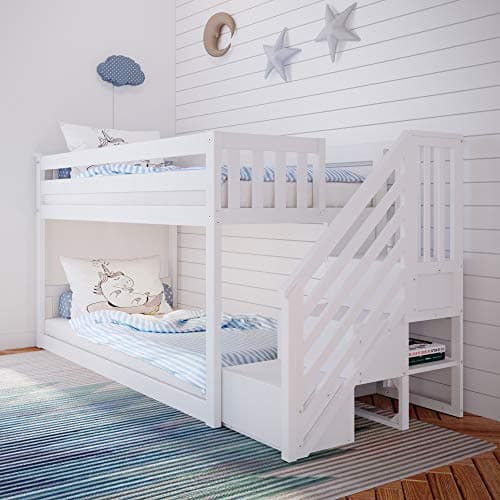 Max & Lily Twin Over Twin Low Bunk Bed with Stairs Stairs instead of a ladder on a low frame — the combination that makes a bunk workable for a child who is not a confident climber. | Younger children, and anyone who climbs up at 2 a.m. | 8.2 | |
| 3 | 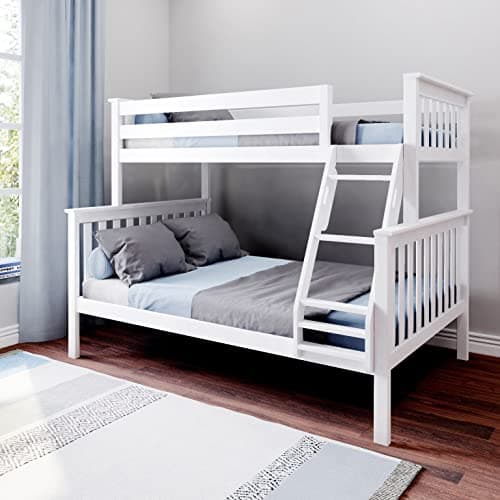 Max & Lily Twin Over Full Bunk Bed A full-size bottom bunk that an adult can actually sleep in, which quietly makes this a ten-year bed rather than a five-year one. | A younger and an older sibling, or a room that hosts guests | 7.9 | |
| 4 | 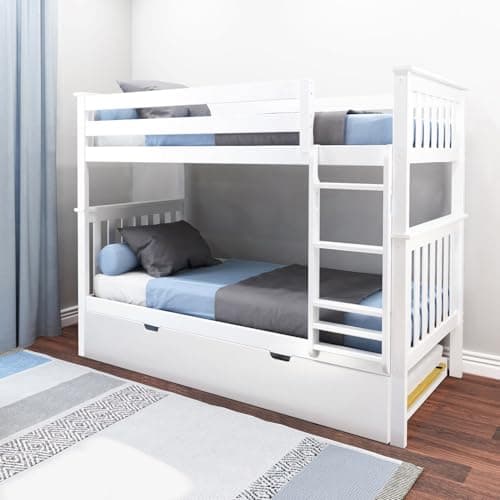 Max & Lily Twin Over Twin Bunk Bed With Trundle The only trundle bunk we found that publishes a rail height, a per-surface weight limit and a separate mattress ceiling for the trundle itself. | A shared room that hosts a third child most weekends | 8.7 | |
| 5 | 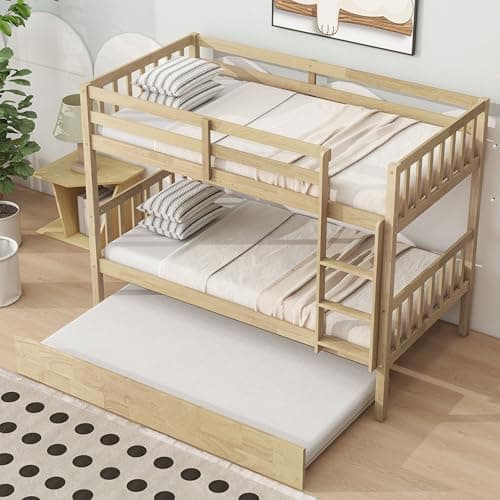 Harper & Bright Designs Twin Over Twin Bunk Bed with Trundle Three sleeping surfaces in a twin-over-twin footprint, which is the cheapest way to solve a sleepover problem. | Rooms that need a third bed occasionally | 6.9 |
How we chose
We are a small publisher, not a testing lab. We don’t buy, assemble or sleep in the beds we write about, and we won’t pretend otherwise. What we do instead is read the published specifications and check them against the rules that actually govern children’s beds in the United States: the federal standard for children’s bunk beds (16 CFR Part 1513), the ASTM F1427 requirements it incorporates, and the American Academy of Pediatrics’ guidance on upper-bunk age. Where a manufacturer publishes no number, we write “not published by the manufacturer” rather than guess — that absence is itself worth knowing. We read owner feedback at volume for the things specs can’t tell you, and we label it as signal, not proof.
We earn a commission when you buy through our links. It never changes an ordering. Our full editorial policy.
The short answer
For two children of similar age sharing a standard bedroom, buy the Max & Lily Twin Over Twin Bunk Bed. It carries 400 lb per sleeping surface — the highest published figure in this roundup, and enough that it is still the right bed when both children are teenagers — and the full standing clearance under the bottom bunk is what makes a shared room workable rather than just occupied.
If one of the two is under six, buy the Max & Lily Twin Over Twin Low Bunk Bed with Stairs instead. Same 400 lb frame, a shorter fall, and stairs rather than a ladder for the climb that happens in the dark. The AAP advises against children younger than six on a top bunk at all, so in that case the younger child takes the bottom and the stairs are for the older one.
The floor-area arithmetic nobody does first
Two single beds side by side in a 10 by 10 bedroom take about 42 square feet of a 100 square foot room, and they take it in the middle, which is where children play. A bunk takes 18 square feet and takes it against a wall. That is the whole case for bunking two children, and it is a stronger case than any feature in a listing.
The counter-case is real too, and we set it out in full in bunk beds vs two twin beds: two beds mean two children can be put to bed independently, nobody climbs anything, and a sick child at 3 a.m. is reachable. If the room is big enough and the children are young, two beds is often the better answer.
This roundup assumes you have already decided the room is not big enough. What follows is ranked on the published safety numbers first — guardrail height, weight limit, mattress ceiling — and on what the configuration gives back in floor area second.
| Setup | Weight limit | Guardrail | Sleeps |
|---|---|---|---|
| Max & Lily Twin Over Twin Bunk Bed | 400 lb per surface | Not published for this model | Two |
| Max & Lily Twin Over Twin Low Bunk Bed with Stairs | 400 lb per surface | Not published for this model | Two |
| Max & Lily Twin Over Full Bunk Bed | 400 lb per surface | Not published for this model | Two, one on a full |
| Max & Lily Twin Over Twin Bunk Bed With Trundle | 400 lb per surface | 14 in above the slats | Three |
| Harper & Bright Designs Twin Over Twin Bunk Bed with Trundle | Not published | Not published | Three |
1. Max & Lily Twin Over Twin Bunk Bed — best overall
The plain twin-over-twin is the default for a reason. Both children get the same bed, which removes an argument that otherwise runs for years; the frame is solid New Zealand pine rather than particleboard; and 400 lb per surface means the bed outlives the childhood rather than the growth spurt.
Max & Lily publish a clear guardrail number on their low bunks and not on this one, which is a genuine gap. It is not a reason to avoid the bed, but it does make the 5-inch clearance check yours to run with a tape measure when it arrives — measure from the top of the mattress to the top of the rail, and if it is under 5 inches you need a thinner mattress.
The full standing clearance under the bottom bunk is the feature that earns the top spot in a shared-room context. That space takes a bookcase, a toy organizer or rolling boxes for two children’s worth of belongings, and in a shared room there is nowhere else for them to go.
2. Max & Lily Twin Over Twin Low Bunk Bed with Stairs — best for a younger pair
Same 400 lb frame, lower deck, and stairs instead of a ladder. Both changes matter for the same reason: the climb down in the middle of the night is where bunk-bed falls happen, and a low deck shortens the fall while stairs make it less likely.
The cost is floor length. A stair bunk projects an L into the room, so check your floor plan against the bed’s overall footprint and not just the mattress size.

3. Max & Lily Twin Over Full Bunk Bed — best for a wide age gap
When one child is nine and the other is four, two twins is the wrong shape. The twin-over-full gives the older child a full mattress on the bottom — which they will still fit at sixteen — and the younger one the twin above, with the same 400 lb per-surface frame.
It also makes the room a guest room when it has to be, because an adult can sleep on a full. The trade is width: a twin-over-full is about 57 inches wide against 42 for a twin-over-twin, which is a foot and a bit of wall you may not have. We compare the two sizes properly in twin over twin vs twin over full.
4. Max & Lily Twin Over Twin Bunk Bed With Trundle — best when a third child visits
The only bed in this roundup that publishes both a guardrail height and a mattress ceiling: 14 inches above the slats, 8 inches maximum on both bunks with 5 recommended on top, and 5 inches on the trundle. That is the spec sheet we wish every manufacturer wrote, because it lets you do the clearance arithmetic before you buy rather than after.
A trundle in a shared room is for the cousin, the sleepover or the grandparent, and it is only worth the under-bed space if that happens often. If it happens twice a year, buy storage instead and keep a folding mattress in a closet.
5. Harper & Bright Designs Twin Over Twin Bunk Bed with Trundle — the budget three-sleeper
The cheapest way in this registry to put three sleeping places in one room. The reason it finishes fifth is the spec sheet: Harper & Bright Designs publish no guardrail height, no weight limit and no mattress ceiling for this model, which means every one of those checks falls to you on arrival.
That is a real cost, not a formality. Without a published mattress ceiling you cannot know before ordering whether the mattress you own will leave 5 inches of rail above it, and on a top bunk that is the number that matters most.
Who gets the top bunk is a safety decision, not a fairness one
The American Academy of Pediatrics advises that children younger than six should not sleep on the top bunk — the issue is coordination on the climb and the ability to stay put while asleep, not maturity. In a shared room with a six-year-old and a three-year-old, the six-year-old takes the top and that is not negotiable by rota. Our top bunk age readiness guide covers the signals that matter beyond the birthday.
Setting the room up once both beds are in
Two children in one room sleep better with a dark room and a lit route, which sound contradictory and are not. Blackout at the window handles the summer 9 p.m. bedtime and the 5 a.m. sunrise for both of them at once; a low motion-sensor night light on the climb route handles the one who needs the bathroom without waking the other. The case for both is in blackout and kids sleep.
Storage is the other half of the job. Two children generate twice the clothes and roughly four times the toys, and the only free volume in a bunked room is under the bottom bunk and up the walls. A tall bookcase and rolling under-bed boxes do more for a shared room than any amount of tidying.
Finally, make the beds easy to make. A top bunk you have to climb onto to tuck a sheet into is a bed that stays unmade, which is why we keep recommending zip-up bedding and fitted-only setups for upper decks — see bedding for a top bunk.
Key takeaways
- A bunk takes about 18 sq ft against a wall; two twins take about 42 sq ft out of the middle of the room.
- 400 lb per sleeping surface is the figure to look for - it means the bed lasts into the teen years.
- Where a brand publishes no guardrail height, the 5 in clearance check is yours to run with a tape measure.
- A wide age gap suits twin-over-full; a similar age suits twin-over-twin, because identical beds end the argument.
- A trundle and under-bed storage compete for the same space. Choose on how often a third child actually sleeps over.
The picks, in full
Every pick below carries the same spec block, so you can compare the numbers across this page and every other page on the site.
#1 · Rooms where the space under the bottom bunk has a job
Max & Lily Twin Over Twin Bunk Bed
Max & Lily
Full-height version of the low bunk, same 400 lb frame, and the extra clearance underneath is the whole reason to buy it.
| Guardrail height above mattress | Not published by the manufacturer |
|---|---|
| Stated weight limit (per bunk) | 400 lb per sleeping surface |
| Manufacturer minimum age | Not published by the manufacturer |
| Mattress thickness ceiling | Not published by the manufacturer |
| Materials / construction | Solid New Zealand pine, GREENGUARD Gold certified finish |
What works
- Same 400 lb per-surface capacity as the low bunk
- Full standing clearance under the bottom bunk for storage or play
- Knot-free solid pine rather than particleboard
- Reversible ladder works on either side of the room
What doesn’t
- Guardrail height is not published for this model, so you have to measure it yourself on arrival
- A full-height top deck is a longer fall than the low bunk version
- Heavier and more awkward to assemble than the low bunk
The catch: Max & Lily publish a clear guardrail number on their low bunks and not on this one. That is not a reason to avoid the bed, but it does mean the 5 in clearance check is yours to run with a tape measure rather than theirs to guarantee on the listing.
#2 · Younger children, and anyone who climbs up at 2 a.m.
Max & Lily Twin Over Twin Low Bunk Bed with Stairs
Max & Lily
Stairs instead of a ladder on a low frame — the combination that makes a bunk workable for a child who is not a confident climber.
| Guardrail height above mattress | Not published by the manufacturer |
|---|---|
| Stated weight limit (per bunk) | 400 lb per sleeping surface |
| Manufacturer minimum age | Not published by the manufacturer |
| Mattress thickness ceiling | Not published by the manufacturer |
| Materials / construction | Solid New Zealand pine, GREENGUARD Gold certified finish |
What works
- Stairs are dramatically easier to climb half-asleep than a vertical ladder
- Low frame keeps the top deck within reach for tucking in
- Solid pine with the same 400 lb per-surface rating as the rest of the line
- Steps double as a place to sit while getting dressed
What doesn’t
- Stairs claim floor space a ladder does not
- Costs more than the ladder version of the same bed
- Guardrail height is not published
The catch: Stairs eat about a foot and a half of the room along one end. If you are buying a bunk because the room is small, the staircase version can cancel out the space you were trying to save.
#3 · A younger and an older sibling, or a room that hosts guests
Max & Lily Twin Over Full Bunk Bed
Max & Lily
A full-size bottom bunk that an adult can actually sleep in, which quietly makes this a ten-year bed rather than a five-year one.
| Guardrail height above mattress | Not published by the manufacturer |
|---|---|
| Stated weight limit (per bunk) | 400 lb per sleeping surface |
| Manufacturer minimum age | Not published by the manufacturer |
| Mattress thickness ceiling | Not published by the manufacturer |
| Materials / construction | Solid New Zealand pine, GREENGUARD Gold certified finish |
What works
- Full-size bottom bunk fits a parent reading at bedtime or a guest overnight
- 400 lb per surface means the bottom bunk is genuinely adult-rated
- Solid pine construction with metal-on-metal bolt connections
- Two different mattress sizes gives the siblings a real distinction
What doesn’t
- Wider footprint than twin-over-twin; measure the room before ordering
- You buy two mattress sizes, which costs more than two twins
- Guardrail height and mattress ceiling are not published
The catch: The full bottom bunk is the selling point and the cost. It adds roughly a foot of width over twin-over-twin, and in the small room most people are buying a bunk for, a foot is the difference between a walkway and a squeeze.
#4 · A shared room that hosts a third child most weekends
Max & Lily Twin Over Twin Bunk Bed With Trundle
Max & Lily
The only trundle bunk we found that publishes a rail height, a per-surface weight limit and a separate mattress ceiling for the trundle itself.
| Guardrail height above mattress | 14 in above the slats |
|---|---|
| Stated weight limit (per bunk) | 400 lb per sleeping surface |
| Manufacturer minimum age | Not published by the manufacturer |
| Mattress thickness ceiling | 8 in on both bunks (5 in recommended on top); 5 in on the trundle |
| Materials / construction | Solid knot-free pine, GREENGUARD Gold certified finish |
What works
- Publishes all three numbers that matter on a trundle bunk, including the trundle's own mattress limit
- 400 lb per sleeping surface is the highest stated capacity in this roundup
- Trundle can be assembled to pull out from either side of the bed
- Separates into two standalone twin beds, so the frame outlasts the sharing arrangement
What doesn’t
- The trundle takes a 5 in mattress, which is thinner than most people expect and narrows your options
- No minimum age published, so the AAP's under-6 top-bunk guidance is the only age rule you get
- The trundle on this model has no wheels, so it wants a hard floor or a low-pile rug
- Sits at the top of the price range for the category
The catch: That 8 in bunk ceiling and 5 in trundle ceiling are two different numbers, and buying one mattress for all three surfaces is the obvious mistake. A 5 in trundle mattress on the top bunk wastes rail margin you paid for; an 8 in mattress on the trundle stops it sliding under the bottom bunk at all.
#5 · Rooms that need a third bed occasionally
Harper & Bright Designs Twin Over Twin Bunk Bed with Trundle
Harper & Bright Designs
Three sleeping surfaces in a twin-over-twin footprint, which is the cheapest way to solve a sleepover problem.
| Guardrail height above mattress | Not published by the manufacturer |
|---|---|
| Stated weight limit (per bunk) | Not published by the manufacturer |
| Manufacturer minimum age | Not published by the manufacturer |
| Mattress thickness ceiling | Not published by the manufacturer |
| Materials / construction | Solid wood frame with slat support |
What works
- The trundle adds a third bed without adding a footprint
- Solid wood rather than the particleboard common at this price
- Trundle rolls away completely when not in use
- Priced below the solid-pine specialists
What doesn’t
- None of the four safety numbers we track is published for this model
- Trundle mattresses have to be thin to clear the bottom bunk
- Assembly is long — three beds' worth of hardware
The catch: The listing is quiet on every spec that matters for a top bunk. That is common at this price and it is still a real cost: you are buying a bed whose compliance you have to verify yourself with a tape measure rather than read off the page.
Questions parents actually ask
What is the best bed setup for two kids sharing a room?
A twin-over-twin bunk for two children of similar age, because it gives both the same bed and returns about 24 square feet of floor compared with two separate twins. Choose a low bunk with stairs if either child is young, and a twin-over-full if there is a wide age gap.
At what age can two kids share a bunk bed?
The bunk itself can be shared as soon as the lower child is out of a crib, but the American Academy of Pediatrics advises that no child under six should sleep on the top bunk. In practice that means a shared bunk works once the older child is six or more, with the younger one on the bottom.
Is a bunk bed or two twin beds better for a shared room?
A bunk if floor space is the constraint, two twins if it is not. Two beds let you put children down independently and reach a sick child at night without a ladder; a bunk gives back roughly half the floor area, which in a small room is usually decisive.
How do you fit three children in one bedroom?
A bunk with a trundle is the most common answer and the cheapest. The alternative is a triple bunk, which needs a ceiling tall enough for three decks. Either way, check the trundle mattress ceiling — it is usually 5 to 6 inches, well under a standard twin.
Where should storage go in a shared kids room?
Up the walls and under the bottom bunk — those are the only two volumes a bunked room frees up. A tall bookcase and rolling under-bed boxes hold more than any amount of floor furniture, and they keep the middle of the room clear, which is the point of bunking in the first place.
Sources
Read next
- Bunk beds vs two twin beds
The decision this roundup assumes you have already made.
- How to organize a shared kids room
Zones, storage and the two-children problem.
- Top bunk age readiness
Who gets the top bunk, and why it is not a rota.
- Best bunk beds with trundles
When the room has to sleep three.
Back to Bunk Beds.