Bunk Beds
Bunk beds with storage: stairs, drawers or a trundle
Every storage bunk solves the same problem three different ways, and each one takes something back - floor length, ladder safety or the space under the bed.
We earn a commission from qualifying purchases made through links on this page, at no extra cost to you. How this site is funded.
How we chose
We are a small publisher, not a testing lab. We don’t buy, assemble or sleep in the beds we write about, and we won’t pretend otherwise. What we do instead is read the published specifications and check them against the rules that actually govern children’s beds in the United States: the federal standard for children’s bunk beds (16 CFR Part 1513), the ASTM F1427 requirements it incorporates, and the American Academy of Pediatrics’ guidance on upper-bunk age. Where a manufacturer publishes no number, we write “not published by the manufacturer” rather than guess — that absence is itself worth knowing. We read owner feedback at volume for the things specs can’t tell you, and we label it as signal, not proof.
We earn a commission when you buy through our links. It never changes an ordering. Our full editorial policy.
The short answer
For a small room with nowhere to put clothes, buy storage stairs — the Harper & Bright Designs Bunk Bed with Storage Staircase turns the climb into a chest of drawers and removes the ladder at the same time, which is two problems solved by one piece of furniture. It costs you roughly 30 extra inches of floor length, and that is the whole trade.
If the room cannot spare that length, buy base drawers instead and keep the ladder. If you need a third sleeping place more than you need storage, buy a trundle — but understand that a trundle and under-bed storage are the same cubic feet, and you can only have one of them.
Three shapes, one cubic volume
There is a fixed amount of dead space around a bunk bed: the volume under the bottom bunk, and the volume a ladder would otherwise occupy. Every storage bunk on the market is a different way of using those two voids, and no bed gets both twice.
Storage stairs convert the climb into drawers. You gain three to four drawers and a much safer route to the top deck; you lose about two and a half feet of room length, because stairs have to run out at an angle a child can walk rather than straight up like a ladder.
Base drawers sit in the plinth under the bottom bunk. They cost no extra floor area at all, which is their entire appeal, and they need pull-out clearance in front of the bed — typically the full depth of the drawer, so 20 inches or so of standing room.
A trundle uses the same void as the base drawers for a third mattress on casters. It is the right answer when sleepovers are frequent and the wrong one when they are not, because a trundle sitting empty is a bed-shaped box of nothing.
| Bed | Storage shape | Published capacity | What it costs you |
|---|---|---|---|
| Harper & Bright Designs Bunk Bed with Storage Staircase | Stair drawers | Capacity not published by the manufacturer | About 30 in of extra room length for the stair run |
| Harper & Bright Designs Twin Over Full with Storage Stairs and Drawers | Stair drawers plus base drawers | 200 lb upper, 250 lb lower; 7.6 in slat spacing | Length for the stairs, and clearance in front for the drawers |
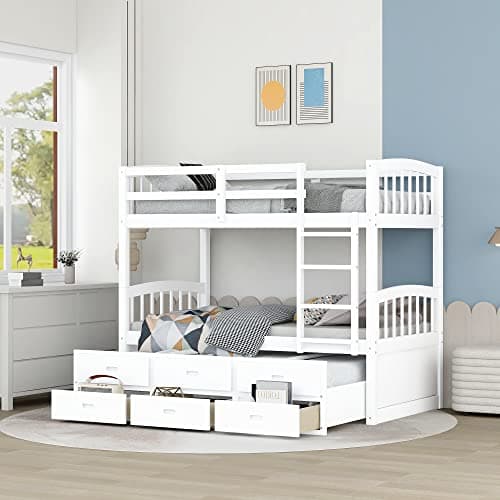
| Harper & Bright Designs Twin Over Twin with Trundle and 3 Drawers | Trundle plus drawers | 400 lb top and 400 lb bottom on this listing | The trundle and the drawers share the under-bed void |
| Rolling Under-Bed Storage Drawers | Aftermarket, any bed | Not published; sold by height | Nothing, if the bed has clearance - measure first |
Storage stairs: the option that also fixes the ladder
The reason we keep coming back to stairs on this site is not storage. It is that a child who has to come down from a top bunk at 2 a.m., half asleep, does it on stairs far more safely than on a ladder — and that is a nightly event, not an edge case. The drawers are the bonus. Our stairs vs ladder comparison goes through the climb itself in detail.
What the listings do not tell you is how much floor the stairs eat. A twin-over-twin bunk is about 80 inches long. Add a staircase and the footprint becomes an L roughly 80 by 70 inches, because the stairs run perpendicular off one end. In a 10 by 10 bedroom that is most of one wall and a chunk of a second, and it is the single most common reason a storage-stair bunk gets returned.
The drawers themselves are shallow — stair treads are not deep — so they hold folded clothes, pajamas and socks well, and almost nothing bulky. Neither Harper & Bright Designs staircase bed publishes a per-drawer capacity, which is a gap we would rather they filled.
Base drawers: the no-footprint option
Drawers in the plinth are the only storage that costs zero extra floor area, which in a genuinely small room is decisive. The twin-over-full with storage stairs and drawers publishes 200 lb upper and 250 lb lower and a 7.6 in slat spacing — and that slat figure matters, because a drawer base usually means a solid plinth and a slat deck rather than a sprung base.
The practical limits are two. First, you need standing room in front of the bed to open them, which a room with a bunk against a doorway may not have. Second, a drawer under a bed is where things go to be forgotten; a child who cannot see into it will not use it. Shallow and visible beats deep and dark, every time.
If your bed already has clearance underneath and no drawers, rolling under-bed boxes do the same job for a fraction of the price. Measure the clear height under the frame first — it is the number that decides which boxes fit, and bunk clearances vary from about four inches to over a foot. Our under-bed storage guide has the measuring method.
A trundle and under-bed storage are the same space
This catches people out at the order stage. If you buy a bunk with a trundle, the void under the bottom bunk is full and there is nowhere for storage boxes. If sleepovers happen twice a year, buy the storage and put a folding guest mattress in a closet. If they happen twice a month, buy the trundle and find your storage elsewhere in the room. The trundle roundup covers the beds that take the second route.
The safety checks a storage bunk adds
Storage changes the safety picture in three specific ways, and none of them appear in the marketing copy.
Stairs are a climbable surface. A chest of drawers with a bed on top is exactly the shape that tips, and a toddler in the room will climb the open drawers like a ladder. Anchor the bed to the wall, and treat stair drawers the way you would treat any other dresser — the reasoning is in anchoring kids furniture to the wall.
Drawer weight makes a frame heavier, not sturdier. Loading 60 lb of clothes into the base of a bunk does nothing for the stability of the top deck, which is carried by the posts and the bolts. Check those on the schedule in bunk bed assembly and stability.
A trundle mattress has its own ceiling. Trundles roll under the bed frame, so the mattress has to be thin enough to clear it — commonly 5 to 6 inches. Put a standard twin mattress on a trundle and it will not go back under the bed.
Which to buy
Small room, no dresser: storage stairs, if the floor plan can take the L. This is the configuration that does the most work per square foot.
Small room, no spare length: base drawers, and keep the ladder. Add a night light on the climb route.
Frequent sleepovers: trundle, and accept that storage has to come from a bookcase or a storage bench instead.
Bed already bought: rolling under-bed boxes. Measure the clearance, buy boxes an inch shorter, and skip the whole decision.
Key takeaways
- Storage stairs, base drawers and a trundle all use the same two voids - the under-bed space and the ladder run.
- Stairs add roughly 30 in of room length and give you a much safer nightly climb; that is the real reason to buy them.
- Base drawers cost no floor area but need pull-out clearance in front of the bed.
- A trundle and under-bed storage are mutually exclusive. Pick on how often you actually host.
- Anchor any bunk whose stairs are drawers - open drawers are a ladder to a child, and that is how furniture tips.
What we'd buy
Every pick below carries the same spec block, so you can compare the numbers across this page and every other page on the site.
Small rooms with nowhere to put clothes
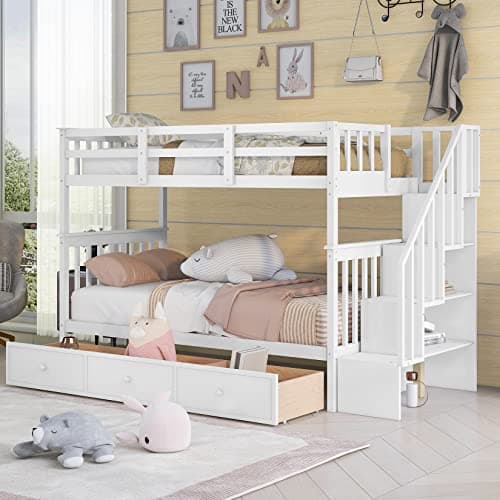
Harper & Bright Designs Bunk Bed with Storage Staircase
Harper & Bright Designs
A staircase whose treads are drawers — genuinely the best storage-per-square-foot answer in a small shared room.
| Guardrail height above mattress | Not published by the manufacturer |
|---|---|
| Stated weight limit (per bunk) | Not published by the manufacturer |
| Manufacturer minimum age | Not published by the manufacturer |
| Mattress thickness ceiling | Not published by the manufacturer |
| Materials / construction | Solid wood and engineered wood with drawer staircase |
What works
- Staircase drawers replace a dresser in a room that has no space for one
- Stairs are far easier to climb at night than a ladder
- Handrail on the staircase side
- Stronger value than buying a bunk and a dresser separately
What doesn’t
- No published guardrail, weight or mattress figures
- The staircase is fixed to one side, so room layout is decided for you
- Drawer glides are the first thing to wear at this price point
The catch: The staircase is fixed left or right depending on the variant you order, and it cannot be reversed after the fact the way a ladder can. Work out which wall the bed goes against before you choose, not after.
A shared room that has to hold everything as well as everyone
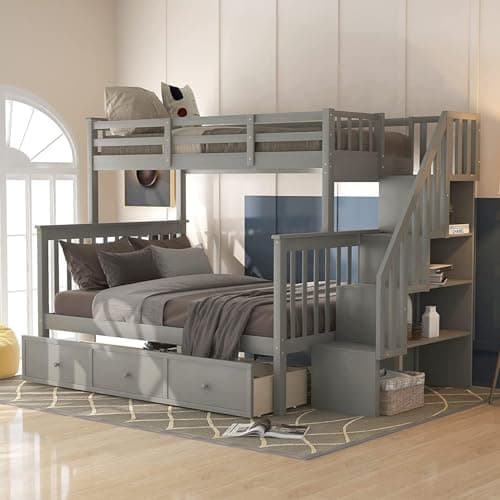
Harper & Bright Designs Twin Over Full Bunk Bed with Storage Stairs and Drawers
Harper & Bright Designs
Stairs, four stair compartments and three under-bed drawers at a price the solid-pine staircase bunks cannot touch, with the lowest published capacities here.
| Guardrail height above mattress | Not published by the manufacturer |
|---|---|
| Stated weight limit (per bunk) | 200 lb upper, 250 lb lower |
| Manufacturer minimum age | Not published by the manufacturer |
| Mattress thickness ceiling | Not published by the manufacturer |
| Materials / construction | Solid pine and MDF with iron alloy bolts, 7.6 in slat spacing |
What works
- Four compartments under the staircase plus three drawers under the bed, all published
- Splits into two separate beds, which is the exit route when the children stop sharing
- 34.84 in of published clearance between the bunks tells you whether an adult fits below
- Slat spacing of 7.6 in is published, which is unusual and useful if you are buying a foam mattress
What doesn’t
- 200 lb on the top bunk is the lowest stated capacity in this roundup and will not see a teenager out
- No guardrail height published despite a full-length rail being the headline safety claim
- MDF content makes repeated disassembly a bad idea
- 91.73 in long by 54.33 in wide, so the staircase is not free
The catch: The 200 lb top-bunk figure is the thing to read twice. A twin-over-full is usually bought so the older child gets the bigger bed below, but families often swap the children around, and 200 lb is a number a growing teenager plus a mattress can get close to. Decide who sleeps where before you buy, not after.
A small room that needs storage and a spare bed
Harper & Bright Designs Twin Over Twin Bunk Bed With Trundle and 3 Drawers
Harper & Bright Designs
A trundle and three drawers under one frame at well under the price of the solid-pine specialists, with a published weight limit and nothing else.
| Guardrail height above mattress | Not published by the manufacturer |
|---|---|
| Stated weight limit (per bunk) | 400 lb top bunk and 400 lb bottom bunk on this listing |
| Manufacturer minimum age | Not published by the manufacturer |
| Mattress thickness ceiling | Not published by the manufacturer |
| Materials / construction | Pinewood and MDF with iron alloy bolt connections |
What works
- A trundle and three storage drawers on a single frame, which is two furniture purchases avoided
- Wheels on the trundle unit, so it pulls out on carpet without lifting
- Publishes a per-bunk weight limit, which the cheapest wood bunks often do not
- Separates into two individual beds
What doesn’t
- No guardrail height and no mattress ceiling published, so the 5 in clearance check is entirely yours to run
- MDF in the mix means the frame tolerates being taken apart and rebuilt less well than solid pine
- Harper & Bright publish very different weight limits across near-identical trundle models
- Long assembly — a bunk, a trundle and three drawers share one manual
The catch: This brand's trundle bunks are not one product. We found listings from the same range rated 150 lb on the top bunk and listings rated 400 lb, in frames that look nearly identical in the photographs. Read the weight limit on the exact variant and color you are ordering, because it does not carry over.
Bunk beds and any bed with clearance
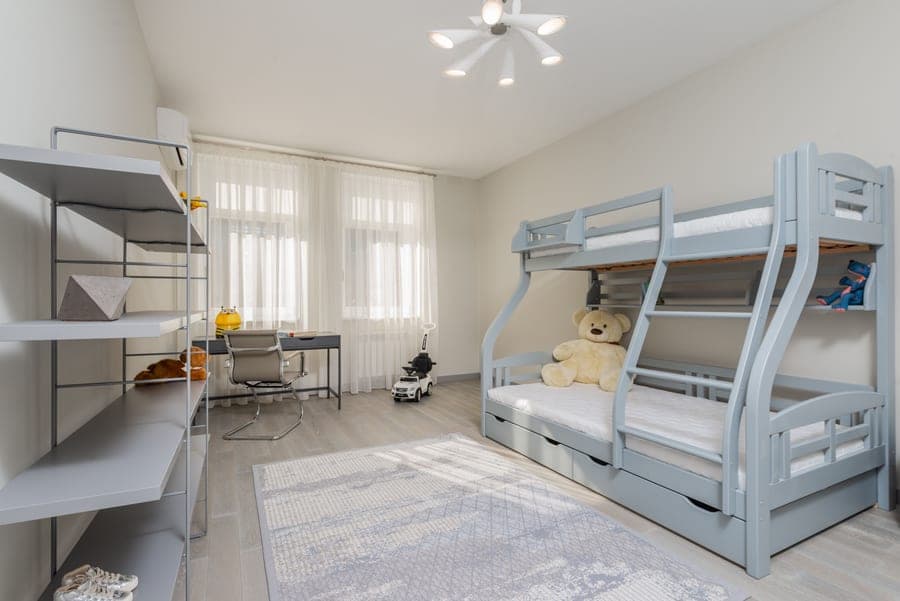
Rolling Under-Bed Storage Drawers
Various (search by height)
Turns the dead space under a bottom bunk into the drawers the room does not otherwise have.
| Guardrail height above mattress | Not applicable |
|---|---|
| Stated weight limit (per bunk) | Not published by the manufacturer |
| Manufacturer minimum age | Not published by the manufacturer |
| Mattress thickness ceiling | Not applicable |
| Materials / construction | Plastic or fabric body on low-profile casters |
What works
- Uses space that is otherwise completely wasted
- Wheels mean a child can pull it out without help
- Lower cost per unit of storage than any piece of furniture
- No assembly to speak of
What doesn’t
- Clearance under a low bunk is often less than the drawers need
- Casters catch on carpet and thick rugs
- Plastic bodies crack at the corners with rough handling
The catch: Measure the clearance first, and measure it under the bed at its lowest point, not at the edge. Low bunks in particular often have less room under them than a standard under-bed drawer needs.
Questions parents actually ask
Do bunk beds with storage take up more space?
Storage stairs do — about 30 inches of extra room length, because the stair run projects off one end of the bed. Base drawers and trundles do not add footprint at all; they use the void under the bottom bunk that already exists. Drawers do need standing clearance in front of the bed to open.
Can you have a trundle and drawers on the same bunk bed?
Some beds offer both, but they share the space: a trundle fills most of the under-bed void, so drawers on a trundle bed are shallower or mounted to one side. Treat a bed advertising both as giving you a partial version of each rather than two full systems.
How much weight can bunk bed storage drawers hold?
Most manufacturers do not publish a per-drawer figure, including both of the Harper & Bright Designs storage beds in this comparison. Where nothing is published, treat the drawers as suitable for folded clothing and soft goods rather than books or hardware.
Are storage stairs safer than a ladder?
For the nightly climb down, yes — a child descends stairs facing forward with a handrail, rather than backward on rungs. The trade is floor length and the fact that drawer fronts are climbable, so a stair bunk should always be anchored to the wall.
What size mattress fits a bunk bed trundle?
A twin, but a thin one. Trundles roll under the main frame, so the mattress ceiling is usually published at 5 to 6 inches. A standard 10-inch twin will not clear the rails, and the trundle will not close.
Sources
Read next
- Best bunk beds with drawers
The drawer beds, ranked on published specs.
- Best bunk beds with stairs
Stair bunks, including the storage staircases.
- Best bunk beds with trundles
When the third bed matters more than the storage.
- Under-bed storage for kids rooms
The aftermarket route, and how to measure for it.
Back to Bunk Beds.