Desks & Storage
Under-bed storage for kids rooms
The volume under a child's bed is the largest unused space in the room, and the only thing standing between you and it is one measurement nobody takes.

We earn a commission from qualifying purchases made through links on this page, at no extra cost to you. How this site is funded.
The short answer
Measure from the floor to the lowest point under the bed frame — usually a side rail or a slat support, not the mattress — and buy boxes at least one inch shorter than that number. On casters, subtract the caster height too. That single measurement is the whole job; everything else is preference.
For a bunk or a bed with real clearance, the Rolling Under-Bed Storage Drawers in our registry are the right shape: low profile, on casters, and sold by height so you can match the measurement rather than guess. For a bed with little clearance, Collapsible Fabric Storage Cubes go flatter and cost less.
How to measure, properly, in two minutes
Step one: find the real low point. People measure to the underside of the mattress and then wonder why the box jams. The constraint is whatever hangs lowest — a side rail, a cross support, a slat batten, or on a metal frame the bar running the length of the bed. Put a tape measure on the floor and run it up to that part.
Step two: subtract an inch. A box exactly the height of the gap will not slide; carpet compresses unevenly, floors are not flat, and a lid needs clearance. One inch is the working margin.
Step three: subtract the casters. If the box rolls, the published height usually excludes the wheels. Check whether the figure is with or without, and if the listing does not say, assume it is without and take another inch off.
Step four: measure the approach. A box 36 inches long needs 36 inches of clear floor in front of the bed to come out. In a small room with a bunk against a doorway, that is often the binding constraint rather than the height.
| Bed | Usual clearance | What fits |
|---|---|---|
| Toddler bed | 3-5 in | Flat fabric trays, nothing rigid |
| Standard twin on a frame | 6-12 in | Rolling drawers, deep fabric cubes |
| Bottom bunk of a bunk bed | 4-10 in, varies widely | Low rolling drawers; measure, do not assume |
| Low bunk, bottom deck | Often under 4 in | Usually nothing - storage goes elsewhere |
| Loft bed | Full standing height | Anything; this is a bay rather than a gap |
Note the low bunk row. A low bunk is low all the way down, and the bottom deck often sits almost on the floor — which is exactly the trade you made for the shorter fall. If that is your bed, the storage has to come from the walls instead.
What belongs under a bed, and what does not
Belongs: out-of-season clothes, spare bedding, costumes, large flat games and puzzles, the toy category the child plays with in long sessions rather than constantly — track sets, building blocks, doll clothes.
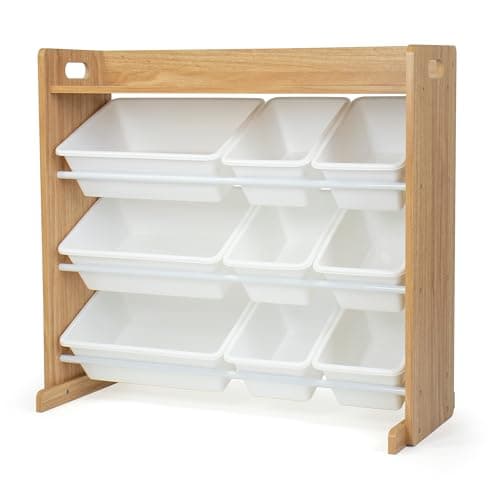
Does not belong: anything the child needs daily. A drawer under a bed is out of sight, and out of sight for a seven-year old is out of existence. Daily toys want to be at eye level in open bins, which is what a Humble Crew Toy Storage Organizer does — nine tilted bins at a child’s height, each level rated to 20 lb. The broader argument about visible versus hidden storage is in toy storage that works.
Never: anything heavy enough to be a problem if it falls out, anything with a cord, and nothing stored loose. Loose items under a bed migrate to the middle and become unreachable within a month.
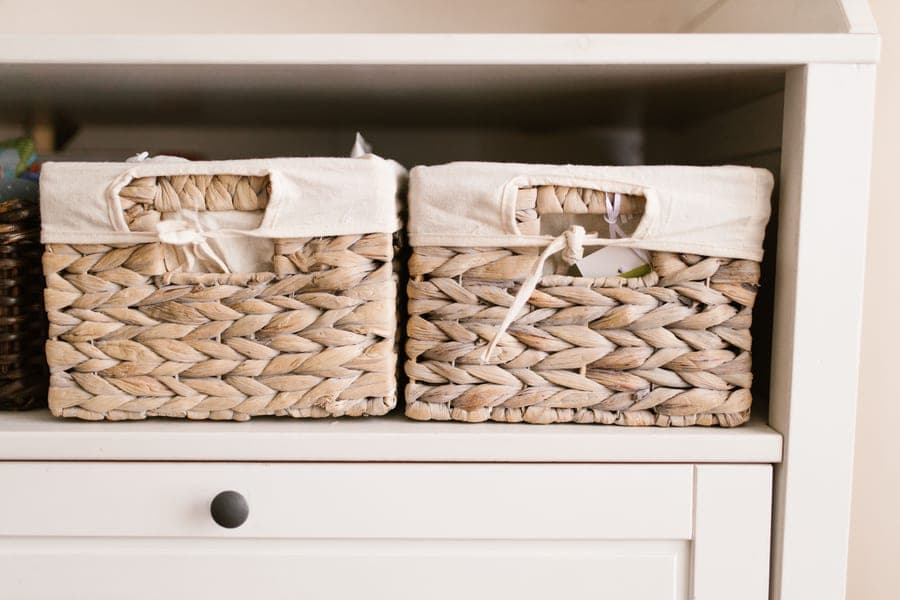
Rolling drawers vs fabric boxes
Rolling drawers are rigid, they hold their shape when loaded, they slide on casters, and they tolerate being dragged across carpet by a child. They cost more and they need a published height you can match to your measurement.
Fabric cubes go flatter, fold away when not needed, and cost a fraction as much. They sag when loaded with anything dense, and without casters they drag rather than roll, which on carpet is hard work for a small child. For light, bulky things — soft toys, dress-up, spare bedding — they are the better value.
Either way, buy them lidless or leave the lids off. Lids on under-bed boxes are a fiction: nobody pulls a box out, removes a lid, puts something in, replaces the lid and pushes it back. Open boxes get used.
Do not block the ventilation or the ladder landing
Two things to keep clear. First, the floor directly at the foot of a bunk ladder — that is the landing zone, and a storage box in it is a trip hazard at 2 a.m. Second, if the under-bed space is also where a trundle lives, it is not storage at all; see bunk beds with storage compared for that trade.
Labeling, which is what makes it work
A storage system a child cannot use is a storage system the adult maintains forever. Two rules fix most of it.
One category per box. Not “toys” — “blocks”, “cars”, “dress-up”. A box with one category in it can be tipped out and refilled by a child without any judgment calls.
Picture labels for pre-readers. A photograph of the contents taped to the end of the box that faces out. It sounds fussy and it is the difference between a child putting something away correctly and asking you where it goes.
Put the label on the short end, which is the face you see when the box is under the bed, not on the lid.
When under-bed storage is the wrong answer
Low bunks and platform beds with under 4 inches of clearance. There is nothing to work with, and forcing a flat tray in there achieves little.
Beds with built-in drawers. The space is already spent. Adding boxes behind the drawers makes a cavity nobody can reach.
Rooms where the real problem is vertical. If the floor is clear and the surfaces are covered, the answer is shelving and a bookcase rather than more floor-level storage — see best kids bookshelves.
Under a loft bed. A loft gives you a standing-height bay, and filling it with floor-level boxes wastes it. That bay should take a desk, a dresser or a reading corner — what fits under a loft bed has the options.
Key takeaways
- Measure to the lowest part of the frame, not the mattress, then subtract an inch - and another for casters.
- Check the clear floor in front of the bed: a 36 in box needs 36 in to come out.
- Under-bed storage is for things used occasionally. Daily toys belong at eye level in open bins.
- Leave the lids off. A box that needs two actions to open is a box that stays shut.
- One category per box, labeled on the short end with a picture for pre-readers.
The largest unused volume in most children’s rooms is under the bed, and the measurement that unlocks it is in under-bed storage for kids rooms.
A bench earns its place fastest in a room with two children in it, for the reasons set out in how to organize a shared kids room.
What we'd buy
Every pick below carries the same spec block, so you can compare the numbers across this page and every other page on the site.
Bunk beds and any bed with clearance
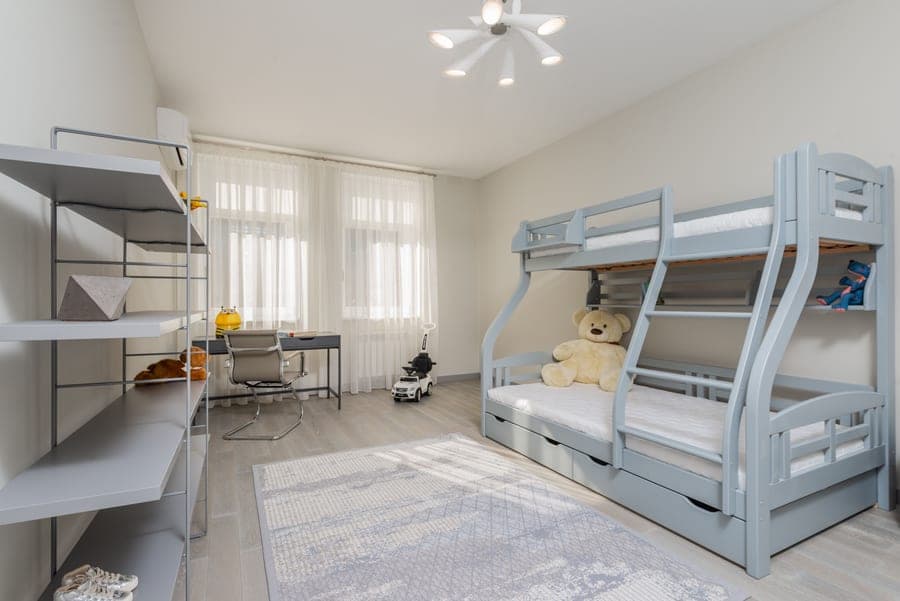
Rolling Under-Bed Storage Drawers
Various (search by height)
Turns the dead space under a bottom bunk into the drawers the room does not otherwise have.
| Guardrail height above mattress | Not applicable |
|---|---|
| Stated weight limit (per bunk) | Not published by the manufacturer |
| Manufacturer minimum age | Not published by the manufacturer |
| Mattress thickness ceiling | Not applicable |
| Materials / construction | Plastic or fabric body on low-profile casters |
What works
- Uses space that is otherwise completely wasted
- Wheels mean a child can pull it out without help
- Lower cost per unit of storage than any piece of furniture
- No assembly to speak of
What doesn’t
- Clearance under a low bunk is often less than the drawers need
- Casters catch on carpet and thick rugs
- Plastic bodies crack at the corners with rough handling
The catch: Measure the clearance first, and measure it under the bed at its lowest point, not at the edge. Low bunks in particular often have less room under them than a standard under-bed drawer needs.
Cube shelving and under-bed storage
Collapsible Fabric Storage Cubes
Various (search by size)
The cheapest storage that actually gets used, because a child can carry one to where the mess is.
| Guardrail height above mattress | Not applicable |
|---|---|
| Stated weight limit (per bunk) | Not published by the manufacturer |
| Manufacturer minimum age | Not published by the manufacturer |
| Mattress thickness ceiling | Not applicable |
| Materials / construction | Non-woven fabric or cotton canvas with carry handles |
What works
- Light enough for a small child to lift and carry full
- Collapses flat when not needed
- Fits standard 11 in cube shelving and most under-bed gaps
- Costs very little per bin
What doesn’t
- Non-woven fabric bins sag and tear within a couple of years
- No published load rating anywhere in the category
- Opaque, so everything gets forgotten in them
The catch: Non-woven bins are disposable — cheap, and they sag, fray and end up in a bin liner. Cotton canvas costs roughly double and lasts several times as long, which makes it the cheaper option over any real period.
Toy chaos at floor level
Humble Crew Toy Storage Organizer with Shelf and 9 Bins
Humble Crew
Nine removable bins and an anti-tip kit in the box — the storage unit that publishes a per-shelf load and ships the anchor.
| Guardrail height above mattress | Not applicable |
|---|---|
| Stated weight limit (per bunk) | Each level supports up to 20 lb |
| Manufacturer minimum age | Not published by the manufacturer |
| Mattress thickness ceiling | Not applicable |
| Materials / construction | Engineered wood frame with reinforced steel dowels; BPA- and phthalate-free bins; wall anchor anti-tip kit included |
What works
- Publishes a per-level weight limit, which storage furniture rarely does
- Anti-tip wall anchor kit is in the box
- Bins lift out, so tidying is a child-sized job
- BPA- and phthalate-free bins
What doesn’t
- 20 lb per level is reached fast by wooden blocks or die-cast cars
- Bins hide what is inside, so things get lost in them
- Engineered wood frame flexes if it is not anchored
The catch: 20 lb per level is not a lot. A single bin of wooden blocks can get close, and overloading an engineered-wood frame is exactly how it starts to lean — which is also why the anchor is in the box.
Questions parents actually ask
How do you measure for under-bed storage?
Measure from the floor to the lowest point of the bed frame — a side rail or slat support, not the mattress — then subtract an inch for clearance and another inch if the box runs on casters whose height is not included in the published figure.
How much clearance do you need under a bed for storage?
About 6 inches makes rolling drawers practical. Between 3 and 5 inches you are limited to flat fabric trays. Under 3 inches there is no usable storage and the space should be left alone.
Can you put storage under a bunk bed?
Under the bottom bunk, yes, if there is clearance — it varies from about 4 to 10 inches depending on the frame, so measure rather than assume. If the bed has a trundle, the space is already occupied, and if it is a low bunk there is often nothing to work with.
What should you store under a kid's bed?
Out-of-season clothes, spare bedding, costumes, flat games, and toys that get used in long sessions rather than constantly. Keep daily toys at eye level in open bins instead — anything out of sight stops being used.
Are fabric or plastic under-bed boxes better?
Plastic rolling drawers hold their shape under weight and slide on casters, which suits books, blocks and anything dense. Fabric cubes go flatter and cost less, which suits soft toys, dress-up and spare bedding. Both work better without lids.
Sources
Read next
- Toy storage that works
Visible versus hidden, and why it matters.
- Bunk beds with storage compared
When the bed itself carries the storage.
- How to organize a shared kids room
Two children, one floor plan.
- What fits under a loft bed
When the gap is a standing-height bay.
Back to Desks & Storage.